Showing posts sorted by relevance for query bigfoot encounters. Sort by date Show all posts

Wednesday, October 21, 2009

Interview with David Paulides of NABS, Release of Ray Crowe's THE TRACK RECORD Newsletter on CD

NEWS: THE TRACK RECORD Newsletter Reissued on CD!
A Discussion with DAVID PAULIDES of NABS.

David Paulides and North America Bigfoot Search (http://www.nabigfootsearch.com/) have just released the collected, complete 174-issue run of the newsletter of the Western Bigfoot Society and Ray Crowe, The Track Record (view it on Amazon through this link), on a computer-viewable CD (an Adobe Reader PDF format document). Bigfoot Books decided to have a talk with Mr. Paulides about this exciting new resource, Ray Crowe, his bigfooting work, and about Bigfoot topics in general. This interview was conducted by email in mid-October, 2009, and has been only very slightly edited for format.

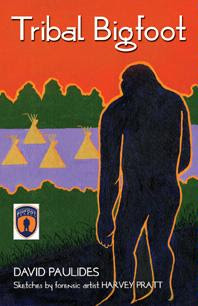
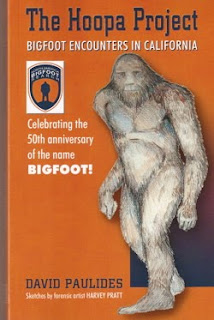
Dave is the author of two notable and acclaimed, though also sometimes controversial books, The Hoopa Project and Tribal Bigfoot. The first was winner of the 2008 Crytozoological Book of the Year, awarded by Cryptomundo.com. The second one expands upon the principles of the first, extending its range to other areas of Northern California, Southern Oregon and beyond to Minnesota and Oklahoma. In both you will find new methodologies and sightings, as well as interesting theories on such matters as the possibility that the Bigfoot species is more human than previously thought, and not an "ape."
READ ON--this isn't just an advertisement!

Note: Dave specifically stated that he did not want to discuss certain "controversial" issues, and we have endeavored to respect that wish. He does, though, bring them up a bit all on his own.

Note, too: All colored text parts in this blog are tested and legitimate Bigfoot site links--check them out for more information, or just roll over them with your mouse to see the site address. Many of them are links to the fine Squatchopedia Wiki pages.

BIGFOOT BOOKS: Hello Mr. Paulides. The Track Record on CD is an amazing recovery of a lost resource for the Bigfooting field in the 21st Century. Thanks to you and NABS (North America Bigfoot Search) for doing it! Now, for those readers who may not know the man and his influence, could you tell us a bit about Ray Crowe and his Bigfooting organization, research and newsletter, and perhaps what his approach to Bigfoot research was?

DAVID PAULIDES: Ray established the Western Bigfoot Society out of his used bookstore in Hillsboro, Oregon. He had a lifelong interest in crypto topics and soon started a newsletter that he called, “The Track Record.” Ray was one of those people that got along with everyone and that served him well for making and keeping contacts throughout the world. His passion was bigfooting but he entertained items that included UFO's, chupacabras, Loch Ness Monster and many other crypto topics; but, his true love was bigfoot. He produced the newsletter for 16 years, 3000 pages that included information from all parts of the world and every state in the U.S. NABS saw the value in the document and when Ray decided to sell his research, we immediately bought that and all rights to his writings. Two years later and after hundreds of hours of documentation, we released The Track Record on CD along with an 80 page WORD document that is a master index of those 3000 pages.

Nothing compares to these documents anywhere in the crypto world. We knew this would be a valuable research tool for NABS but part of our organizational objective is to give back to the bigfoot world and assist researchers. There were actually several members of Ray's organization who heard what we were doing and tried to encourage us not to do it, they wanted to keep this to themselves...
 Ray had a policy to print just about anyone's sighting. He didn't go into the field and validate everything but he did go out and conduct field research. He was friends with many of the old time researchers and several of their reports included in the TR are very fascinating. I remember that when I originally met Ray and expressed my admiration for his work he told me "keep your skepticals on." I did ask him what his views on bigfoot were, meaning did they migrate, were there different species, did they have special abilities, etc. Ray looked directly at me and stated, "The more you read, the more people you interview, and the more time you spend in the field, the more you realize you really don't know much about our big friend." I think Ray was right! The Track Record is truly a bigfoot researcher’s encyclopedia of information. Ray painted the picture and NABS put the frame on it.

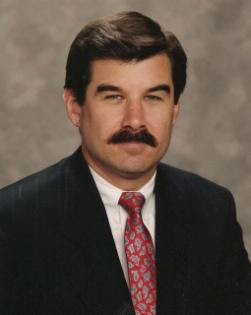
Image, David Paulides in his formally-attired author photo.

BIGFOOT BOOKS: Yes, I've always been impressed with that “Wear Your Skepticals” slogan on every issue, especially as during Ray's time active in the field he was perhaps kind of like a bigfooting Art Bell (original host of Coast-to-Coast AM), operating a clearing house for information on things that otherwise people mostly would just not have heard about. In the few issues I'd read before seeing your new CD version it seemed to me that Ray was covering some of the “weird” side of Cryptozoology, often moving more into what we'd have to call the "Paranormal." But then, he was operating at a crucial time (when did he get started?), when the old hoopla over Bigfoot had faded somewhat, but the internet age had not yet begun to take hold. Groups like NABS and BFRO enable, like never before, sightings reports and information sharing, not to mention the myriad regional groups, blogs, conferences and online radio shows.

Also, there seems to be a much higher level of technology and scrutiny applied to reports now, for example with NABS using affidavits and BFRO (Bigfoot Field Researchers Organization) excluding a large number of unconfirmed or “strange” reports from what they will put on their public web site. In your view, aside from its obvious historical value, how does the Western Bigfoot Society research and newsletter hold up today? How has the field changed from the time of its founding until now? And how have views of and approaches to the Bigfoot phenomenon evolved? Also, what sorts of evidence or sightings did Ray Crowe himself have?

DAVID PAULIDES: Remember, Ray represented all views, researchers, etc. Example, John Green hates Peter Byrne and yet both contributed greatly to the newsletter. Ray was able to walk that fence line so well that all research was uniquely represented. Ray's newsletter was something that was greatly needed at the time. It was a method to dispense information across North America before the internet. There still isn't a bigfoot search engine anywhere that has a searchable internet database for sightings. There are several that exist for states and counties but, there isn't one single location where you can look-up "brown colored bigfoot" sightings… until now--the TR's index has this ability.

To the best of my knowledge Ray never actually had a sighting. He had many unusual incidents happen to him but I think the sighting always eluded him, as it has many researchers, including myself.

The sightings in The Track Record actually hold up better than almost anything we are currently reading. Most witness descriptions mimic much of what NABS has found today, there is a distinct human quality to bigfoot. The more we read the historical record of sightings, the more you realize that witnesses have stated that the biped is very human, and, this is much of what you find in the TR.

The bigfoot field has changed greatly since Ray first introduced the newsletter. Peter Byrne was the first researcher to enter the field with significant funding and brought a level of professionalism and protocol to the arena. Since Peter, there have been very few researchers who have been able to commit to the research on a full time basis and this is what is needed if you want to make significant contributions. Probably the one group that made significant contributions to research without any funding was the "Bay Area Group," headed by George Haas. Where Ray was the absolute expert at documenting and dispensing information, George and his team did some incredible research on a shoe string budget. Much of their research still is extremely credible and timely and we are shocked it didn't get more publicity at the time. NABS is posting all of George's Bigfoot Bulletins on our website.

BIGFOOT BOOKS: Isn’t Haas’ and the Bay Area Group’s (B.A.G.) The Bigfoot Bulletin the first newsletter on Sasquatch, starting in the late sixties? Before that there wasn’t much being published aside from Ivan Sanderson, John Green, and Roger Patterson’s book. The seventies were a heyday for Bigfoot, but a lot of that was kitschy pop-cultural stuff--even though most of the early foundational Bigfoot books were published at that time. Arising out of this period and the lassitude of the 1980s we had Ray Crowe’s work arise, and then Daniel Perez’ The Bigfoot Times (publication starting in 1998, and still at it today, despite the internet). The Track Record can then be seen as an important transitional effort, bridging the past and its laboriously typed and cut-and-pasted publications sent to very small groups of the interested few to today’s slick and widely read web sites and glossy Hancock House-style books. Since the late 1990s there’s been a virtual explosion of these publications, and Bigfoot is seen on TV, with its myriad cable specialty channels, more than ever before. It is difficult to find anyone now who does not know at least the rudiments of the subject; even though what they often know is just the myths and stories of hoaxes.

By way of example, my own humble Bigfoot’s bLog has garnered over 7,000 site hits in only the first six months or so I’ve been monitoring. I don’t know the numbers of readers for Crowe’s original Track Record--do you? I would bet the circulation was fairly small, representing even more clearly how much dedication it took to produce it. Would you say, then, that The Track Record represents a kind of bridge to the current era? It seems significant to me that, as you say, the newsletter represented so many researchers from beyond the core group of the Western Bigfoot Society. I mean, John Green basically stopped writing books after Apes among Us. So it is important that he is represented in The Track Record during the time that preceded a work like Meet the Sasquatch, and his appearance at meet-ups such as the 2003 Willow Creek International Bigfoot Symposium.
Do you think that this semi-underground newsletter publishing, and the small groups that made them, kept Bigfooting alive during a period where serious interest and research could have been buried and lost in the somewhat foul wave of popular cultural exploitation? It seems that one can trace a lineage, from the early “elders,” to the newsletters and groups, and then a handing off to the modern period and new generation of the internet explosion and a sophisticated, new NABS/BFRO-type pursuit of the subject. Also, not having been able to read The Track Record until now, save in a strange photocopied book assemblage that has since been stolen from the Willow Creek Library, I wasn’t aware that so many notable Bigfooting figures had published in the newsletter. How much of it was Ray Crowe’s writings, how much reader and sighting submissions, and how much consisted of writings from the more known, professional-type researchers of the time?

And also, as you mention it, would you say that Ray himself would agree with your and NABS’ theories about the humanness of the Sasquatch? When you quoted Crowe saying the more we look at the Bigfoot phenomenon the more we realize how little we know about it (“him”?), does that imply that the more we look the more we see it as a being that is no mere animal, that it has mysterious or maybe even more human ways? And do you intend, perhaps, to publish the Haas newsletter in some non-internet way, like you have done with Crowe’s?

DAVID PAULIDES: Peter Byrne kept professional investigations in our field alive when he received funding for his project. There's been a long line of amateur and con artists that have entered the Bigfoot arena, but there have been very professional approaches to research. It's really not hard to understand why many stay away from our field of study. Just go to a conference, read newsletters and you see the amount of jealousy, back stabbing and outright lies that some people make about others, it's embarrassing. As I've told everyone who will listen, DO NOT believe ANYTHING you read about NABS or our people unless you read it on our website or you hear me say it. The last 9 months has been a continuous series of lies, fabrications and exaggerations about us by people who call themselves "researchers" perpetuating these myths. No, you won't hear us respond to these ridiculous accusations and we won't be intimidated into backing away from research into areas that need a professional approach. We have resources, personnel and access to technology and professionals that no other group has, and, with that, we have had many things given to us because of our approach to the topic and people's belief in our cause.

The Haas newsletters are posted on our website, free. They are only a fraction of the size of The Track Record so we have the ability to post them, http://www.nabigfootsearch.com/.
[Ed. note: GO HERE, they're great!: http://www.nabigfootsearch.com/Bigfootbulletin.html.

[Ed. note, paraphrase: And re. the question as to whether the B.A.G. newsletter was the first, Dave responds:] I'm actually not sure. [And re. the circulation stats for the original The Track Record newsletter, Dave responds:] Do you? No--don't know. [Re. the “humanness question” Dave responds:] I think this was explained fully in Tribal Bigfoot. [Ed. OK, folks! Go out and get yourself a copy of the book—it is quite interesting, and extends the unique approaches found in his great first book, The Hoopa Project. One thing: in an earlier email Mr. Paulides clarified that he proposes that the Sasquatch is possibly part of the human gene tree, a closer relative to us than to apes, but not exactly human in the same way we are.]

BIGFOOT BOOKS: A few more questions, then. Let's not forget that Ray is still alive and kicking. What is he up to now, and why did he retire? I know he had some health issues, but how can one get Bigfoot out of the bloodstream, so to speak?

DAVID PAULIDES: Ray did have some serious medical issues and I believe that he is living in an assisted living home in northern Oregon.

BIGFOOT BOOKS: On the “Squatchopedia.com” website there is a mention of Tom Biscardi funding and producing The Track Record newsletter for a while, in its last days. Do you know of this, and what was Biscardi's role in producing or directing the publication, if any?

DAVID PAULIDES: Ray was having problems funding the newsletter and Biscardi stepped in at some point and started to subsidize it at some level. I suppose it gave him more access but the newsletter and its content didn't change much.

BIGFOOT BOOKS: It’s so great that you've rescued these newsletters from possible oblivion! Comparatively, I always wonder what was in the Rene Dahinden archives, but we see next to nothing being released to the bigfooting community by his sons and whomever else may have inherited them. The Bigfoot Bulletin stuff on your website is a great addition, too. Thanks! What else besides The Track Record was contained in the Ray Crowe materials and archives? Was there any interesting evidence, footprint casts, hair or photos, cultural items and other stuff that might be released by NABS?

DAVID PAULIDES: We have dozens of letters from Rene and probably more from Ray Wallace. In the future we will release some of these letters as they give the reader quite an insight into the internal politics of this arena. We know that many have bashed Ray Wallace in the past, but I guarantee that the man knew things about Bigfoot that few at the time did. He surely had contacts and insight that few did at the time, to be as accurate on his sightings as he claimed. When you read what Wallace wrote in a time prior to the internet you can readily see that he knew this topic well and he gave much credit to the Native Americans, something that piqued our interest early on.

We also have many letters and sighting reports from John Green. John has always been on the ape side of the fence and has not given much credence to the human side of the genetic scale in regards to Sasquatch. If we do release these letters you will be able to see a very opinionated and sometimes gruff side of Mr. Green that many don't want to see or refuse to acknowledge. Some of these conversations have taken place recently.

This statement is not to bash John, quite the contrary. He entered this arena at a time few would, and, he developed the protocol of requiring affidavits from his bigfoot witnesses, a brilliant move. If a witness to a bigfoot event doesn't want to sign an affidavit, there should be a careful examination of the issue. Everyone who is watching should be asking, "why wouldn't the witness sign an affidavit to what they say they observed," and, I'm sure, this was john's mindset when he initiated that process.

NABS understands John's opinionated attitude; heck, he's been on this topic since before I was born. NABS does believe that every researcher should be open to developments garnered through technological advancements, and, if you haven't kept up with what technology can do, it may be hard to accept and appreciate.
Much of Ray Crowe's casts, hair and other evidence has been loaned for the past 6 months to the Bigfoot Discovery Museum in Felton, which they have put on display.

BIGFOOT BOOKS: So how did Felton (Bigfoot Discovery Days III) go?

DAVID PAULIDES: Scott Nelson is riveting. His evaluation of the Sierra Recordings is very, very convincing that our friends [Bigfoot] use language.

BIGFOOT BOOKS: Yes, I found Nelson's cryptolinguistic presentation very interesting at the Yakima Bigfoot Round-Up this year. To many, on first impression, the Sierra Sounds might sound kind of silly, but under Nelson's analysis unique language-like structures and patterns do emerge that make it quite difficult to debunk and dismiss the recordings out of hand.

I'm sorry to have missed your presentation. I still haven't had the chance to see you at any of the conferences. Would you mind briefly telling we who were not there to hear what you talked about, and what new and interesting directions is your and NABS' research taking these days? Are there any other things you'd like to say to the bigfooting community, or at least the readers of Bigfoot Books' blog?

DAVID PAULIDES: NABS is continuing down the path of getting a complete understanding of the Bigfoot hair issue. The public has been collecting the hair for 50 years but little has been done to positively identify and extract DNA. This project is ongoing.

In the past 18 months NABS has been given affidavits and other evidence on a variety of topics that may be construed to be controversial. We do not believe that an individual would perjure themselves over a Bigfoot-related issue, so, we put significant emphasis when someone comes forward with a claim, signs an affidavit and names individuals. I think it would be a gross injustice to the community if we shelved this evidence and didn't investigate.

Many in our arena are not used to professional investigations. It appears that our world revolves around rumor, innuendo and finger pointing. We do not believe in this type of journalism or research. Years ago I was working a child molestation case where the victim named a high profile individual in the community. We worked the case for months without ever notifying anyone of what we were exactly investigating. If the allegation was found to be untrue, we didn't want to ruin the suspects name in the community. The last contact any professional investigator has in any case is with the suspect. The investigator needs to know more about the suspect than he knows about himself, he needs to know every possible answer that may be placed on the table and every excuse that could be used. In the case of the molestation, the suspect gave us information that could exonerate him. We later had the victim come in for a polygraph test. Just as they were getting hooked to the machine, they admitted the allegation was a lie. This is why you don't go public with allegations until you have proof beyond a reasonable doubt.

It would appear that some people in our community call themselves journalists yet they won't post what others send them, and they aren't interested in the facts. They like to bash people over innuendo and they have no belief in the statement, "if you don't have anything nice to say, don't say anything at all." NABS has a policy that we won't cater to tabloid journalism, and we truly don't care what the people who have these sites think about us. We are privately funded, we are polite, professional, and will go deep where others will not.

BIGFOOT BOOKS: Dave, for those who have not read your books (or for those who still wonder a bit), could you tell us about the seemingly unlikely course you took going from being a policeman and detective to a Bigfoot hunter and investigator? In the public mind these are seen as kind of... contradictory. What grabbed you and pulled you into the world of the Sasquatch mystery?

DAVID PAULIDES: I have never called myself a bigfoot HUNTER.... They are not contradictory. I made a career of telling the truth, digging deep for facts, building partnerships and respecting people's rights. I know that the background of myself and the people I work with has many in our community intimidated. Most researchers in the bigfoot community have never attended an investigations, interview, or even an evidence collection class; we've done all of this multiple times. Many have the wrong opinion of us; but, almost every one of these people have never met us. I would encourage anyone who wants a realistic view of our organization, go to Hoopa, Happy Camp, Forks of the Salmon, Bena (MN), etc., places where we have conducted research, and ask those people how they were treated. I just got a note today from a witness in Happy Camp who stated NABS was viewed very highly by everyone in that community.

My background in law enforcement and human resources has trained me well to treat everyone with respect. If you treat people the honorable way, they will do the same in return. In two years in Hoopa, word spread quickly that we could be trusted and witnesses were coming to us.

BIGFOOT BOOKS: I fully understand that you did not want to talk about those "controversial" topics. The the bigfooting world can be such a soap opera of gossip and rumors, so much that people seem to forget the REAL GOAL. I must agree, from what I've heard anyway, by my experience in the Bigfoot Books shop here in Willow Creek, from the locals and people from Hoopa--they say good things about you and NABS (as distinguished, especially, from their prior mostly bad experiences with Mr. Tom Biscardi's GABRO group!).

Do you think we are getting closer to proving to the world at large that the Sasquatch exist? And also, what do you think the ramifications and cultural impact might be, especially if the creature proves to be--as you have proposed--much more human than ape?

DAVE PAULIDES: I would hope that in the next year NABS will have clear resolution on the hair issue and DNA can readily identify where on the genetic tree the biped belongs. If the DNA comes back and shows that bigfoot is more human, I think the ramification is minimal. It will put a lid on many of the older bigfoot/sasquatch researchers--we won't hear from them anymore. But, it's obvious that the biped is doing well, sightings are up, the biped is seen across the U.S. and Canada; it's obviously not endangered. The findings will be a minor blip on the news, but, it may initiate universities across North America to take notice and commit funds to a long-term academic study, this would be beneficial to everyone. The most important aspect of a finding that it's on the human side of the tree--it might cause some of the trigger happy hunters who believe a specimen needs to be taken to think twice about killing one. The first rule that every hunter with any morals must abide by--you don't shoot anything unless you are positive you know what you're shooting, and, we don't know right now....

BIGFOOT BOOKS: Dave, those were great answers. And this has been a great interview. Thanks! I sincerely wish you the best, and hope you have further success in your bigfooting endeavors. I am hoping this interview will help make your Track Record CD known more widely, and that folks out there will realize the significance of it and what NABS has done in publishing it. 

---END OF INTERVIEW---
Read on for more, including ANGRY BIGFOOT SPEAKS!...

THE TRACK RECORD is available from NABS or on Amazon.com (just enter "track record bigfoot" in the Search box). List price is US$19.95. It is also available in-store or by email request from BIGFOOT BOOKS, in Willow Creek, CA.
 
DAVE PAULIDES' BIOGRAPHY, as entered on Amazon: "Dave Paulides received his undergraduate and graduate degrees from the University of San Francisco, and, has a professional background that includes twenty years in law enforcement and senior executive positions in the technology sector. In 2004 he formed North America Bigfoot Search (http://www.nabigfootsearch.com/) where his investigative and analytical experience were invaluable in researching Bigfoot/Sasquatch sightings, encounters and behavior. He spent two years living among the Hoopa tribal members, listening to and recording their Bigfoot stories. The Hoopa Project is his first book, based upon his experiences in the Bluff Creek area of Northern California. David's second book, Tribal Bigfoot is a quantum step forward in Bigfoot research and allows for a common sense understanding of this elusive biped. These two books have been called the new standard for crypto research."

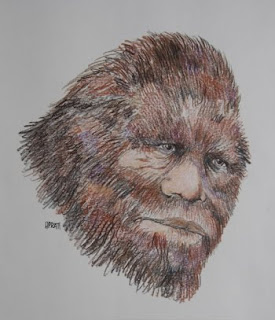
Image above by Harvey Pratt, NABS' amazing forensic Bigfoot artist, from the NABS website.

THE NABS "ABOUT US" (from their web page): "North America Bigfoot Search (NABS) is a privately funded organization that had its start in Silicon Valley, California. A small group of technology executives had prior incidents in the woods of Northern California and dedicated resources for the research and investigation of the Biped. One significant difference between NABS and every other Bigfoot organization is our dedication to stay on a regional project until every possible angle of every sighting has been researched, witnesses interviewed, locations and food sources understood, and an extensive list of variables answered. Our organization will stay in a community sometimes for months/Years and thereby develop the trust, integrity and contacts to make our research valuable and enlightening. The organization is interested in all regions of North America and can have a researcher dispatched to a specific area in your state in hours. We do appreciate information on any Bigfoot sighting anywhere in the world. Our researchers and investigators have extensive experience in their specific field and may have knowledge about your area that is unique. Our ability to keep a researcher on site to develop that "unique" knowledge has assisted our organization in developing advanced techniques in gathering information. Our ability to communicate and align with all facets of government, business, academics and various levels of society make our field personnel an unusual commodity in Bigfoot circles. The researchers we field may be from any one of a variety of academic backgrounds, private industry and university adjunct positions. We pride ourselves in being professional, discrete and open to all ideas and feedback.

An article about The Hoopa Project appeared fairly recently HERE, in Humboldt County's local paper, The Times-Standard.

Go to the NABS website to find loads of interesting materials. Not just the Bigfoot Bulletin, but David Paulides' own blog, and many other great features abound there: http://www.nabigfootsearch.com/. Explore the sidebar to the left of the page--you won't be disappointed.

An article about Ray Crowe's interesting fictional book, The Bigfoot Bar & Grill: HERE. We have a rare copy of it available here at Bigfoot Books. There is a REAL Bigfoot Bar and Grill, in Salem, OR.

************************************************************************

ANGRY BIGFOOT SPEAKS!!!
"I quote human: 'Can't We All Just Get Along?' Bigfoot very angry. Too many humans think crazy human drama what really matters. Bigfoot hates human soap opera. Hate!!! Bigfoot says Ha Ha Ha! Human bigfooters argue, accuse each other of bad things, then they see blobsquatches, and Ha Ha! I get away into the forest. You never even smell me, not ever see me!"

***********************************************************************

Interview rights reserved, copyright 2009, Steven Streufert, but may be used with permission and by all rights at least a citation and reference, and a link to this blog. The proprietor of Bigfoot Books bookshop, Steve sometimes does other things besides Bigfoot/Sasquatch... MySpace, Facebook, Email.

COMING UP, we hope (if all goes well)!: An interview with BIGFOOT TIMES publisher and editor, DANIEL PEREZ.
The Bald Hills Road and Klamath Trip, not to mention the Leap of Skepticism and Blobsquatching blog entries are on hold for now--there's just too much going on!

Wednesday, March 17, 2010

Continued DISCUSSION WITH A SKEPTIC; plus LETTER TO A YOUNG SQUATCHER; News, Comments, and ANTHROPOMORPH ATTACK: 9-11 Mystery Solved!


NEWS FLASH! 9-11 CONSPIRACY THEORY UNRAVELED... IT WAS COOKIE MONSTER!
Giant Anthropoid Feeding Frenzy and Question of Genetic Origin of Creature Cause Hysterical Speculations.

It wasn't Dick Cheney and George Bush and the PNAC plan. It wasn't al-Qaeda and Osama. It wasn't intentionally demolished nor destroyed by airplanes and fire. What the government and all the news channels didn't show you that day in September, 2001, was the REAL truth. Cookie Monster destroyed the World Trade Center Twin Towers!

Evidence now shows that the fire-retardant insulation in the buildings, along with thermite demolition explosive materials, combined to create an aroma uncannily similar to that of chocolate chip cookies. This attracted the giant blue monster, and man was he ever hungry! No malign intent on the part of the creature has yet been discovered. It would seem he just could not resist the tasty flavor. "Om Nom nom nom! AWWWWM-num-num-num-num!"

We have always wondered, just WHAT is Cookie Monster, the cookie-addicted hominoid creature from the Sesame Street TV show? We now know, thanks to a Sesame Street Magazine cover of October 1976 (recently unearthed by our friend Brian), that Cookie is actually related to King Kong. And we ALL know what Creature is the REAL source for the King Kong legends and movies. Right? That's right! Could Cookie Monster be an icy-blue Yeti, or an aberrant Bigfoot/Sasquatch, just with a sugar-mutated blue coat of fur? We believe so. That this issue of the magazine came out in the ninth anniversary month of the Patterson-Gimlin Film of Bigfoot in Bluff Creek only serves as a secret clue.

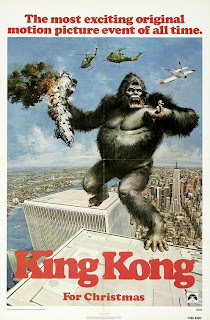
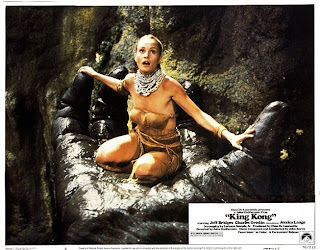
The remake version of the KING KONG movie, from 1976, prominently features not only the Twin Towers with a Giant Ape, but also an incredibly inspiring Jessica Lange in her Golden Globe-winning first major film appearance. We saw it in the theaters when we were just a pre-teen kid, and it was truly scary, and... fascinating.

Visit the Muppet WIKI, and their Cookie Monster page HERE.

As Cliff Barackman, noted Bigfoot researcher, recently put it on his fine NORTH AMERICAN BIGFOOT BLOG:
"I've been interested in sasquatches for a long time. When I was very young, it was clear to me that King Kong and even Curious George were depictions of bigfoots. After all, they stood and walked on two legs. Perhaps they really weren't bigfoots, but to my young mind there was no difference. I... ponder the similarities between the Curious George story and a possible scenario of the first live capture of a juvenile bigfoot. Unlike Curious George, I do not think that a juvenile bigfoot would take comfort in its zoo surroundings. How long could a sasquatch be kept in a traditional zoo setting? Not long, I imagine... a rampaging sasquatch that escaped from captivity would be a formidable thing to reckon with."

*********************************************************

Another NEWS FLASH!

M.K. DAVIS and Don Monroe's 34-minute video interview with AL HODGSON has finally surfaced. Apparently they felt pressured to at last release it after our own interview with Al Hodgson was transcribed and published HERE (in three parts, two and a quarter hours, unedited and complete--click link to get started). This interview done by MK has been used in tiny out of context quotes to fuel all manner of false presuppositions on forums like the GCBRO and other internet dens of iniquity. One may notice in viewing it that not once does Al speak of a "Massacre" of Bigfoot in Bluff Creek. Go figure. Still, it is Al, so it is interesting. VIEW THE STREAMING VIDEO MK DAVIS-AL HODGSON INTERVIEW HERE. You'll notice that the paranoid and delusional Bigfoot conspiracy theorists will make hay out of just about anything. Also, they spelled Al's last name wrongly. Go figure, eh?

"They don't want you knowin' the truth. That's the truth!" -- Don Monroe, BF researcher
OK, Don Don.

NOTE: If any of you know of a streaming hosting site for audio the would post our mp3 audio file of the Al Hodgson interview, please do let us know. We'd like to get the full recording out there for all researchers concerned to hear.

*********************************************************

We'd like to briefly comment on the concept of "Bigfoot People," as recently brought up by Linda Martin on her BIGFOOT SIGHTINGS web site blog in her comments on an upcoming MonsterQuest episode featuring the "Sierra Sasquatch." View that entry HERE. Our humbly submitted comments:

People, “human beings,” are animals, creatures and beasts, so what is the problem? Humans are apes, or more properly, in the same family of animals. We all eat, defecate and procreate. It’s just that some of us do it in houses, and some do it in the woods. To say “Bigfoot People” is misleading–it implies that the Creatures are human like us, which they decidely are not, based on the vast majority of sightings. “People” think they are special, but we are just another form of animal. All animals have their own special abilities and evolved survival talents, as do we; but what is important is noticing all the differences. That is how we tell one thing from another. Otherwise they would just get all blended together in our minds. I think the word we should be avoiding is “monster.” Then again, what do you expect on a show called MonsterQuest? I've taken lately to using "Creature," but capitalized to leave in Mystery and respect. I agree, "beast" implies "monster," which is the word we really need to get away from. Hence the irony of MonsterQuest. They are really just seeking animals, odd ones perhaps; but we should never consider "animal" as a pejorative term. We need to come to respect and understanding of different forms of life and consciousness.

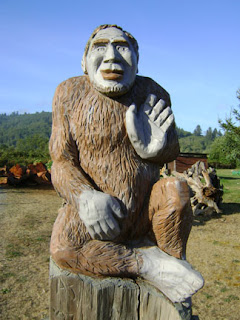
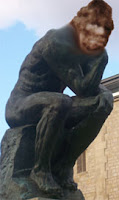
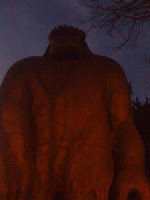
Image: A Bigfoot statue at Orick, CA, says howdy, or acts like a wise sage, or..... Photo, Steven Streufert, 2009.

*********************************************************

LETTER TO A YOUNG SQUATCHER *

Recently, a middle school kid from Southern California sent us a letter asking questions for a school project about the world of cryptozoology, Sasquatch, Bigfoot research, and what it's like to be a part of it. What, basically, is it like to explore things that the majority of society views as crazy? We started by thinking the answer to this would be a simple few short sentences per question, but now we find there are no simple answers. At least, we cannot stop from going on and on about Squatchy stuff. His questions are numbered in the following, with our responses between each number.

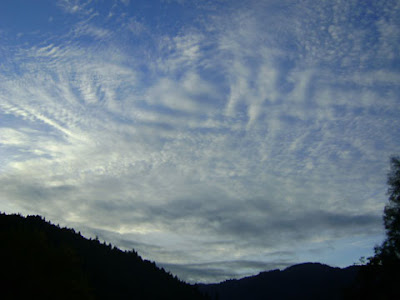
Images, here and at  bottom of this section: Winter clouds above Willow Creek, CA and Bigfoot Country at sunset, By Steven Streufert, 2010. All photos, CLICK TO ENLARGE.

1) Did any one person inspire you to research Bigfoot?

No one person was my singular influence, but I have to say that it was the Patterson-Gimlin film that first intrigued me, as a kid of about 10 years old, when I saw it at a drive-in movie theater. From there I read all of the books I could find in the local library, and within these I became enamored with the adventurous image of Roger and Bob on their horses exploring this great mystery of nature. The images of them I saw in this early documentary, riding their horses through the wooded creek bed, settled in my mind the idea that the natural world held surprising and fascinating things, beyond just lions, tigers and bears. Those old black and white photos in John Green's books seemed to come from another world; but then, nearly thirty years later, I found myself living in Humboldt County, and then Willow Creek in particular, right in the center of the history of the Bigfoot phenomenon. Standing on the ridge where those early footprints were found by Jerry Crew in 1958, and others were found later in 1967, proved to be absolutely inspiring. It was like a Christian going to the Holy Land. In 2000 I camped in Louse Camp, where the Pacific Northwest Expedition was based, and just could not believe the powerful feeling I had hiking up Bluff Creek itself, toward the P-G film site. At night I could have sworn there were big Creatures out there watching me in the dark woods.

Over the years those early photos of the investigators really stuck with me. Reading their stories was even better. It was Rene Dahinden who, with his witty humor, critical sarcasm and determination, really influenced me the most. I never got to meet him, but since his death I have met many of the most famous bigfooters, and can even email them or talk to them on the phone when I have questions. It is amazing how closely-knit, or how interconnected, the Bigfoot community really is. Once you put your foot in the door and prove yourself to be sincere, you suddenly seem to know just about everybody, or at least know of them and their activities. The one of them all who inspires me the most these days is Bob Gimlin. He is still alive and sharp as a tack, and he has held true to his story of how they filmed the Creature all of these years ago. Perhaps the most convincing thing to me that tends to prove Bigfoot exists is hearing Bob Gimlin, a guy who obviously would not lie to you, say that he saw what he saw on that sandbar back on October 20th, 1967.

As far as current researchers, I'd have to choose Daniel Perez as an inspiration. When I first got a hold of his BIGFOOT TIMES newsletter and books BIGFOOT AT BLUFF CREEK and BIG FOOTNOTES I was really impressed with the fact that someone out there was doing scholarly work with full documentation and historical fact-checking. Daniel is also a great critical gadfly, and he keeps all bigfooters on their toes, lest they wander down the wrong paths and suffer the wrath of his pen. Perez is the real successor to both John Green and Dahinden, though he doesn't get out into the field as much as guys like Matt Moneymaker, James Bobo Fay and Cliff Barackman of the BFRO, who also inspire and interest me greatly.

2) Have you bought any Bigfoot memorabilia not including books?

Well, I have to admit it: I am kind of a Bigfoot geek. Just like Star Trek fans collect all kinds of stuff, and in fact sometimes everything having to do with that show, I too seem to gather up Bigfoot things. I don’t like to buy new novelties so much, but love any classic Bigfoot object, from old clippings from magazines, footprint casts, little statues, movies, buttons, patches, coffee mugs, stickers, posters and just about anything else. The clear favorite Bigfoot collection is my authentic replica of the sculpted head of Bigfoot that Roger Patterson made before he made his famous film--it is one of the few things that don't end up for sale in the shop. Really, though, since I am in the business of selling used and rare books, I try to focus my spending and collecting on obtaining rare and unusual books on Bigfoot/Sasquatch. I don’t really make much money on these things, but stock them nonetheless, as I like to have them all around me, and I love to be able to share them with customers and visiting Bigfooters. Really, though, one could spend all day and all of one’s money collecting Bigfoot junk. There is just SO much of it that one has to draw a line somewhere. Plus, it is usually really hard to find, and rare. Therefore, I do try to stay away from hunting for the Creature on eBay when I can.

3) Are there any specific requirements or types of training needed to have a job involved with Sasquatch?

I have to tell you that there really isn’t any “job” that officially involves Bigfoot hunting. In fact, most of the bigfooters seem to spend all of their own time and money financing this hobby and obsession. It sometimes comes to dominate people’s lives over everything else, as it did with Rene Dahinden, and often results in divorce and poverty. Sometimes a belief in Bigfoot, if too prominently displayed publicly, can threaten your employability. This would especially apply in positions such as a college professor or police officer. That being said, police officers and rangers are one of the largest groups of Bigfoot witnesses out there. There are rangers, such as Robert Leiterman here in Humboldt County, who also do Bigfoot field research in their spare time. Mr. Leiterman is even paid to do campfire presentations on the Bigfoot mystery in his job in the redwood forest. He is also an author of fictional Bigfoot books for young readers.

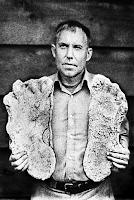
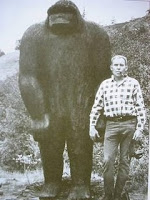
Images: Two of Rene Dahinden, historical. Also, the "Bigfoot Lives" metallic pin, produced by Bishop Products.

If you want specifically to explore a career that could involve Bigfoot in some way, then I would recommend that you choose a field that could put you out in nature where the Creatures are. Either that, or be like Dr. Jeff Meldrum or Kathy Moskowitz-Strain, both noted Bigfoot researchers you may have seen on television, and study in an academic field that could somehow relate to the Big Hairy Guy. Both of the above are in Anthropology. Another way would clearly be to study Biology, and perhaps to focus on wildlife and ecological issues. Researchers such as John Bindernagel have strong backgrounds in traditional studies that suit them well when out in the field looking for Bigfoot, or as authors and public speakers on the subject. Or, perhaps, you could be like myself—I studied Literature, Philosophy, Religion and Psychology, got two Masters degrees, and somehow ended up in love with the antiquarian book trade and selling books in Willow Creek. My love of all things interesting and strange eventually kept me from wanting to specialize in any one single thing. Through books I can specialize in everything; but somehow, in great measure because of where I live, Bigfoot seems to have taken over my life and much of my time. I say that if you are deeply interested in Bigfoot, then you will find that Bigfoot is tracking YOU. Just moving to the town where I live has put me right in the middle of Bigfoot action and history. What more could I ask for that to see that famous Bigfoot statue, which I knew of in childhood, every day as I go to work?

4) At school many people make fun of me because I am researching Bigfoot. Have you ever been put down because of doing what you love to do?

You know, there will always be some of your peers who will pick on you for whatever you do in your life or for that in which you believe. Mostly they are just insecure in themselves, and seek to find what they think are weaknesses in others. They are either jealous or afraid of being different themselves. They live with a herd mentality, it would seem, a state quite contrary to human intelligence and individuality. I would say you should pursue what you are interested in and love, and not to worry about the rest. No one has ever achieved greatness by being the same as everyone else. People are at their pinnacle when they have the guts to strike out on their own and look at things in new and interesting ways. I think you will find that the Universe will pay you back accordingly, providing satisfactory rewards for you to the same extent that you are willing to stick your neck out and really go for it.

Bigfoot research is really not that strange, if you know the full history and body of evidence. It is just the study of an animal that can't be captured or proven, or hasn't been yet, anyway. It seems funny if all you know is what appears in bad, joking television shows and tabloid magazines. Rather, I would argue, the huge body of sightings and reports over a long period of time suggest at the very least there is something more to this phenomenon than mere hallucination, craziness, and wishful thinking. There really does seem to be something real behind it, even if some of that is really within the realm of human psychology.

In the field of Bigfoot research it does one well to have studied Logic. If you are going to profess any kind of belief you should be quite sure that your ideas make sense, and their bases are reasonable. Before I ever considered writing or blogging on Bigfoot I made darn sure that I knew what I was talking about first. I read something like 60 books on Bigfoot/Sasquatch before I ever began internet publishing. I read ALL of the skeptical books, too, so that I would know exactly what I would be up against and what tactics I would have to use to combat illogic coming from the so-called skeptical, scientific side of the argument.

Image: Doesn't this Yeti look like a Muppet?

I would advise strongly that you consider whether you want to be a public figure in Bigfoot research, or a private investigator. Once you enter the field as a known person you will find that the “B-word” will be attached to you wherever you go. If one Googles my name, for instance, one will find innumerable Bigfoot references and links. If I were a professional in some field where it mattered I might have thought twice about it. Luckily, though, I am self-employed, and I can’t imagine there are many book-buying customers who would hold Bigfoot against me. It could impact me if, say, I ever wanted to get involved with something like teaching, though. However, there are many Bigfoot researchers who hold down perfectly normal jobs, and don’t have to hide their interests, people like researchers Cliff Barackman and Thom Powell, both of whom are school teachers. I don’t care, personally—I am committed. I don’t say “I believe” because I don't like that term, but rather that I am infinitely interested in the subject. That keeps me going, and it keeps the skeptical bugs off my back.

5) Have you ever been on any documentary like shows similar to MonsterQuest?

No, I’ve never been on that show, or any other major television or radio shows. However, I do know personally or communicate with many of the people you see on MonsterQuest and the other ones. It’s funny, a small world kind of feeling, in the Bigfoot world. I have appeared live on an hour-long internet radio show called SquatchDetective (click link to listen), on BlogTalk Radio. That was fun, though a little nerve-wracking, especially at first. After the first few minutes, though, I found that Bigfoot interest took over, and there was by the end not nearly enough time to cover all that I’d wanted to talk about. It just flew by; and I am one who is not too fond of public speaking to groups any larger than my close friends.

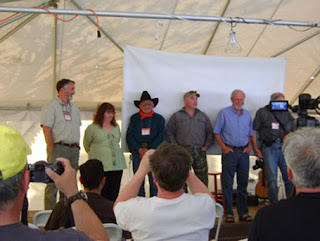
Image: Speakers at the Yakima Bigfoot Round-Up, 2009, with Bob Gimlin. Jeff Meldrum, Kathy Strain, Gimlin, Derek Randles, John Bindernagel, and Chris Murphy (obscured by camera). By Steven Streufert.

I didn’t decide to come out publicly as a "bigfooter" until the 2007 Willow Creek Patterson-Gimlin Film 40th Anniversary Celebration. Before that I was just privately curious, and not too aware of how vast the Bigfoot Community really is. I published my first writing on Bigfoot in an article concerning that conference, in the North Coast Journal, a Humboldt County arts and culture paper. I was pretty involved before that, though, co-founding the humorous Church of Bigfoot, Scientist in 1999 or so, and attending the great International Bigfoot Symposium here in our town in 2003. During the last decade I developed my own personal interest in the cryptid hominoid questions, and have also had a few "strange" moments in the woods that may have been Bigfoot encounters. I live in the forested mountains, so it isn't hard for me to go "Bigfoot hunting." In 2008 something large and heavy, not some bear or deer, walked down by my cabin on a hill above Willow Creek. I can only explain it as a Sasquatch. What else could it have been? I ask myself constantly. There’s no turning back now, I suppose, though I have never actually SEEN the creature with absolute certainty. Currently my blog has garnered almost 23,000 hits in just over a year of publishing it, and it is growing. Recently we have been featured at the top of the list of the “Best Bloggers on Bigfoot Research” on the BFRO web site, the most popular Bigfoot site in the world so far as we know. Who knows what the future may hold? Bigfoot calls me onward.

6) Has researching Sasquatch ever backfired on you (i.e., someone avoided you for researching Bigfoot)?

Well, I’ll tell you, the ladies don’t seem to like it very much. They seem to generally think Bigfoot research is just a little “icky.” You don’t want to talk about Bigfoot when you’re out on the town, or out on a date. A lot of my friends don’t seem to like it, especially as they can’t seem to understand why I have gotten so deeply into it. It seems strange to them, not from the perspective of the Creature being strange so much as they think I am a bit strange. That is OK. I like strange and mysterious things!

One way that Bigfoot research can backfire is in regard to relations with other researchers. They all have their opinions, and sometimes not that much real substantiation for them. Pretty much ANY position one takes will end up angering someone. These battles over points, which for the most part cannot be proven any more than the Creature, may end up frequently in public recrimination, flame wars, and the flinging of insults and anger all over the internet and in the Bigfoot rumor mill. I call this phenomenon “The Bigfoot Wars,” and this has gone on essentially from the start, when early guys like Bob Titmus, Peter Byrne, Rene Dahinden, and John Green all ended up kind of hating each other. At least, they tended not to want to work together, and so the research only suffered because of personal differences. It seems to work like this: because the creature is so elusive, so intangible nearly all the time, so un-provable in the normal scientific ways, and because we cannot really pin down basic features, facts and behaviors without a captured specimen, we are left just with the sometimes vague or contradictory things that witnesses say, and then the all too human arguments about them after the fact. These arguments exist even though much of the time they are based on nothing, on nothing but hot, thin air and defensive egotism.

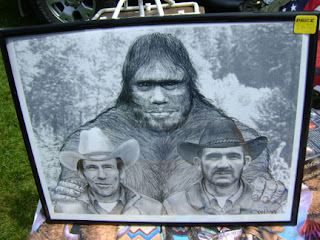
Image: Roger and Bob with Bigfoot, drawn by Mike Rugg, on Jerry Hein's memorabilia sales table, Yakima Round-Up. By Steven Streufert, 2009.

Another problem which I regret to have to mention is that of the witnesses. This is a big issue these days. In my store I get dozens of reports a year, and one has to really wonder about some of them. Most are quite ordinary and believable, and the people seem wholly credible and reliable. Other times there are people who seem to have a problem with pathological lying or exaggerated tall tale telling. Sometimes they just want to see if they can trick you into believing them, to see if they can pull your leg. Though the majority of them are believable, often there are people who report things that seem good at first, and then get stranger and more elaborate and unbelievable as they go along telling the story. One has to take a step back and wonder if these people are possibly having drug problems, delusional, confused, irrational, or just dishonestly seeking attention. They are the few, but they often have the most grand and impressive stories. Sometimes one gets involved with them on a personal level, and they begin to regard one as a friend and confidante. This can be dangerous as the researcher then starts to lose objectivity on the one hand, and gets wrapped up in their antic personal or family problems on the other. This has happened to me in several instances, where I really had to back away from a witness I no longer trusted to tell the truth and be psychologically clear.

It is as Daniel Perez has told me, “Trust, but Verify.” One should check these things out, but not be led down a loony or hoaxing path. Most of the witnesses are for real, though, and this is the most impressive proof that there is SOMETHING out there, for sure. The Backfire Effect of which you speak is why I have "ANGRY BIGFOOT SPEAKS" on my blog. He helps me say serious things in commentary on issues, but with humor and satire. Hopefully he lessens backlash, and I get to vent my own feelings.

7) Which Bigfoot-related movie is your favorite and which would you recommend to me?

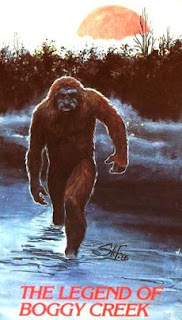
I like everything that has Bigfoot in it, generally. Though, one does often grow tired of the fictional B-movie grade Bigfoot slasher/killer horror films. There are some classics in this genre, however, such as ABOMINABLE. And then there is the great THE LEGEND OF BOGGY CREEK. The latter is of particular interest, as it is basically a docudrama, based on a true story, using original locations and even local people from Fouke, Arkansas, but it combines them with typical horror motifs that keep the film entertaining and at times exciting. It is also a nature film, and I must say that perhaps the scariest aspect of the film is the excellently done, beautiful but sinister footage of the spooky swamps where the creature is said to live. I’ve seen most of the Bigfoot films, and the fictional ones are nearly all pretty bad; but I watch them all anyway--it's fun, if nothing else. I am interested in the Creature itself as an apparently real creature, but I am just as intrigued by popular cultural manifestations of the motif. HARRY AND THE HENDERSONS was too cute for me to really like, too silly, but it had a good message at its heart.

I really prefer the non-fictional documentaries, but they are made for TV, and it is truly rare that one is made that does not degenerate into tabloid mockery or superficial skeptical dismissal without real substantiation. There are some that are partly good, like MONSTERQUEST, and the National Geographic ones, but these fall short with critical flaws and their attraction to over-dramatizing things for ratings rather than taking them fully seriously. SASQUATCH: LEGEND MEETS SCIENCE is a very good one that tries to consider some real evidence in real ways, and looks at a few of the famous films made of the creature. Also very good are the A-and-E ANCIENT MYSTERIES documentary, with Leonard Nimoy narrating, and the old IN SEARCH OF… BIGFOOT episode.

CLICK LINKS OF LAST FEW TITLES TO VIEW FOR FREE OR BUY VIDEOS, the last two are online streaming, courtesy of the BFRO web site.

You have to take the serious and the humorous together. One leavens the other. If one can’t necessarily find or prove Bigfoot, it is OK to watch a silly horror flick that can make you laugh. Some will even make you wonder. Good luck with your I-Search project! Keep your mind and eyes open. You never know what you may see!

* (Title after Rilke's Letters to a Young Poet)

BONUS LINK: View a good MonsterQuest PGF presentation with Bob Gimlin narrating HERE.

*********************************************************

A DISCUSSION WITH A SKEPTIC ON BIGFOOT,

PART TWO, A More Brief Addendum.

BIGFOOT BOOKS TALKS ABOUT SASQUATCH WITH A SCIENTIFICALLY-MINDED ANONYMOUS READER… CONTINUED.

CAN THE MINDS MEET ACROSS THE GREAT DIVIDE OF EMPIRICISM AND POSSIBILITY? An on-going exploration.

A brief interaction with “Skeptic” from our previous blog entry, DISCUSSION WITH A SKEPTIC ON BIGFOOT (click linked text to read it), began after he saw the recent National Geographic documentary, American Paranormal: Bigfoot. This is a minimal update to our previous post. As we were on our iPhone and hence limited in our typing patience, we mainly just let him do the talking. It is interesting, as one may see how he is ALMOST convinced by the Patterson-Gimlin Film, and even admits the possibility of a real Bigfoot to some degree. He sent in the following:

SKEPTIC: Actually, I saw a show on BF last night on Nat Geo. It heavily features Bill Munns' digitization and analysis of PGF. It was definitely biased in that they didn't talk to a lot of experts, but they did show some interesting stuff. The musculature of the PGF creature may be the convincing thing, at least in the way it was presented. The "compliant gait" could be faked, longer arms could be added as part of the suit, but the way the fur clings to the body and muscle contraction seems visible. That is hard to fake even now, but particularly with ape suits available at that time. So maybe it is real. I just don't know. I wish a panel of totally disinterested anatomists and kinesiologists could really be brought together to look at the film. The film is ultimately the closest "proof" there is.

"Skeptic," again, followed up when he had proposed that perhaps the PG Film was real, but that the Bigfoot had gone extinct since then, and when we replied that there are more sighting reports now than ever:

SKEPTIC: The fact there are more sightings WITHOUT film or other evidence makes it less probable that it is real, you know. So the fact that there are more sightings now, yet still without evidence, argues against the existence of Bigfoot, and more that there are more people now there, more delusions, wishful thinking, mis-sightings (brown bears, whose habitat is similar to that of many BF sightings), weird feelings in the woods, more hoaxes, etc. The more the encounters, the greater the chance of real documentation, if the creature is real and alive.

Then, on Mar 13, 2010, at 12:36 AM, Steven Streufert, Bigfoot Books wrote, and started it up again:

BIGFOOT BOOKS: “Bigfoot?” Check this out:
http://www.youtube.com/watch?v=banaB07Fu9c&feature=related
Watch it until the midpoint, at least.
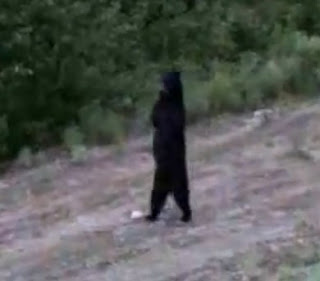
(This is the video of a three-legged bear waking bipedally upright, looking a lot like a Bigfoot when it moves through the woods, obscured partially by branches.)

SKEPTIC: I think a lot of bigfoot "sightings" are probably black bears. Their habitat and the locations of bigfoot sightings overlap very nicely. Others are just hallucinations or "spooked feelings" onto which people project some image in their brains, like a lot of ghost "sightings." On another note, it's amazing that the bear survived after presumably losing one of its front legs/arms in a bear trap. It defied the odds in surviving bleeding or infection. It then later survived the odds by surviving with this very real handicap. It may have been aided in its survival by scavenging on thrown-away human food in garbage cans and dumps.

BIGFOOT BOOKS: It looks amazingly like a bigfoot when it is moving through the trees. A huge number of BF sightings are probably wishful thinking or mis-interpretive imagination. However, there are many that are vividly up close and personal, undeniable... unless the witnesses are liars. Bears are impressive creatures. That they can survive as they do indicates that an omnivorous BF creature could, too, if it were adaptive and flexible.

SKEPTIC: Yes, some bears will survive and maybe thrive as scavengers as our population continues to grow, largely due to third-world fecundity and immigration. Other bears, less adaptable, like Grizzlies are doomed, as are many other animals.

Bigfoot is either fiction or has died out due to its own lack of adaptability and loss of habitat (or isolation of once continuous roaming areas by human development). Other hominid species and non-hominid primates have existed until fairly recently, and bones really do decay or become buried under leaves and soil fast in forests. So it is possible that there was a human-like animal in N. America until recently. I don't think it exists anymore, if it did. With more humans, more cameras (virtually every cell phone now), there'd be more PGF-type footages at the least.

Bigfoot fulfills the human desire for transcendency and escapism from the nudging and gnawing sense that we are animals, born for no reason, dying for no reason, just here to eat, shit and reproduce. Everyone feels this. We need mystery to survive psychologically. Without mystery, we have to face the banality and triviality of our own lives and deaths.

It is ironic that we seek both certainty and mystery. Certainty, because it alleviates our own questions about our positions in the world and our own decisions. Mystery, because so long as there is mystery, there is a chance of there being something more than random material cause and effect, which is a kind of certainty, but not the kind we crave, as it is dehumanizing and mechanical. We need both, and in some way they reinforce each other, even though they are diametrically opposed.

We want fascistic certainty about our own importance, yet we want unknowables that point to other worlds to which we may one day ascend. Related but distinct, and again irreconcilable with strict logic. But reconcilable when considering human psychology.

BIGFOOT BOOKS: There is a lot of evidence in Native American culture that there were once a whole lot of them out there. BFROVIDEOS on YouTube had a really cool thermal video. They may have made it pay-per-view, though. There is still a lot of habitat. Come on up here sometime and I'll show you "Bigfoot Country." I predict that wolves and grizzlies will one day re-colonize in the lower 48, perhaps even spreading into Northern California. Only a matter of time, and Conservation….

SKEPTIC: There was also a belief that the world was created by spiders or other creatures in N.A. cultures. And, again, when I go outside at night, I can sometimes "feel" weird creatures in the woods, and it frightens and thrills me. We all want that. We want to know there is more than just what we see out there, even as we want to know there are rules.

It is easy to project our desire for "others" (which beyond maintaining the mystery we need also alleviates the loneliness we feel) onto human-like creatures that may be out there. We have had language longer than the last date of extinction of other hominids, e.g. Neanderthals and probably others. So there is also an oral tradition of man-like creatures, which once did exist alongside of us, that may have been passed down to many cultures.

And I am willing to concede that some ape-like creature, perhaps even a hominid, did exist alongside us in N. America for some time. They did certainly in Europe (until probably about 20K years ago), and, although it is controversial, possibly in Indonesia even until perhaps even just a half-dozen to a dozen thousand years ago. There may well be more.

However, if bigfoot did exist in N. America for some time, migrating like H. sapiens over the ice bridge (since one thing is certain, apes, including the hominid group of apes, all evolved in Africa), it is almost certainly extinct now. If it did exist, it may have gone extinct long ago (in which case PGF would be a hoax) or very recently. But with so many people and so many devices for recording encounters, it defies all logic that it could still exist now.

BIGFOOT BOOKS: Some things are metaphoric, some aren't. Spiders = “web of stars,” for instance. Indonesia area still has "hobbit" reports. Orang Pendak… Google it.

SKEPTIC: I know, but there was controversy about whether the fossils were properly identified. I don't give much credence to recent reports. Some things are metaphoric, yes, and so BF might be too. It's the wildman myth.

BIGFOOT BOOKS: "The mythology has to come from somewhere. It doesn't just come out of a Kellogg's corn flake box!" --Rene Dahinden

I LIKE the maybe, and BF is the best of them all as he stands just the other side of real, and may be real. Look into HOBBIT. They have found many more skeletons. A ... population! Views have changed. Be open minded. It's the best way to be. By no means have humans reached the limits of understanding.

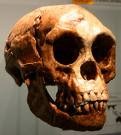
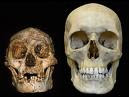
SKEPTIC: There are bones of H. floresiensis. There are none of bigfoot. The controversy about the hobbit is whether it was a separate species or just a group of miniature humans.

There is something one learns when taking an ecology class. Large animals require truly huge areas. Shy and retiring large animals require even more. And while the total amount of undisturbed area may still be great, it is broken up. And, again, one learns in ecology classes that it is not sheer area that matters, but connectivity. One huge area of 100,000 acres, say, means more biodiversity, especially for larger animals, than 100,000 acres broken up by roads and human settlements into 10 x 10,000 acres.

Images: Homo floresiensis skulls, and one from H. sapiens for comparison. Sourced on Wikipedia Commons.

This is actually a last-ditch conservation philosophy, providing corridors for animals to gain access to larger area footprints. It's often just a simple road that cuts habitats in two and prevents access to the larger territory. Corridors don't always work, though, as it means somehow funneling animals through a small "tunnel" to access to other part of the territory.

So, even when the "virgin" areas may seem large in sum, if they are broken, even just by small roads, into parcels (and for a big animal even 50 sq. miles - a huge "parcel" by our standards - may not be enough), it just doesn't work for certain animals.

If you consider the number of, say, 50 sq. mile areas that are unbroken and undisturbed in the world by any road or other human scar, there are very few. Perhaps in the Amazon, but, even there, that's disappearing fast.

BIGFOOT BOOKS: There are LOTS of those areas here, with only dirt or very sparsely traveled roads. Come see for yourself!

SKEPTIC: If BF is human-shy, it would not be sparse enough. Look at a Google satellite map of the area. Not as sparse as that. Also, where are the movies and photos. Everyone has a cell phone with a camera these days.

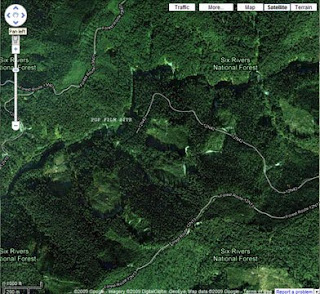
BIGFOOT BOOKS: You have never walked on the GROUND in these areas. It is incredibly sparse, and humans may log or plow dirt roads, but they soon leave. It is incredibly dense and inaccessible in most places. Google Earth is deceptive. Go to Orleans CA there, go west a little ways, you will be in the Bluff Creek country. Then go north, into the Klamath-Siskiyou Wilderness. You won't see Bigfoot on Google Earth, but you would get a whole different impression trying to walk around in there.

Image: Thank you Google Earth. You helped me greatly in studying the P-G film site zone before venturing forth! Click to enlarge to see the location of the site.

SKEPTIC: Walk and take a camera. Send me a pic of BF!

BIGFOOT BOOKS: I've tried. I think there was one in my yard, a forest actually, but a photo was impossible. I didn't actually see it. But it behaved and sounded like no other animal I know.

SKEPTIC: I've heard weird sounds in my yard too. Doesn't mean it was BF. Maybe it was a chick stalking you.

BIGFOOT BOOKS: This instance was different. I KNOW weird sounds. I had a mountain lion in my yard yesterday. Raccoons, foxes, bears, skunks, owls, doves, hawks, osprey, deer--all sorts of things live up here. That one night, whatever it was, was NONE of them. I doubt it was a 500 pound man in the middle of the night, either.
Chicks? I don't tend to go for the ones that make the ground shake when they walk, though.

SKEPTIC: Maybe, but probably not. The mind is a powerful instrument of hallucination and misinterpretation of senses. Mama Cass is stalking you.

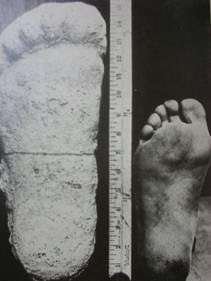
Image: Rene Dahinden's foot is dwarfed by the Bigfoot track, this one appearing to be from the 1967 Patty creature. Historical.

BIGFOOT BOOKS: I was absolutely lucid during the event, and checking my assumptions all along the way. Basically... WTF?!  Mama Cass? Maybe her reincarnation?

SKEPTIC: With 500-lb creature, you would have seen footprints afterwards. Did you check?

BIGFOOT BOOKS: Yes, hard-packed dirt, but there were depressions in the understory plants. Hadn't been there before.

SKEPTIC: But 500-lb depressions?

BIGFOOT BOOKS: Who knows??? Heavy, but how can you tell? I don't know the actual weight, but it sounded huge, heavier than a black bear.

SKEPTIC: Did it smell?

BIGFOOT BOOKS: I didn't notice scent/odor. But I was smoking at the time.

At this point the discussion died out due to the late hour back on the east coast as compared to our much more kind Pacific Time. We started it up again with one more, final question, this time luxuriously typed out on a proper keyboard.

BIGFOOT BOOKS: I am intrigued by your previous discussion of our need for at once Mystery and Certainty. I've thought about the role of the mysterious for a long time now, and the meaning of "Bigfoot" within those functional roles. You put the case very well.

In this sense, a bona fide mystery can serve the very same role as a mythological one. In fact, they blend with each other in the human psyche. But aren't the "real" things just as mysterious, especially at early points of discovery? Aren't there always mysteries, and isn't this what drives Science and exploratory quests and hypotheses?

I would argue that Bigfoot is no different from all the other things we have sought to know, and explore, and discover. The entire world at one time was a great unknown to our species, full of potent magic and mystery and, of course, fear. Fear of the unknown, fear for survival, these drove us , along with a desire for power. Now it is really much the same, as though we do know a lot, the mysteries still seem to expand at as great or a greater proportion to our discoveries and validations. Think of Cosmology and Quantum Physics, for instance. Or the exploration of Genetic mapping, of micro-processes within cells, within matter itself.

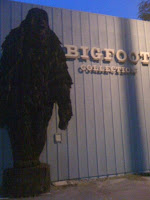
Images, above and below: Three Willow Creek Bigfoot statues, shot in one night on a low-grade iPhone camera, for "artistic effect." By Steven Streufert, 2010.

In the great Age of Exploration, and the Colonial period that followed, Europeans spread out and sought to discover, know and conquer. Strange things were encountered, including heretofore unknown beasts and monsters of mythic proportions and forms. At first these were monstrous, but were gradually understood. Hence, the gorilla becomes just another quite interesting creature of known habits and taxonomy, rather that a savage giant that rips humans to shreds and eats them, or abducts human women for breeding. Even the great sea monsters are now known to be squid, whales, manatees or sharks. Could not Bigfoot be just the last hold-out in this process, now still a monster to some, and yet to others experienced and understood as simply another living creature?

I would argue, also, that the sense of banality and absurdity in life, though at times crushingly real to us, is really just a lack of imagination and inspiration. What we know is really quite small compared to what is, and there are ample mysteries abounding in the universe beyond our small, known world. Though we cannot escape bodily physical death and the daily monotonous requirements of life, there are means for transcendence readily available to us at all times, techniques of art and vision, and technologies of the "soul" like Buddhism, which may allow us to escape the narrow bounds of a time-space bound form of consciousness.

Perhaps this is part of the appeal of Bigfoot: that it is a creature that is man-like, but not confined by mankind's narrow society and civilization. It is a creature that embodies at once the power of the natural world and a potential unknown form of consciousness and existence utterly strange to us, but strangely and deeply familiar. It appeals to our deeply known evolutionary and wild past, but also, perhaps, to our future.

Your reply? 

[ANSWER PROMISED BUT STILL PENDING. Check back here soon for the final update, coming soon to this blog entry!]

*********************************************************
ANGRY BIGFOOT SPEAKS! And Roars! And Munches!

Me have to admit it. Some time me can not stop self from stealing hu-man food. Me not eat hu-man, but cookie or pie hard to resist, and taste so much better. Me steal from window ledge, run off with goodie. That why sometime hu-man get to see me, even though me so sneaky other time. Me angry just because cookie no grow on tree. Would be perfect world in nature if that true. But no. No. Hu-man researcher say me evolve perfect, so no need be civilized. Me say that not all the way true. Why you think you dumb monkeys see me? Not because you clever. It because me hungry, and curious about crazy thing you do.
*********************************************************
HEY! Who is that crazy blue thing over there in my spot!

This blog "copyright" enough, 2010 by Bigfoot Books and Steven Streufert, that you should at least cite and link us when you are appropriating any personally generated materials from this blog web site. We write in the spirit of sharing, so feel free! But spread the word, please, so we may slowly change this old world for, if not the better, than at least to make it a more interesting place to live.