Cryptic News from the Willow Creek View. Transhuman Sasquatch Strangeness from the Middle of Nowhere.
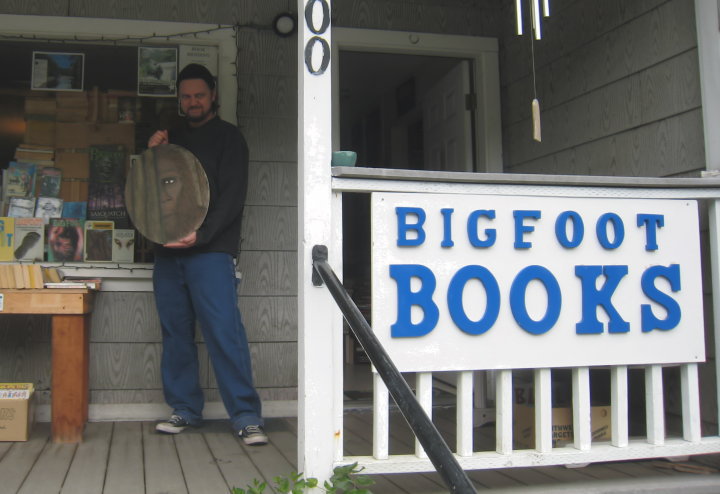
A Voice Howling out from the Klamath-Trinity-Siskiyou Wilderness. This is the Megaphone of Steven Streufert and Bigfoot Books, a Used Book Store in Willow Creek, Humboldt County, Extreme Northern California.
BIGFOOT'S BLOG NEWS FLASH, April 24, 2012 (plus see update, below)
Just a little reminder... yours truly will be on COAST-TO-COAST AM radio TONIGHT, 11:00-1:00 Pacific Time. The subject, of course, will be BIGFOOT.
Stay tuned in the last hour for Lyle Blackburn on the topic of the Beast of Boggy Creek.
"In the middle two hours, scholar of Bigfoot history, Steven Streufert, will share both the history of the creature, including the Patterson film, as well as current reports of sightings around the country. In the last hour, cryptozoology advisor to Rue Morgue magazine, Lyle Blackburn, will discuss reports of a strange beast known as the Fouke Monster that have circulated among the locals in southern Arkansas. First Hour: Plastic surgeon Dr. Tony Youn talks about bizarre and botched surgeries."
Be sure to tune in while the show is on the air, as you have to be a Coast Insider subscriber to access the archived stream or podcast afterwards. On some western stations the show repeats again after 2:00 a.m., if you miss the 11:00 live broadcast. This is a broadcast radio show, so find an affiliate station in your area here: http://www.coasttocoastam.com/stations. Some of them stream live online. The I-Heart-Radio app will allow you to listen on your phone. I use 1190 AM out of Portland to listen, myself.
Well, that was fun, and nerve-wracking! George Noory is a true pro interviewer, and kept me moving along in novel ways that my own agenda may not have pursued had he just let me ramble. Some 5,000 hits have come in to this blog in the last couple of days, which is awesome! Thanks to all at COAST-TO-COAST AM, a show I've enjoyed most days since the very early 1990s.
In the middle two hours, scholar of Bigfoot history, Steven Streufert, shared history and analysis of the mysterious creature. He runs a used and antiquarian bookshop (specializing in "Sasquatchiana") in Willow Creek, California, considered the heart of the historic "Bigfoot Country,"-- the location is near where giant tracks were found in 1958, and "Bigfoot" subsequently became a household word. Willow Creek is also near where the famed Patterson-Gimlin film was shot in 1967, and Streufert has been involved in the Bluff Creek Film Site Project, which has traced the exact location of where Patterson filmed, in order to verify details about the creature, and its environment. He also participates in a Facebook group that seeks to promote the spirit of rational thinking and evidence-based Bigfoot research (in reaction to some of the more fantastical, insubstantial, or promotion-based claims made about the creature).
Streufert spoke about some of the ancient Native-American lore regarding Sasquatch, such as the beings speaking a language, as well as trading with, abducting, and even mating with humans, and producing offspring. One theory, he noted, is that Bigfoot are actually hybrids between humans and proto-humans. He also discussed the current Bigfoot DNA Project, spearheaded by Melba Ketchum, and a controversial case from last year when a hunter claimed he killed two Sasquatch in the central Sierra Nevada mountains, and now has "Bigfoot steaks" stashed in the freezer.
Last hour guest, cryptozoology advisor to Rue Morgue magazine, Lyle Blackburn, discussed reports of a strange beast known as the Fouke Monster that have circulated among the locals in southern Arkansas. In 1971, a family was reportedly attacked by a "big hairy monster," and within a year, there were around 50 more sightings, with descriptions of an adult creature with a narrow build. The creature became popularized as the 'Beast of Boggy Creek,' when the low budget film The Legend of Boggy Creek was released in 1972, and became a hit. The movie was indeed based on some facts, Blackburn said, who added that he considers the creature to possibly be a cross between the foul-smelling Skunk Ape and a Pacific Northwest-type Bigfoot. In 1991, a large skeleton (missing the skull) was found in the woods near Jefferson, Texas that some believe could be a Bigfoot, he added.
Strange Surgeries
First hour guest, plastic surgeon Dr. Tony Youn recounted bizarre and unusual medical procedures. For instance, one plastic surgeon claimed he used the fat extracted from liposuction operations as biodiesel to run his car. Youn also touched on "body transmogrification" in which people have strange modifications such as the lizard-like tongue bifurcation, as well as a new weight loss strategy in which a doctor stitches a mesh patch on the tongue in order to make the act of eating uncomfortable.
Lyle Blackburn shares two images in tandem with his4/24/12 appearance. On the left is an illustration by Dan Brereton of a young hunter encountering the Fouke Monster in the 1960s. The other illustration, by Justin Osbourn, depicts the Beast of Boggy Creek, which the Fouke Monster was later called.
Click on images to view larger.
*******
QUESTIONS I SUBMITTED TO C2C...
Before the show the producers give the guests a chance to submit a range of topics and questions that they would like to cover. You can see from below that George Noory took his own direction in the interview. Here's what I sent them, in rough form....
"Here are a few topics I'd be happy to have George ask me about when I'm
on the show. I like discussion, though, so I'm totally open to whatever
he wants to bring up for the two hours.
1) Life in Willow Creek, CA, the "Bigfoot Capitol of the World," or
"Gateway to Bigfoot Country." What is it like here, and why does this
little town in the middle of nowhere get such recognition. It is the
"Mecca" of Bigfooting. How did Steve end up living there, and was it
because of Bigfoot??
2) How was "Bigfoot" born, and how did it become a household name. In
1958 tracks were found up in the Bluff Creek basin, while they were
building a new logging access road into virgin timber. How far back in
history does this phenomenon really go?
3) The Patterson-Gimlin film. What is its history and how is it
connected to Willow Creek. What controversies surround it? Why is it so
central and important to the study of Bigfoot? How did they manage to
capture the creature on film when so many others have failed? Was it
really a hoax?
4) The Bluff Creek Film Site Project. What is it, and why was the PGF
site "lost" for all those years? How was it found again and documented?
Why did we receive the "Bigfooter of the Year" award for that process?
Why is Bluff Creek so important to Bigfooting?
5) What kind of store is BIGFOOT BOOKS, and how does Steve get any work
done while being constantly distracted by those curious about Bigfoot?
6) Weird Willow Creek, in other words, Bigfoot is not the only strange
thing here. We've had many UFO reports, legends of underground caves and
tunnels and even cities (up in Mount Shasta), and strange cryptid
creatures everywhere, it seems. The local people report seeing black
panthers, river serpents, "Little People," mer-creatures in the rivers,
giant six-foot salamanders, and yes, even a few believe in werewolves
out there. Reports of grizzlies have become somewhat common, and a wild
wolf was reported just north of here.
7) The "Bigfoot Scenic Byway"? What is it? Also, the Bigfoot Collection
at the Willow Creek-China Flat Museum. Is tourism a big factor or
motivation for the spread of the Bigfoot idea?
8) FINDING BIGFOOT on Animal Planet. What is its impact on the Bigfoot
and mass popular culture, and what is it like seeing your friends on TV
(Steve is friends with Matt, Bobo and Cliff from the show). What was it
like to see ONESELF on TV? How will it influence the future of the quest
for Bigfoot? Will it create problems with hoaxers, amateurs and newbies?
9) "THE BIGFOOT WARS"... why does the Bigfoot Community suffer from such
combative egos, theories, and conflicting regional groups? Why is
everything so controversial? Can they ever agree on anything? Is there a
"gold rush" to be the first to "discover" and prove Bigfoot?
10) Will they ever be able to prove Bigfoot? What would it take? WHY has
it not been proven with over five decades of active searching, not
counting the previous Yeti expeditions in the Himalayas?
11) What IS Bigfoot? Is is an ape of some kind of human? WHY is this
even controversial? Does it present problems for Religion or civil
rights if it is "human"?
12) NATIVE AMERICAN background. What are the origins of "Sasquatch," and
how does it relate to the American Bigfoot? What is it like living in an
area with so many native tribal groups (just up here we have the Hupa
from Hoopa, Yurok and Karuk)? What do they REALLY believe about Bigfoot?
13) Bigfoot mysteries? Telepathy, interdimensional travel, "zapping,"
infrasound, curses, taboos, underground civilizations/lairs, and UFO
contact are all associated with Bigfoot. Is it real? Are we looking for
a flesh and blood creature, or something mystic or mythic, either
in/from another world or else generated by some archetypal need in the
human mind? Some even claim to have a Bigfoot as a spiritual TEACHER or
guru, and to receive mental messages from them.
14) What was the necessity for founding the Facebook discussion group,
The Coalition for Reason, Science, Satire and Sanity in Bigfoot
Research? Perhaps this link could be mentioned on the air:
https://www.facebook.com/groups/smartbigfoot/
15) THE BIGFOOT DNA PROJECT... Will it really be published in a
scientific journal in two weeks?
Will it prove Bigfoot???? How did it get started, where did the samples
come from, and what have been the controversies along the way. One
strange aspect of this is a rumor that the head of the project believes
in "ALIEN DNA," that something "out of this world" was found in the test
results.
16) THE SIERRA KILLS. Last year one large controversy was the supposed
killing of two Sasquatch by a hunter in the central Sierra Nevada
mountains. What happened, did it really happen, and how is it connected
to the DNA project? Supposed "Bigfoot Steaks" were obtained, and samples
have been tested for DNA.
17) Is there only ONE Bigfoot, or a whole species? Are the MANY
subspecies of this unknown primate? How do we account for regional
variations like the southern Skunk Ape? Why do they seem to be present
all across the globe, and in human historical legend?
18) How do we deal with the rise of hoaxing on YouTube and the
phenomenon of the "blobsquatch," poor quality photos and films showing
blurry and dubious supposed Bigfoot creatures? Shouldn't the rise of
cell phones and digital cameras help prove Bigfoot? Why haven't they?
What are the motivations of someone faking a Bigfoot video or sighting
report?
19) Public Ignorance: WHY do so many assume that Bigfoot is a Hoax or
just a joke? Without really studying the evidence or after hearing or
reading a poorly researched news article many assume that Bigfoot is
fake, or just a delusion. WHY? Why is this field of study and its
phenomenon not taken seriously, and why do so many false things creep
into the documentation and public understanding of it?
20) HOW do sane, normal people see something that cannot be proven but
was utterly real to them? These include every day rural folks, police
officers, forest rangers, Native Americans, etc. The sightings are often
not at all extraordinary or "weird." These people are simply seeing an
everyday kind of creature, but one that they know darn well is not a
bear or a human. Not all Bigfoot sightings are mere shadows and
phantasms. Some are clear as day, and in fact many have been
face-to-face. I have met these people here locally. What is that like?
21) HABITUATION: Do people really have Bigfoot living in their
backyards, and are they really interacting with these creatures/beings?
Why has so little evidence emerged from them, if so?
22) How did your background in Literature, Critical Theory and
Philosophy, and your profession as a seller of used books, somehow lead
into the strange world of "Bigfoot Studies"? How did that background
prepare you for what you are currently doing.
24) WHAT IS THE FUTURE OF BIGFOOTING? What can we expect?
I hope those are a good start. Let me know if I should send any further
details. Browsing my blog a bit should help George get a handle on what
I've been doing and what my perspective on this mystery is.
Best,
Steve
*******************************************************************
Steven Streufert, Bookseller
Bigfoot Books
P. O. Box 1167
40600 Highway 299
Willow Creek, CA 95573 USA
(530) 629-3076 store
EMAIL: bigfootbooks@gmail.com
That's a lot to try to cram into the less than two hours on the air, after commercial and news breaks are taken out of the picture!
If you missed it... Don't forget, you can get access to the vast archive of past shows by subscribing as a Coast Insider. It's worth it if you can't catch the show on a nearly nightly basis as I do, nightowl that I am.
Someone DID post it on YouTube....
Try clicking the link below, and then clicking the forward button in the video player to
advance to hours two and three, or four.
Me tell hu-man friend, "Break a Leg" for radio show, and guess what? He actually DO it. OK, me help a little....
****************************************************
This blog is copyright and all that jazz, save for occasional small
elements borrowed for "research" and information or satirical purposes
only, 2007-2012, Bigfoot Books and Steven Streufert. Borrowings for
non-commercial purposes will be tolerated without the revenge of Angry
Bigfoot, if notification, credit, citation and a kindly web-link are
given, preferably after contacting us and saying, Hello, like a normal
person would before taking a cup of salt. No serious rip-offs of our
material for vulgar commercial gain will be tolerated without major BF
stomping action coming down on you, hu-man.
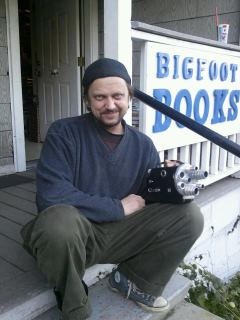
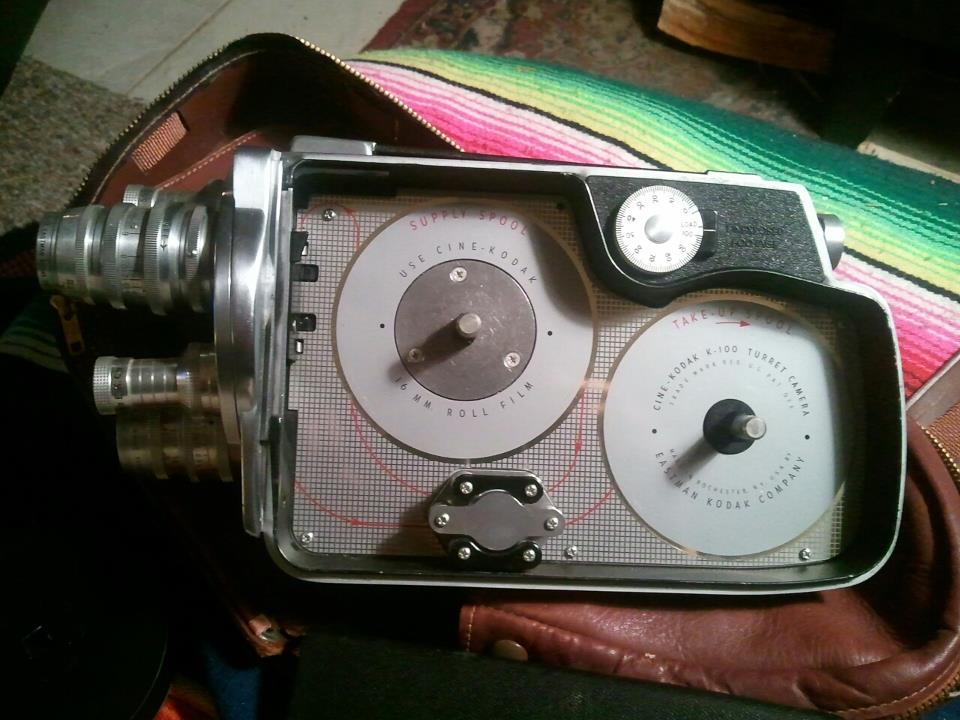
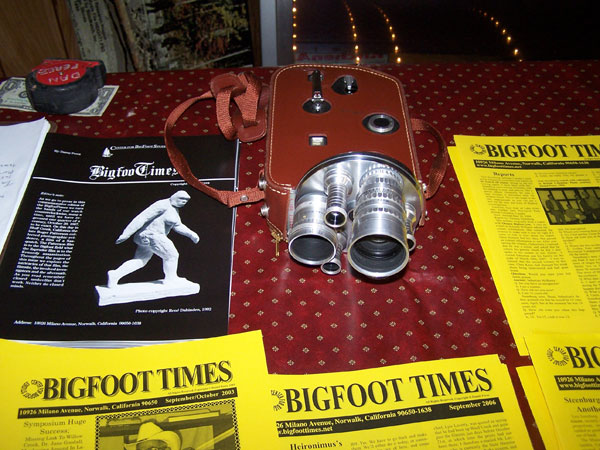
Me and My Friend, the Kodak Cine K-100,
the same camera used by Roger Patterson for the PGF.
BIGFOOT'S BLOG, LATE MARCH 2012 EDITION
Before the next season of Bluff Creek adventures begin, I thought I'd better gather up some of the last loose ends from the previous season's efforts. Season Two of the BLUFF CREEK FILM SITE PROJECT is now completed (view the last episodes below), and we are working on plans for a major pow-wow of new investigations once the area up there is open again. Snow on the ridges and locked road gates usually keep us out until late June, and then lock us out again in late October. Loads of new information has poured in since we proved and verified the PGF site location, some of it very odd and confounding aspects of the Bluff Creek history. We've been told that Bob Heironimus was in Willow Creek in 1965, which is just too odd to blog about without further data. The investigation continues....
*******
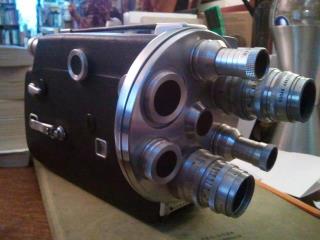
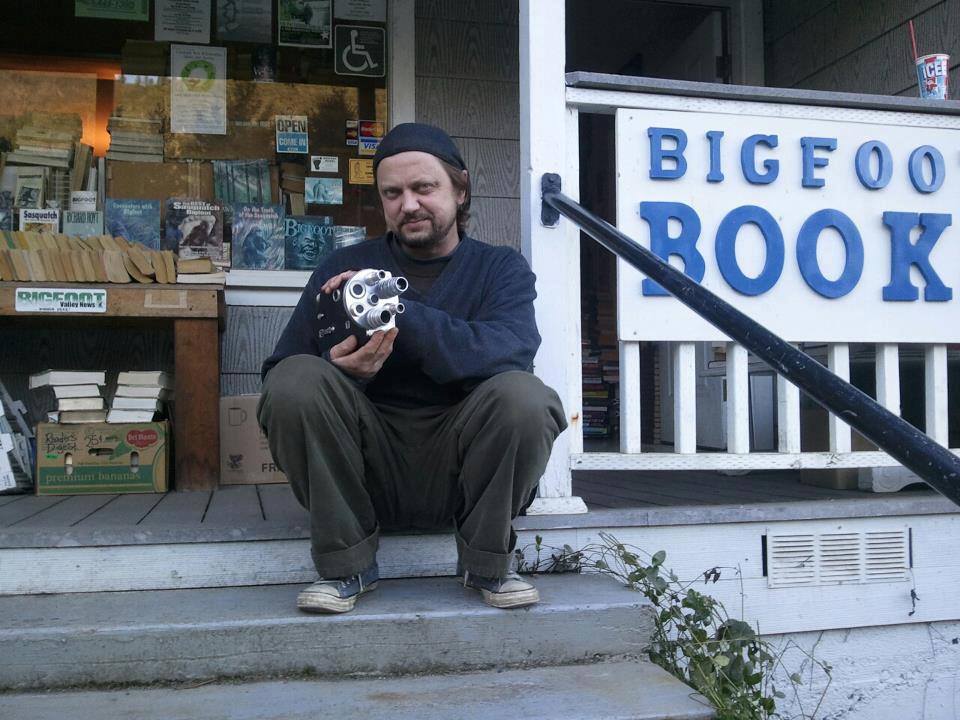
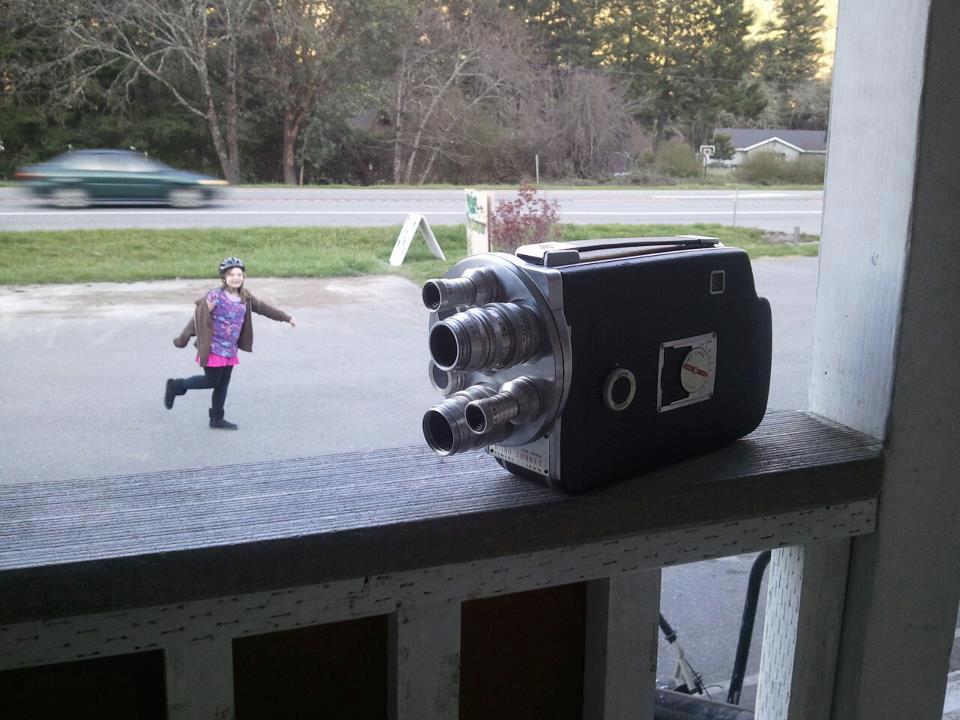
An anonymous (for now) "R.K." sent me a vintage sixties Kodak Cine K-100 16mm film camera, just like the one used by Roger Patterson in 1967. It is an identical model, save that it has a front-loaded lens turret. It is in apparently functional working order, so it may come in handy for research this summer. Here are some nifty photos of that...
The K-100 with the three-lens front turret. Patterson had the single-lens setup.
Ahm a gonna film me one a dem sum-bucks!
Little Bigfoot walks behind the K-100.
Interior of the camera. Click to Enlarge.
*******
The continuing drama of the BLUFF CREEK FILM SITE PROJECT, Season Two, Episodes 63-67
This is Season Two, brand NEW. Back to the Creek Again! Here you will find the "Checking the Grid and Site Draft Map, and Measuring the Big Trees" episode. Part 63. Check it out!
Here you will find the "Measuring the Big Trees and Making Test Footprints" episode. Part 64. Check it out!
Here you will find the "Robert Survives Solo Camping on the Film Site and Does the Tree Bores" episode. Part 65. Check it out!
Here you will find the "Aftermath Discussion at the Old Bigfoot Motel" episode. Part 66. Check it out!
Here you will find the "Robert Interviews our Mathematician/Geologist on the Film Site Math Proof" episode. Part 67. Check it out!
*******
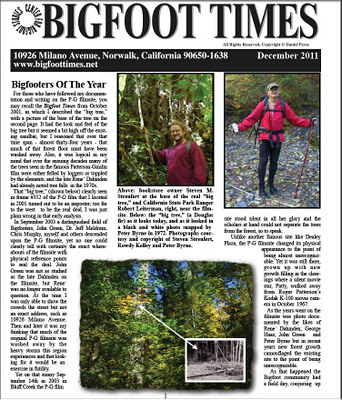
Before he awarded us the BIGFOOTERS OF THE YEAR award, Daniel Perez sent Robert Leiterman and I some questions. Here is that email interview....
QUESTIONS FROM DANIEL PEREZ, the Full Text.
(Parts of this were published between the December 2011 and January Issues of THE BIGFOOT TIMES. Click the name to visit Daniel's site and subscribe.)
Robert and Steven: some questions for a write up in the Bigfoot Times newsletter.
PEREZ: 1) Who made the decision to create The Bluff Creek Film Site Project?
STEVE: It was Ian and I who started this research project by obsessing over small details in the history of Bluff Creek. There were a lot of unanswered questions, and many outright contradictions. This included five main opinions as to the location of the PGF site, and many more minor locations proposed or hinted at by others. As explained below, the official “Project” was started in 2010, when Robert joined us and started filming our research and investigations, and releasing the results on the BFRO YouTube page. I’ve been blogging about it, too, on BIGFOOT’S BLOG. It has been a long personal process for each of us, but our collective work took the last two summer-fall seasons, with preliminary stuff between Ian and I before that in 2009.
PEREZ: 2) When did this project begin?
STEVE: Ian and I were separately heading up to Bluff Creek in the early to mid 2000s, and began working together on this history after meeting at the Yakima Bigfoot Round-Up in 2009. In 2010 we began working with Robert, who wanted to document the process. Three summer-fall seasons, then, went into this Project. I first looked for the film site, using John Green’s sketch in his first pamphlet/booklet, in 2001. Green’s map was rather vague and imprecise. Questions lingered until I was back up there in 2007 with Cliff Barackman, James “Bobo” Fay, and others. From their opinions, guided in part by what Gimlin had said in 2003, and the marked maps found in BIGFOOT AT BLUFF CREEK, we tried to find the film site. It was a strange place, at once familiar, and yet very alien. No clear indications were found anywhere of the scenery familiar in brief glimpses in the PGF itself. The following years were a slow and sometimes agonizing process of trying to pull the real information from the word-of-mouth and presumptuous statements made by various researchers. Ian was there in 2006, where he met Daniel Perez and Richard Henry. His outdoors and navigational experience gave rise to a parallel interest in discovering the site. Ian and I met in Yakima, Washington, but were able to conveniently meet and head to Bluff Creek as he lived nearby in Redding. I’d known Leiterman for a while, and when he heard about our research his own curiosity to find the site was ignited. He became a driving force to get us to apply our research on-site, rather than just hike around and theorize.
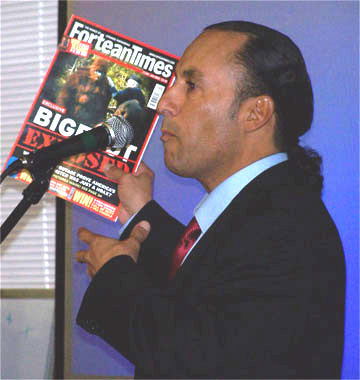
Perez, 2007, Willow Creek. Photo by Streufert
PEREZ: 3) Who was part of the project?
STEVE: Ian C., Steven Streufert, Robert Leiterman, with part-time participation of Rip Lyttle, and then Rowdy Kelley toward the end of it. We were aided immensely, of course, by the remaining older locals from the general Willow Creek area, like Al Hodgson and Jay Rowland, as well as many of the old-time Bigfoot researchers like John Green, Jim McClarin, Bob Gimlin… and yourself Daniel Perez, among many others.
PEREZ: 4) Many other parties claimed to know where the filmsite was but nothing bore fruit. Do you think they were doing it to attract attention to themselves rather than the subject?
STEVE: Before what I like to call the “Great Confusion of 2003" (when many major researchers along with Gimlin himself tried to find the site and could not), I think many just assumed that the site was “known.” We found, living here and having the time to try to actually find the spot, that it was NOT known. As it turned out, the spot found in BIGFOOT AT BLUFF CREEK was correct, but the trackway course was not found, nor the big trees, nor frankly any of the things actually seen in the film. The last positive ID of these features that we’ve been able to determine was made in 1983, by Thomas Steenburg, who had help from Dahinden. After this it really seems to have become overgrown and lost to time, with Green and Titmus not being able to find it at all by around 1998.
The many researchers who have made the varied claims of “their own” filmsite location seem to have suffered either the confusion of faded memories, or else a certain arrogance that their own “information” and “knowledge” were sufficient, despite a nearly total lack of verification and validation. Those like MK simply made up their own location, with no substantiation whatsoever save that the spot “felt” right to them, and they had heard some snippet or rumor that they felt must be accurate. We found, in trying to investigate this stuff, that there were MANY such snippets, and NONE of them could prove anything. What we saw was an oral history disintegrating into legend. We sought to correct that, and it truly was not easy to do. We sought to establish truth and reality, a real history, which are rare things in the field of Bigfooting, I’m sorry to say.
I have to say that the biggest enemy in this endeavor has been the presupposition of unfounded claims made by some researchers who never even bothered with proof and documentation. Just saying something is so is never enough. As in the case of MK, one false conception can lead to a thousand others following. Attention-getting? YES. It seems to be what drives Bigfooting the most, as we generally can’t seem to produce very good evidence of the phenomenon it give more weight to individual declarations, egotism, and imaginary and unsubstantiated claims to truth without real evidence. Everyone in this likes to call themselves “researchers,” but it is stunning how few of them actually bother to document and really study anything.
PEREZ: 5) Are you confident that after 40+ years you have located the exact spot?
STEVE: Yes. Indeed. Well, we still have to prove it absolutely to the world. Proof, in a scientific and surveying or optical/photographic sense, is a whole other order of business. The history is ambiguous and contradictory, too. I am satisfied, though, that this is the site, and I see absolutely NO evidence for any other location we have investigated. ALL of the evidence and history, such as it is, points to this one single sandbar on the long course of the creek. There is no doubt in my mind, as I walk on the very course of the trackway on that site. It is big enough, with all the landmarks and proportions in order. Once understood, the site becomes clearly visible (conceivable, at least, though one cannot really see in the way Patterson’s camera did back then), despite these 44 years passed and new forest growth since the filming event.
PEREZ: 6) Of the team, who had that Eureka moment of pinpointing the "big tree?"
STEVE: The “Eureka” moment was really a gradual process realized as a group over a few years. It was I, Steve, who began insisting on that particular big tree and area, and seeing the sandbar and the angle of view in the film toward the “right” side of the sandbar. But I'm not claiming credit for it personally. It was group research, and no one of us alone could have brought this project to fruition. That is why we go by "BLUFF CREEK FILMSITE PROJECT."
We’d looked in that area before, but always felt that the trees were just way off too far toward the end of the film. We had decided that we would focus on that spot and do a site survey last year, but we ran out of time with the seasons and weather changing. Robert and I were even more convinced when we heard that it was Gimlin who had identified the spot of the first sighting. Ian remained skeptical, thinking the site and big trees were not big enough, and so forth.
I found my way to that tree again this mid-summer (during a time when we were unable to get the group together up there), and gave it a serious new look. I had to change my whole mental image of the film site around to realize it was the correct tree in the right spot. In many ways the image in the film is an optical illusion of perspective, with a moving subject and camera position. We had to think around “square” models such as seen in Murphy’s diorama of the site. I began pointing out that tree to the others, the biggest one down there in that general spot. Robert agreed, but reserved judgment until we could do the site survey grid. Robert was very determined to get to that level of documentation before concluding anything. Ian wasn’t able spend much time at the spot with us in the one time we were all of us together there this summer. He still has reservations, but I think we’re making a little headway convincing him.
When we did our survey with Rowdy we saw things in greater depth and focus, and the landmarks began to emerge from the “jungle.” We saw the trees for the forest. So many had assumed that that area was just not big enough, but when we measured it the known film distances fit in there perfectly, with all the right pieces of the puzzle. Next to that big tree there were others in what appeared to be exactly the correct locations. When we were there as a group surveying without Ian I showed that big tree to the guys again. Rowdy then insightfully spotted the maple next to the big tree, with a slightly bent trunk. I then identified the spiky snag, which I'd never thought before could still be standing. The "ladder tree" and middle tree were obvious, once the big tree was found. The other background big tree clusters are notably similar, but we have yet to fully study and measure all of them. Measuring anything on that hillside is very difficult.
Robert gets loads of credit for conceiving of and managing the site survey. It was Robert who was most fixated on the stumps, which are other lasting features that will help prove this location with finality. Rowdy helped out in huge ways at that point, in organizing and conducting the site measurements. Rowdy, who has a degree and works in film, has already contributed many new views and analyses that hadn’t occurred to us before he got involved.
Ian’s skepticism and rationalism have been constant guards against false assumption.
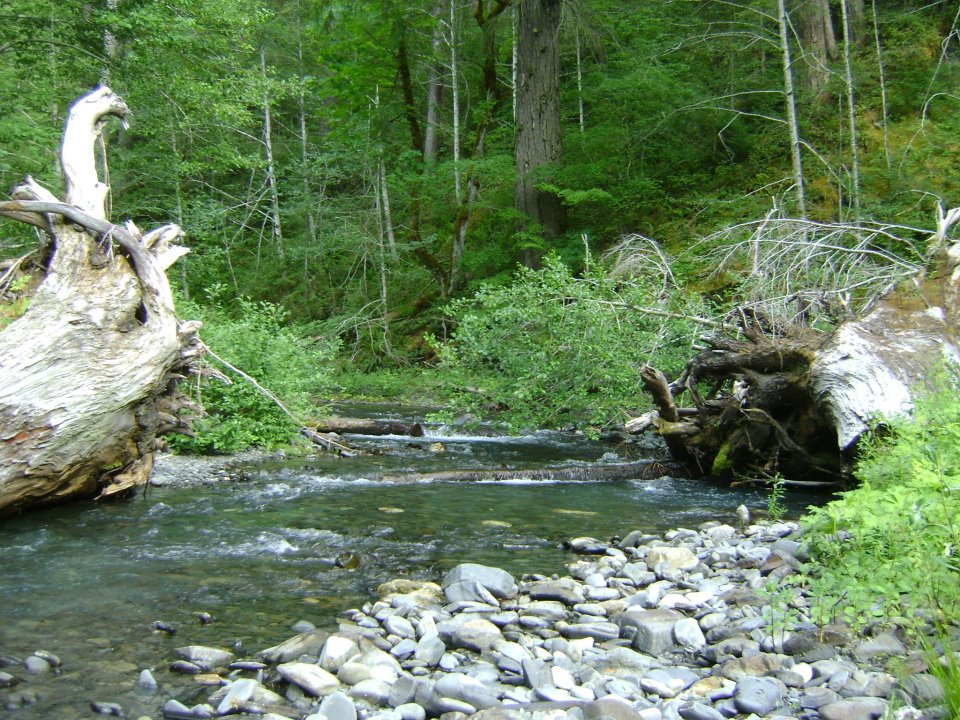
The Process: The arrow in the Perez booklet identifies the end point of the film, pointing specifically to the upper sandbar zone. Gimlin identified the crook in the creek downstream as the first sighting spot in 2003, and more decidedly this summer on site. In 2010 Perez, upon being asked to pinpoint Rene's exact mark on the map, marked this very spot. We had already ruled out all locations downstream, and focused on the upper sandbar when Gimlin arrived here. We had to try to conceive of that sandbar without the new tree growth, trying to see again what Dahinden saw in his "aerial" shot from the hillside. We realized that the big trees had to be farther toward the end of the sandbar, and that the film was shot diagonally across the apparent north orientation of the sandbar. Munns put out an animation recreating the motion of cameraman and subject within the setting, and this was instrumental in our revisualizing the site. We drew a magnetic north axis on site and found it oriented perfectly with the biggest tree there, one we'd previously thought was way too far to the "right" to be the big tree. Upon close inspection, all the other main trees were found, and in our site survey the old stumps and debris piles were amazingly still there.
PEREZ: 7) In the blog site, it is stated, "Though the proof is not officially final..." Who makes it official?
STEVE: “PROOF” cannot be had by mere photography, as the site is a totally overgrown jungle now. Each detail needed to be analyzed by itself, and put into location on our site grid map in order to be seen and understood in context. This was the real, full “Eureka” moment, when Robert finished his map. There was so much more correspondence than we’d ever imagined we’d find.
We have shared our results with Bill Munns, and he has confirmed preliminarily that we’ve gotten it correctly. We are hoping to continue this work on-site in 2012, hopefully with those who have expert knowledge in surveying, cameras and optics, not to mention geology and natural history. We have found innumerable ways in to this subject, and have had to learn much in order to be able to understand what we were seeing and finding. We are all of us amateurs, so we did our best, and at this point we are hoping that others will be able to verify our findings in a fully convincing and professional way that will leave no doubt lingering into the future.
PEREZ: 8) About how many man hours did it take to produce your quadrant map?
STEVE: Ask Robert about that one. We spent three days the first trip, myself one day and Robert two days the next trip, in the map/survey process. Robert spent countless hours working on the maps once he got back from the site.
ROBERT: Daniel--Steven, Rowdy and I had spent approximately 60 man hours of actual work time on the film site gridding the gravel bar for the map during October, 2011. This included compass work, some brush clearing, tree boring (determining ages of trees), gridding and flagging the site with north/south (Y) and east/west (X) axis points and lines, also drawing in the stumps, logs, trees, debris piles and root balls (artifacts) and double-checking our data on the ground (searching/walking/confirming/correcting). See the hourly breakdown by researcher below.
October 22 nd. 2011 total combined 22.5 hours
Robert - 7.5 hours
Steven - 7.5 hours
Rowdy - 7.5 hours
October 23 rd. 2011 total combined 22.5 hours
Robert - 7.5 hours
Steven - 7.5 hours
Rowdy - 7.5 hours
October 30th 2011 total combined 9 hours.
Robert - 5.5 hours
Steven - 3.5 hours
October 31st 2011 total combined 6 hours.
Robert - 6 hours
Approximately 6 + 9 + 22.5 + 22.5 = 60 hours of field work and another few hours transferring the data to the final map.
The lower bend and root balls at PGF site area.
Photo by Steven Streufert
PEREZ: 9) When I told Robert in 2007 I believe it was a waste of time to look for the filmsite because I thought it was all changed forever, you didn't buy into that idea. Was this the result of training as a forest ranger and schooling and general experience about the woods and longevity of trees?
STEVE: Leaving this one for Robert…
My comment: We knew that the geology and history of the Bluff Creek area could be understood. We sought to discover all we could that would bear upon the stories told about the events from 1958 to 1967 that involved Bigfoot. What we saw in the creek area were the remnants of the 1964 Flood. We then understood that the sandbar, established by that 500-year event (or whatever it was) should still be there in some form. We found no evidence of logging having been done since 1965-66 salvage work post-Flood. Hence, we refuted the things people had been saying, such as: “It’s all been washed away,” or “The trees should be stumps now.” We showed that with persistence reality may be discovered and history documented. We showed that it is idiotic to just assume things as these people did, without any clear evidence for such assumptions.
We were determined not to just say, for instance, that we knew how to get to the Los Angeles urban area. We wanted to get to Norwalk, and then to a certain address, and eventually find the spot of a specific location, like finding Daniel Perez’ house there. Many said that it could not be found, or that it did not matter; but we found many clues along the way, and it was fun playing Sherlock Holmes with these Bigfoot-related mysteries.
ROBERT: Steven covered some good stuff already. I will add to it. I find that few people have the patience to get down and get dirty in the field. Very few of us have the ability or take the time to double-check what others say about things. Sometimes we find it easier to assume the obvious and go with the flow, giving some statements credence. If three people agree it's got to be fact right? And let’s face it, we’re no longer a society of outdoorsmen and women whose very existence had depended on the ability to read the signs and predict the weather.
As a park ranger, spending time in the forest is my profession. Being able to read my surroundings can be an essential skill. Though not all park rangers live and work in forests, I do. I spend a considerable amount of time in the outdoors and have taken it upon myself to feel more comfortable in them. I have also tried to better understand my home area.
Back to the film site.... I realize a lot of change can happen on a gravel bar in 44 years, but I also realize that certain landscape features like trees, stumps and logs will take time to totally disappear. Much of that is dependent on insects, fungi, the weather, topography and other factors. Nature has its way of making sure of that. If there were once big trees, then there should be the remains of either the big trees themselves or stumps, and some stumps can hang around for a good bit of time. If the downed logs and stumps were no longer visible, then there should be debris pile remains in their place, possibly in the form of logs and stumps. Stumps last longer than most logs. Different tree species break down faster than others. As an example, alders and cottonwoods will break down faster than firs. Determining the age of trees on the floodplain could also help us see the forest despite the 40-year-old newer trees. For the most part, the positions of the artifacts (logs, stumps, trees) shouldn’t change unless they were washed away, buried or hauled away by salvage loggers. All we needed were clear pictures, a good aerial view of the P.G. Film Site (compliments of Rene Dahinden's 1971 overview) to match some artifacts, as well as patience and time. With the photographs in hand, and a little determination, we were bound to find something. As it was, we did find something... a whole lot of somethings that looked an awful lot like the Rene 1971 overview.
PEREZ: 10) The big tree, what is the present diameter and circumference of it? And is it in your opinion still the largest tree in that immediate vicinity?
STEVE: It is the largest tree in the upper sandbar area. Downstream from there we found two other trees of that huge size, but they are of course in the wrong places. Unfortunately, time and the mass of things to do somehow overwhelmed us, and we didn’t get to measure the diameter of the tree. You can see in the photo of it with me in front how large it is. I’m standing right at its base, so rough measurements of my size and the tree behind me may be made. I’d say the tree is about five feet in diameter. It is an old growth Douglas fir, of the top size found in that climate, soil and terrain, but it certainly is not the largest fir I’ve ever seen. I think it is big enough indeed to be the one seen in the film. Hopefully an optical expert like Munns with be able to tell us this with certainty, based upon our measurements.
PEREZ: 11) Was the Eureka moment derived by association of other items that made a match from 40+ years ago?
STEVE: That is explained above mostly. All the factors of history that we could find played into this. We talked to all the witnesses of the site and area that we could find, and investigated some six miles of the creek watershed. We were frankly astonished to find how much STILL remained, however much others assumed it would all be changed. I mean, stumps and big trees, yes, were there, but we also found the debris piles rotting away but still in the same places. We have over two dozen clearly identifiable matching features outlined in Robert’s comparison map done with the 1971 Dahinden “aerial” photo. And there are many more possible ID points to be found with further analyses. Even the empty spaces on the sandbar are positive data points, as it is quite unlikely up there for something NOT to grow on a spot. Hence, if there is no stump or tree over 40 years old on the site now, and the same state existed in 1967, that is another correlation and correspondence. Finding the big tree was great, but it was astounding to find the other trees along the line, one by one, and to see that their layout was a perfect match for what is seen behind the creature in the 1967 film.
PEREZ: 12) Did the two of you have a physical advantage over the Bigfoot community because you live geographically closer to the area than most others?
STEVE: Of course! For some it is a lifetime Mecca journey to get up there. For me it is an easy day trip. Hence, we were able to return again and again to answer lingering questions and to explore new information, and finally to check and re-check data.
PEREZ: 13) To Robert, are you surprised that this area, once relatively clear, is an "overgrown jungle" today?
ROBERT: You mean young temperate forest? No. We’re talking successional growth, part of the natural cycle. The flood waters gave that bend in the river a clean slate. Sunlight, nutrients, organic debris for shelter against the harsh elements, the proximity of water, all of these were factors. The new layer of sand and silt was a seed bed for the successional plants. After they established themselves, the trees were soon to follow. What we’re looking at now is a forest reestablishing itself in a prior habitat right in the middle of the P.G. Film Site.
PEREZ: 14) Do you think you ruffled feathers with discounting Murphy's location and his physical filmsite model?
STEVE: Well, when I questioned Christopher Murphy about this stuff he was always open and helpful. When I contacted him before his Sasquatch Summit presentation he listened to my points without defensiveness, and then changed his talk to reflect parts of our research. He did a very fine job in making his site model diorama, but we found it ultimately limiting as it created a predisposition to view the perspective and motion in the film wrongly. It was just a recreation of frame 352, based on Dahinden’s measurements. When we cracked our minds out of those shells we were able to look at the actual locations in new ways.
The site location found in Murphy’s books was based on only one visit there in 2003, for only a few hours, so he cannot really be blamed for getting the location wrongly. It was really pretty close, but inexact. In any case, he was getting cues from others there, so any confusion in his books or internet statements only reflects the difficulties that PGF site location research faced at that point. It is not his fault, really, and he’s been a gentleman about it… unlike many others who have acted as if this were a PERSONAL ISSUE. It is not, and it should not be. It is about facts, not egos.
PEREZ: 15) Where many of the stumps noted in the original P-G film and noted by later researchers still there?
STEVE: I’ve answered this above. We need to get someone with high-level optical photo-analysis skills and software to look at this, but from Robert’s comparison work we’ve shown, I think, a level of correspondence that goes way beyond randomness and is in the highest level of certainty. This is just eyeball work, though, done while constantly having to adjust one’s assumptions trying to approximate the true film perspective in comparison with the site map and overview hillside photo. It isn’t easy to do. As far as we can tell at this point essentially ALL of the bigger features of the film are still present there, and are to be found in more or less exactly the same position and similar condition now as they were in 1967.
PEREZ: 16) Did the woodpecker holes that Peter Byrne said where there in 1972 on the big tree something that strengthened the case for the correct site?
STEVE: Well, Byrne’s memory of how to get to the film site seems to have faded over the years since he was there and it was recognizable. We know from his photos that he was there on the right spot. He took the best photos documenting the site. But since then he has been taking people or guiding them to the spot right at the road bottom, at the bat boxes. This is wholly implausible, much like the MK Davis location, for near-total lack of corresponding features and a landscape that is totally different from that in the film itself. One thing he DID remember was the pock-marked bark of the Big Tree. This is EXACTLY what we found when we identified the tree. Apparently these are holes made by woodpeckers trying to get at bark beetles and other insects infesting the tree. This may indicate weakness in the tree, so it may be quite aged and on its way out sometime in the not too distant future.
We are going to try to get a core-bore of the tree’s rings next summer, and of course this time we will have the required two people and time enough to get a diameter and circumference measurement of it. That is the funniest aspect of this research: just as we think we’ve discovered something or the solution to some mystery, we find that a dozen new avenues of research open up requiring further investigation. Something tells me this Project is not over, and will continue on for many more years.
One thing I’d like to say here is that Bob Gimlin was RIGHT. After all the researchers had become lost and confused, Bob, who had only been there once before 2003, was able to re-identify the site. This is a real kick in the pants of those who constantly want to say that Gimlin has poor memory, or that he is confabulating. ALL ALONG THE WAY we found that Gimlin’s accounts of the locality, the scene of the filming event, and the features found down in that creekbed were essentially CORRECT.
We have to give credit to Rene Dahinden, especially, as it was his memory and research dedication that were preserved in BIGFOOT AT BLUFF CREEK. To you, too, Daniel, we are very grateful in that you actually bothered to document that recollection before the site was lost entirely to time. The clues preserved added up to enough for us to find the site again.
PEREZ: Anyway, those are my questions. Should you have additional comments, just jot them down as I would like to go to press with this soon. Best, Daniel Perez
Daniels 2007 table at the Willow Creek PGF 40th Celebration Conference.
There in the middle is Daniel's K-100 Kodak movie camera, very similar to ours.
We had NO idea that he was thinking of giving us the "Oscar" of Bigfooting at the point of this interview. Do keep in mind that this was done before we had final mathematical confirmation of the site geometry. We have that now, such that we now have absolute proof that we have found the correct location. What will follow is further measurement and hopefully more useful perspective on the film itself, and its strange, hairy subject.
*******
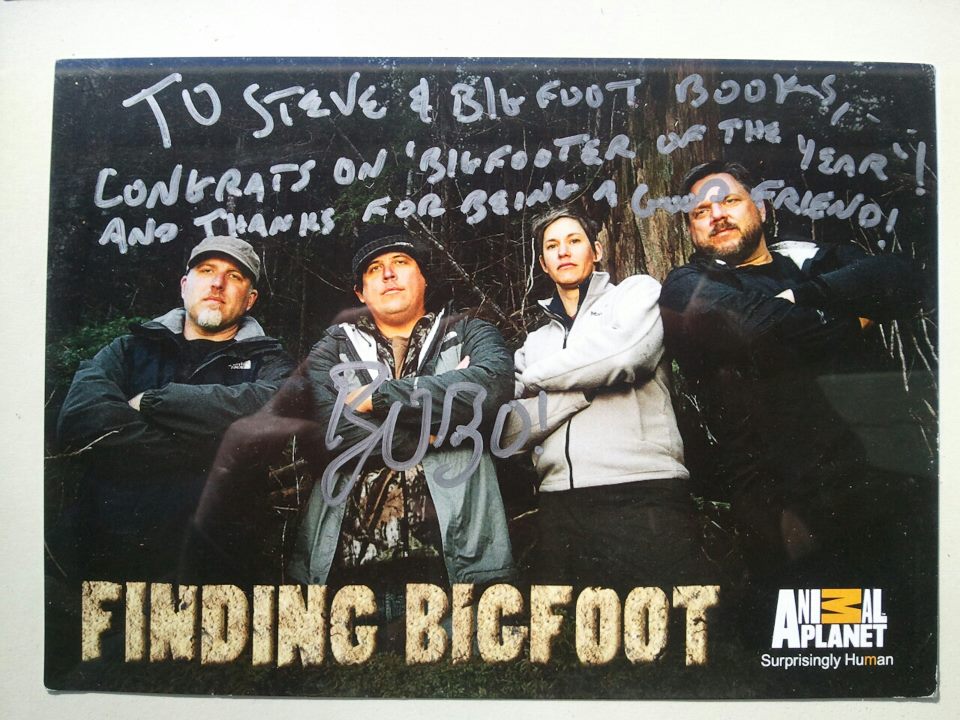
Recently Bobo, from FINDING BIGFOOT, stopped by BIGFOOT BOOKS. Though he is a friend, I couldn't resist getting him to sign a promotional card for the show for display in my shop. Here it is:
James "Bobo" Fay signed this card for Bigfoot Books.
Kids visiting the shop LOVE this thing, as they love the Bobes.
Unfortunately, Bobo was recently mauled by a Bigfoot on The Soup, but somehow survived to continue filming episodes of Season Three of the show. He is in Louisiana now, and we have word that they are heading to Australia for the Yowie, and to Southeast Asia as well. Wow! Here is the video of the attack:
And listen to a podcast episode from SAVAGE HENRY, a Humboldt humor magazine, to hear the "real" Bobo, complete with drinking games, here: Episode 10 of SHIT Talkin'.
Until next time, SEE YA!
**************************************************** ANGRY BIGFOOT SPEAKS! Me Mute.
No Me No Speak.
**************************************************** This blog is copyright and all that jazz, save for occasional small elements borrowed for "research" and information or satirical purposes only, 2007-2012, Bigfoot Books and Steven Streufert. Borrowings for non-commercial purposes will be tolerated without the revenge of Angry Bigfoot, if citation and a kindly web-link are given, preferably after contacting us and saying, Hello, like a normal person would before taking a cup of salt. No serious rip-offs of our material for vulgar commercial gain will be tolerated without major BF stomping action coming down on you, hu-man.
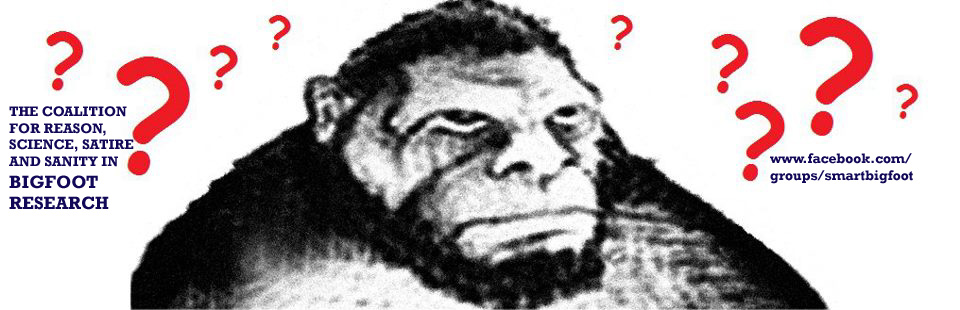
Hello all. In case you have wondered why I have not been "blogging" much lately, well, I feel you should have an explanation. Aside from a general annoyance with the state of Bigfooting these days, and a general sense of finishing something up in Bluff Creek, I've just been active elsewhere. In case you don't know about it, I'd like to invite you to check out our new discussion group on Facebook, THE COALITION FOR REASON, SCIENCE, SATIRE AND SANITY IN BIGFOOT RESEARCH. It is open to all to read and join, so long as you are a user of this popular anti-social networking site (who isn't?). If you wish to post you may simply join the group. See below for general guidelines.
This group has been VERY active, with some 400 emails coming in today, so if you don't want that happening just set your notifications for the group to "Off" and check in once in a while.
In case you haven't heard... We are "E.V.I.L.":Evidence Verified through Investigation & Logic
Introductory Message:
"This group is open to all, and seeks to promote the spirit of rational thinking and evidence-based reality orientation in a field (BIGFOOTING) gone mad with fantastical dreaming and grandiose presupposition. This is a pro-Bigfoot group open to skepticism and critical thought, so long as it is not hateful or too slanderous. This group is democratic, anarchistic to the greatest degree possible, and non-believers and fanatics are equally welcome to participate. All are encouraged to be either constructive or funny, but we ask that personal insult be saved as a last recourse. Take a stand for the compatibility of Sasquatch and Reason. Add all of your 'Squatching' friends to this group."
Our Holy Teachers:
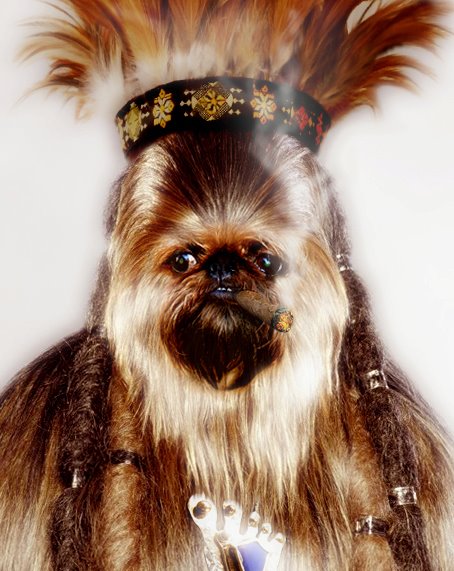
CHOWBUNGA
PROPHET HYPNO-TOAD
THE HEAT MISER SQUATCH
MINDSQUEAK PRIEST TEACHER MOUSE
SAINT RENE
A Further Message:
""We are a group that posits the unusual position in Bigfooting that one may approach the strange and unknown with reason and logic. We seek rational and evidence-based explanations for the phenomena associated with Bigfoot, and refuse to give in to the lazy paranormal option. We do not believe that fact is a matter of belief, and that truth may be known with patience, Science and reason. Reality is indifferent to belief. Sasquatch does not live in the human mind unless it is a mere myth. Evidence points to a flesh and blood animal that walks the earth, eats and leaves scat, and footprints in the physical ground. We wish to explore the possibility of Bigfoot reports and claims with an open, skeptical attitude that sees as much value in exposing false claims and bad ideas as it does in affirming a belief system based on our own experiences and potential encounters. Either a thing is real or it is not, and we seek to know the difference."
And a further Personal Statement for you:
"I stand for Sasquatch as I stand for respect for all beings. All living things have their own ways, and their own forms of sentience. I stand for their right to exist, as I also advocate that humans expand their awareness and understanding of other life forms. We are not the only beings in the universe or this planet capable of feeling, thought, self-awareness, and the experience of Being. The utilitarian viewpoint of anthropocentrism must end, as also must anthropomorphic projection of our biases, values, uses and predilections upon the living world. These are the great ethical crimes of human history.
These are the source of all our destructive impact upon other living beings and peoples of the Earth. The argument as to whether the Bigfoot are apes or humans is specious and spurious. We are part of the same family, Hominidae. We share the same tribe as chimps, the hominin. All animals, all life forms, have their own adaptations and responses to the world. These should be understood on their own terms, respected and valued. We should find ways in which we ourselves may live without devastation and destruction of the habitats and life-ways of others, be they human or other form of animal. We, humans, are animals. We are evolved from and part of what we call Nature.
This is the context which gave meaning and breadth to the lives of traditional aboriginal peoples across the world, the concept that we were all brethren, that one spirit infuses all of us, and is manifest in each creature in its own way and form. All of life, in this view and experience of the world, has meaning, value and its own truth. It is a much more rich and textured way of experiencing life than that of the modern human, isolated in cities, and so hypnotized by the products of our own culture that we do not even see the stars at night and know that we are dwelling in a massive galaxy hurtling through a universally interconnected space-time.
Not to devalue Science, as it is this wonder of humanity which taught us about these very galaxies and our own place in them; but rather, let us practice the expansion of our awareness and knowledge with a respectful and open appreciation for all things, such that they may be discovered, known, and experienced in mutual co-participation in this strange Mystery of existence. Sasquatch, as much of we know of it, and as we know so little, represents the living unknown, a being able to walk like a man but still live in the deep grandeur of natural being. Let us regard this as a guide, and a lesson, for how we may conduct our own daily lives, and the direction for our future civilization."
This blog is copyright and all that jazz, save for occasional small elements borrowed for "research" and information or satirical purposes only, 2007-2012, Bigfoot Books and Steven Streufert. Borrowings for non-commercial purposes will be tolerated without the revenge of Angry Bigfoot, if notification, credit, citation and a kindly web-link are given, preferably after contacting us and saying, Hello, like a normal person would before taking a cup of salt. No serious rip-offs of our material for vulgar commercial gain will be tolerated without major BF stomping action coming down on you, hu-man.
 BIGFOOT'S BLOG




 ANGRY BIGFOOT SPEAKS!