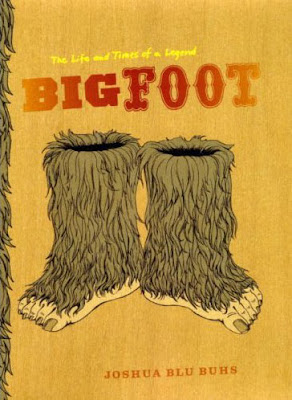
The purchase of a large collection of books on Bigfoot, Yeti and Sasquatch has led to a lengthy interview and discussion between Bigfoot Books' Steven Streufert and author,
Joshua Blu Buhs. Buhs is an independent, Ph.D.-holding scholar in the field of the History and Sociology of Science. His previous book, "
The Fire Ant Wars," is a highly regarded study in how humans interact with and form ideas of nature. Just this year he released a fascinating, deeply researched, skeptical book on the history and culture of cryptozoological hominology,
BIGFOOT: THE LIFE AND TIMES OF A LEGEND.
The book is often lumped together with another skeptical university press publication on the subject published around the same time, Michael McLeod's "
Anatomy of a Beast: Obsession and Myth on the Trail of Bigfoot." But this is unfair. Buhs book is much more distinguished a piece of scholarship, and cannot really be compared with McLeod's joking, journalistic quips and anecdotal narrative.
Personally, this reader found the book highly interesting and enjoyable, though it has caused consternation among some in the Bigfooting community. Particularly,
Dr. Jeff Meldrum wrote a scathing two-part review of the book for
Daniel Perez'
BIGFOOT TIMES (August and September issues). Meldrum brought up some important challenges that I wanted to put to the author. However, the discussion ranged more widely, from social history, to altered states of consciousness, and
epistemology and cultural
ontology.
This interview spanned the course of two weeks from September to October 2009, and went on for 20 single-spaced pages in our word processor. It is a bit of a wild ride through theory and ideas, so please bear with us to the end. We hope it's worth it!
********************************************************
DISCUSSION AND INTERVIEW WITH JOSHUA BLU BUHS:BIGFOOT BOOKS: Hello Mr. Buhs, I'd like to say I loved your book on Bigfoot. Though I do differ somewhat with the view expressed in your thesis.
JOSHUA BLU BUHS: I'm glad you liked the book; I figured some people would certainly disagree. In what ways specifically? I'm always interested to hear.
BIGFOOT BOOKS: Well, mainly, I don't think the "struggle for dignity" or respect is central to all Bigfooters. Many, myself included, are simply curious about the phenomenon, and the cultural manifestations, and the possibility of cryptid creatures actually existing. Your thesis applies pretty well, though, to a guy like Rene Dahinden.
Your book, though often maligned in the "Bigfoot Community," is really a fabulous history, the most thoroughly researched of the lot of skeptical books, and to me a work that does not suffer from the suppression of cultural critique that cripples so many books on the subject from within. Yours displayed a real interest in the subject and the evolution of "Bigfoot" as a cultural motif and historical process within the larger scope of late-frontier Western expansion, digging out amazing details that had gone unpublished before; and yet, your book does not cross the line of the books solely oriented toward debunking of the "myth." It endeavors to understand the phenomenon, if only from the angle of folklore. Hence, for me, it is intriguing and enriching. I always try to defend your book among the true believers, despite whatever disagreements I have with it.
I was really impressed with the depth of your sourcing, like getting into the local historical reading rooms, the Genzoli archives, periodicals, etc. Where many Bigfoot books tend to just tell the same stories over and over again, sourcing from one another in an often unverified chain of citation, yours actually got into primary sources from the times. I appreciate that. Some in the Bigfooting world, as with any “fringe belief group,” feel or act much as those do who are coming from within a religious matrix. It is sometimes almost an article of faith, and if one questions too much one runs the risk of becoming regarded as an apostate, heretic, sower of dissension, or even an "agent" of the "enemy" camp. As a bookseller and writer on this blog and in papers, and also participant in the BF field, I have to be careful to retain objectivity, and an open mind to all sides of issues, all while also valuing and cultivating my sources. Hence, though I may have some questions or reservations, I try not to alienate folks. My own beliefs are somewhat irrelevant to the subject at hand.
JOSHUA BLU BUHS: Thanks for your thoughtful response. I agree that the "struggle for dignity" can't explain all Bigfooters--especially those who have come to the subject in the last twenty five years or so. My intention was to understand how Bigfoot became a legend. What made the subject take off. I do not try to explain what some people have seen, or why some people might be attracted to the subject. I wanted to know what--in Hollywood terms--gave the story legs, and for that I felt I needed to look at the subject in two ways. First, what attracted those who were most instrumental in making Bigfoot a household word--Sanderson and Green and Dahinden and Patterson, among a few others--and then what role the beast served in the media at large. Obviously, some people could have read the stories about Bigfoot in the 1970s in alternative ways, but I think the framing of the stories was meant to play into that struggle for dignity and I think that the evidence suggests plenty of people did get that point. And that, I think, is why Bigfoot became a cultural icon--although you are right, the thesis does not explain everyone's interest, and perhaps I could have done more to explain the diversity of views, although the sourcing on that was pretty thin. It's just a fact that very few people left records of why they read, for example, “Nights with Sasquatch,” and none of the sourcing that I found suggested meanings beyond those I elaborated.
Along those lines, I'd like to push you a little on your suggestion that curiosity alone is explanation enough. I do not doubt that Betty Allen and John Green and Rene Dahinden were curious. But the world presents many things about which one can be curious. The question I was asking was, why did this subject, out of so many other possible ones, compel curiosity. And then I gave the best answer I could come up with that the evidence supported.
BIGFOOT BOOKS: Oh, for sure, there is power in the legend, as legend. And yes, it is heavy with connotation and underlying meaning. These motivations, too, are not always wholly understood as such by those who enter the field and halo of the BF phenomena, whether they are approaching it from "psychic" or naturalistic angles. I'm often struck by how some of the Bigfooters end up kind of looking, and acting or thinking, like Sasquatch (I know it is happening to me, too). The creature becomes a model of both ethical and philosophical, if not stylistic, dimensions. There's that classic comment found in Pyle's "Where Bigfoot Walks":
"These guys don't want to find bigfoot, they want to BE Bigfoot." I'll quote from the book:
"He's a monster, he'll eat anything, alive, dead, fresh, rotten.... He's a survivor... mobile, quick, fast, and strong.... Anybody who sees a slow Sasquatch is not in the ball park.... He's got no limits, climbs any mountain, swims any river. He's got no barriers.... Not an endangered species, that's us.... He can pull down big game on the run or by stealth, like a cougar.... He can lay down a light track or spring like a deer.... Has a lot of humor, yet restraint.... Rocks cars and cabins, but lets folks go.... We agonize, he couldn't care less.... An opportunist at the top of the food chain, in great shape--he's got it made! Adapted to cutover lands, lives a good rugged existence.... He's got no need for wages, lives off the fat of the land, and pays no taxes!" (Jim Hewkin, retired fish and game professional from Oregon)
Now THERE's a list of “manly” American virtues!
How, then, would you explain your interest in the Bigfoot? In your preface you mention an early childhood interest in the paranormal (like SO many of us!), growing up in the 1970s, but then an indifference in adolescence, and eventual adult skepticism. Was it a purely a scholarly interest, related to your underlying curiosity about how mankind relates, in the mind and in practice, to "Nature"? Or did the Sasquatch have some special "call" for you as well?
JOSHUA BLU BUHS: This is a good question, and from where I sit now, I think that there are two answers. The first, and most obvious answer, is that the subject seemed like a natural extension of the work I had done in my first book, just as I said in the preface. One of my interests is how people think about "nature." This is a subject that seems so obvious--there's natural and there's artificial--but when you look at the way people actually live, the two things get totally tangled and so where people do draw the line says a lot about them, about their social world, and how they adapt to, and rework, their own culture. Bigfoot, as a subject--whether true or not--rides one of those lines, between human and animal, which sometimes gets confused with the line between natural and artificial so it seemed like a good topic.
Plus, as far as I could tell, no other scholar was working on the subject from this direction. Pretty much all previous books--there are exceptions, but they are portions of books, not entire studies--have dealt with the issue of whether Bigfoot exists or not. I wanted to ask different questions, and it seemed like a ripe area for exploration.
As I have worked on this subject, and moved on to my next project, a history of the Forteans, I came to realize, though, that there was a second reason I was drawn to Bigfoot. I am fascinated by what might loosely be grouped as Forteana--as experiences people have that don't seem to fit into consensual reality as it is usually described. The Bigfoot book didn't really afford me a chance to write about the experiences of a lot of eyewitnesses, but I do like thinking about that, wondering about how we decide to make reality, and what these outre experiences might say about that process. And, monsters are just kind of cool.
BIGFOOT BOOKS: Could you explain your academic and scholarly background? I note that you specialize in the History of Science, and have written the fine book, "Fire Ant Wars." This might lead into answering the criticisms raised by Jeff Meldrum in his recent review of your book in the newsletter, BIGFOOT TIMES.
JOSHUA BLU BUHS: I received a Bachelor's in science from UC Davis for zoology, and minored in history. I found that I did not like lab work, so much, and was really drawn to a series of classes I was taking for my minor on the history of science. What intrigued me was seeing how scientific ideas fit into the culture at large, how they grew and changed. My professor in that class had done his graduate work at the University of Pennsylvania, and through him I attended that school, too, where I received a Master's and Doctorate in what there is called "The History and Sociology of Science."
That's a mouthful, but it's not so complicated. What I do is look at science as one of many social practices--like, say, religion, or art, or labor, science has a social structure. There are insiders and outsiders, rules for playing the game, institutions and funding and demography organizes the way science is done, the problems that are taken up, the methods that are used, and the way knowledge is made and communicated.
My first book looked at the way knowledge about imported fire ants was made--were they terrible pests or benign migrants?--and how that knowledge was then marshaled to justify various approaches to dealing with the insects--should we kill them all, at any expense, or leave them be?
A similar methodology underwrote my interest in Bigfoot. I wanted to know how knowledge about Bigfoot was constructed. Although reports of the beast may date back centuries, they really weren't collected and disseminated until the middle of the twentieth century. Why?, I ask. And, Why did this knowledge then become so interesting to a large swath of the country? There's no particular reason that Bigfoot should have become, in the words of Daniel Cohen's book, America's Number One Monster. There had to be a sociocultural machine that organized information about the monster, brought it to the attention of the mass media, and then helped to disseminate it.
It's true that in the course of the book I sometimes evaluate the quality of the evidence that is presented. But this is not the main focus of the book. As I say above, I don't really spend a lot of time going over all the various sightings. My attention is on those bits of evidence that became classic, standards, that shaped the general view of Bigfoot. And, in those cases, I think it's my duty as a scholar to explain how good the evidence is. In the end, though, my interest is in how all of that evidence--good, bad, and ugly--came together in the image of the monster we have now, an image so uniquitous that all one needs to do is show a footprint to get the audience to think of Bigfoot, so ubiquitous the beast could be used in commercials without any explanation. Bigfoot has gone from something few people know about to a bit of conventional wisdom. Tracing that path is interesting, I think, and in the process of doing so--to switch metaphors: in the process of describing the cultural machine that built our image of the monster--we can't help but learn something about our own culture.
BIGFOOT BOOKS: Though it is undeniable that Bigfoot IS a "legend" (at least in one view), and functions mythically on many levels in the culture, how does one address the sightings, footprints, hair and other forms of evidence that it actually exists? How do you, as well, think about perfectly normal, honest and reliable people who actually SEE this thing?
JOSHUA BLU BUHS: This is the $64,000 question, isn't it? As I say, my book doesn't really cover this ground, because I am not really sure--certainly not sure enough to say so in a book. But I guess I'm willing to speculate on a blog.
Let me say up front, I do not think that everyone who claims to have seen a Bigfoot is loopy or drunk or crazy. I think many--maybe most, I don't know enough to say--are honest people reporting an honest experience. Some, I think, have been hoaxed. I suspect that the number of hoaxes out there is greater than those who accept the existence of Bigfoot think, in part because I think Bigfooters underestimate the many, many reasons people may have for hoaxing. Some, I think, are mis-identifications. I tell the story in my book about a sighting that John Green investigated. A bunch of people swore that they saw a huge beast along the road that could run at superhuman speeds. It turned out that the Bigfoot was a kid in a hat standing alongside the road. Now, that doesn't mean that any of the witnesses were crazy or liars. Just that we can't always trust our eyes.
Now I'm going to get more speculative. Have you ever read “The Terror That Comes in the Night” by David Hufford? It's a fascinating book. Hufford's a doctor and folklorist who became interested in Old Hag legends--these were stories of people who woke up in the middle of the night, completely paralyzed, and certain that they were in the presence of some creature--a creature that sometimes sat upon them. Such stories had been known for a long time, and usually dismissed. Hufford did not dismiss them. He took the experiences seriously, and suggested that there might be an underlying physiological phenomena going on, a little known and unstudied part of the sleep cycle. The legend of the Old Hag, he argued, gave language for people to talk about this (real!) experience that otherwise went undiscussed. I wonder if something like this doesn't account for some of the Bigfoot sightings: people have some uncanny experience, and stories about Bigfoot give us the vocabulary to discuss such events.
Finally, there's a small group of anthropologists who are starting to study ritual not just as reinforcing a society's culture, but as real experience: that is to say, they look at, for example, a witch doctor ritual and don't just try to find how a culture's ideas about health and the body (for instance) are acted out, but ask what the people involved are actually experiencing. This kind of study is not done often, so the field is in its infancy, but at this point some are arguing that there are just different, maybe incompatible ways of seeing the world, and that it is possible to slip between these different modes of seeing. Perhaps, again, something like this accounts for some of the Bigfoot sightings. That people are just seeing the world in a way that others cannot. It doesn't mean they are crazy or even that what they are seeing is not there. Just that they are seeing a part of reality most of us cannot see. As I say, this is very, very speculative, and I wouldn't put much money down on it, but it is a hypothesis worth chewing on, I think.
BIGFOOT BOOKS: You've raised some VERY interesting issues. From your ultimately doctoral level background in Zoology, Science, History and Sociology, I'd say that you are qualified to comment on the evidence that Dr. Meldrum mentions, as well as the scientific process and method; though, of course, you are not a practicing primate anatomist, nor, admittedly, did you really seek to look deeply into that aspect of the phenomenon. First, as regards Science and "Nature," you mention that these are essentially sociological, cultural constructions. While Science is basically a field of techne, operating from within cultured-ness and historical and social contingencies, striving at once for some kind of practicality and universality, what we call Nature is both the given world of biology, physics and chemistry, but also our IDEAS about the natural world, and hence, naturally, our cognition about ourselves, and how we fit into it or how we do not. Self, as in identity, culture, and yes, our science itself, are productions, artifactual things; but there IS a natural world/universe, outside of our ideas of it.
Bigfoot, as a legend, tells us perhaps more about humanity than it does about the natural world, especially as we have not, as yet, been able to prove to that "consensus reality" that the creature exists. Then again, what if there IS such a creature? If the latter, then there are two Wildman realities, the one in our minds which represents something of the world to us and ourselves to ourselves, BUT ALSO the creature itself, existing independently of us. Hence, there are the images we create, from beef jerky ads to monster slasher erotic abduction films and novels, but there may also be a living animal as its basis. And, by extension, just as humans live separately from a purely natural existence, so too does nature exist independently from us. We all know that “Harry and the Hendersons” is a fantasy, reflecting suburban middle class anxieties and moral aspirations; and yes we know, too, that there have been confabulations and hoaxes of Bigfoot evidence; but based upon the anecdotal history there could perhaps be something underlying these productions. Just as the real natural and physical world underlies and subsumes us, just as in modern Physics there is a discovered and theorized universe that completely eludes not only our consensus reality but also our physical senses, could there not be a creature clever and elusive enough to evade not only our zoology but also our ideas about it?
In my shop in Willow Creek I am constantly astonished at the number of claimed sightings in this area. Everyday people see the creature eating berries in their yards, walking beside or across a road, in the woods standing up and walking as no bear can. These are not people asleep, on drugs, hallucinating nor even seeking attention, or the experience of a Bigfoot sighting; rather, they are ordinary folks, often quite reluctant to admit what has happened to them. And then there are the Native American people of various area tribal affiliations. They have a long tradition of this creature (and/or “spirit being,” as many have pointed out to me) predating any contact with Western European culture, let alone modern mass media. They did not have the great gulf of separation that the Europeans did, but neither were they perfectly integrated with the Natural. They, as humans, had (have) ideas about themselves and their world. But what they did not have was the same anxiety about The Wild that caused the European invaders to call them "savages." They did not, hence, have the same need and motivation to create the mythic man-beast; and yet, there it is, a more or less consistent image and cultural function.
I've said this so many times, but: Santa Claus is a legend, as is Paul Bunyan; but one does not find people SEEING Santa, for the most part, save as a cultural representation on TV or in a mall; and one does not find the footprints of Babe the Blue Ox out in the woods. Yes, I have studied to some degree the idea of the Incubus or Succubus (or “old hag”). Actually, the motif has had somewhat of a resurgence in the UFO field, and it has been suggested that sleep paralysis and some form of lucid dreaming may account for some of this. Also, in the work of Dr. Strassman of UNM, using the psychedelic DMT, similarities have been found wherein subjects fully consciously, but in a state comparable to dreaming on a higher plane of reality, have encountered strange “alien” beings, spirit teachers, machine elves, or whatever other things. These have a large cross-cultural relation to the shamanic states of trance and vision, and “contact,” present universally in the first nations and aboriginal cultures, many still functioning today, as with the ayahuasca cults of South America. In fact, Bigfoot/Sasquatch IS one of these beings, as many a tribal member has declared, living not exactly in the same world as we, but capable of leaving footprints and hurling stones. Science itself has had to admit that the world is larger than our cultural predilections, and mystical traditions indicate a universality of basic form to descents into the "underworld" or "ascents" to higher states of consciousness. STILL, what does one make of the fellow driving along with his family on a perfectly ordinary day who has a sighting of a Sasquatch, one that is confirmed by his entire family? Frankly, it bends the imagination to try to configure this as some kind of group trance or mutual delusion. Occam's Razor. As Bigfoot apparently lives in the mundane world, shits in the woods, and is seen fairly frequently just like any other animal, does this not suggest that it has an identity both IN myth and SEPARATE from it? Shamans may indeed be experiencing the world more as it ACTUALLY is, more comprehensively (as in the Buddhist notion of the world of Maya versus Actuality), yet we judge them as witch doctors. And Bigfoot may actually be a living creature: new species are discovered by the hundreds by actual professional zoologists every year.
I know I'm being long-winded, and not exactly asking a straightforward question, but I'll try to be concise now. I know there are hoaxes, but I tend increasingly to believe in this creature, living out here. Many locals laugh at the idea, and some of the old-timers will tell tales of hoaxes that they have witnessed or perpetrated. Looking at the cover of Philip Wylie's "Bigfoot" I see a footprint that looks exactly like one of Ray Wallace's wooden stompers; and there is another right in the centerfold of one of John Green's books. BUT, however fine the cultural analysis of your book, can you not also concede that there may be something to all of this? Along with nuts and con men like Tom Biscardi with his Georgia Gorilla, and other lunacies, could not groups like the BFRO, though not strictly practicing the methodical scientific method, really be onto something that could in fact someday be verified by science?
Much of this is reminding me of Carl Jung's ideas of UFOs as modern archetypes, projections of our post-nuclear technological paranoias and aspirations. Yet, any sensible person will admit that there COULD really be aliens observing and visiting us, despite all the silly movies. Jung is quite oblique about the actuality (or not) of UFOs, choosing rather to study the function of the IDEA of them. Is this what you were up to in your book? And surely, in that we ALL, regardless of class, watch the same films and television, live in the pop-cultural post-modern matrix of near-virtual cultural co-option and subduction, are not the old cliches of Bubba in his trailer-home seeing Bigfoot with Biscardi... obviated? Is this not the perfect time for Bigfoot to walk right out of the myth and shock us all?
JOSHUA BLU BUHS: Certainly it's possible that Bigfoot exists. I said in the book that I don't think so--based on my review of the evidence--because it's necessary to lay your cards on the table in a book like that. If I had said nothing about my opinions, I would have been in trouble for that, and rightly so. I'd be more than happy to be wrong on this matter--it'd be really interesting if someone finally dragged a Bigfoot in.
But, I think that the frequent sightings actually cut against the case for Bigfoot. If the beast is seen so often, the question has to be, then why hasn't it been caught yet, or run down by a truck crossing a highway? One can argue that Bigfoot is especially skilled at avoiding capture--but, if that's the case, why is it seen so often? That would imply it's not so good at avoiding detection.
My best guess, in these cases--and it is only a hypothesis--is that the many Bigfoots being seen are mis-identifications. I am not saying that the eyewitnesses are liars or hoaxsters--although some may be--but that they just didn't see what they thought they saw. And there's no shame in that. Psychological and legal research has shown, repeatedly, that eyewitnesses are often wrong, that memories, later questions, and preconceived ideas alter what we think we saw. And that's true for everyone, me too.
As for why the reports of the beast are so similar, I have two answers. One is that, over long stretches of time, they actually aren't that similar. When you look back at a lot of the reports from the early part of the century--with the Canadian Sasquatch, Albert Ostman's kidnapping beasts, and the wildman in "The Hermit of the Siskiyous"--the creatures are much more human-like than they are described today. Often, they are not completely covered in hair. They sometimes speak--in their own language or English. After the work of John Green, especially, this image of Bigfoot was replaced by one much more apelike--completely covered in hair, without language or technology. And so we get John Bindernagle, for example, combing through reports and comparing them to known behaviors of great apes.
The second answer seems to contradict the first, but it doesn't. I say, of course the reports are similar. But that's because the reports one hears today are coming from people who live in a shared culture, in which the image of the beast has been stereotyped, through the Patterson-Gimlin film, Harry and the Hendersons, and Jack's Links commercials. Certainly, there are some differences between these representations, but they all agree that Bigfoot is bestial, fur-covered, and more apish than human (that's not a technical definition, but you get my point). Everyone knows what Bigfoot is, and so we all share a vocabulary for describing it. So even if what we really see is a a couple of kids on the side of a road wearing a hat and think we saw Bigfoot, when we put that experience into words, we're going to use a small set that has been culturally designed for just such an experience. In this case, then, there's no need for hypnogogic experiences or alternate states of consciousness, only the normal vagaries of eyewitness testimony coupled with a culturally specific language.
One final point, you contrast Bigfoot with other legendary figures, Santa Claus and Paul Bunyan, and note that people often report seeing Bigfoot but no one ever reports seeing Santa Claus--at least no one over the age of six. That's true. But I think what that misses is that part of the legend of Bigfoot is that it exists. That's not true of Santa Claus, or Paul Bunyan, or Babe the Blue Ox. There's no expectation, subtle or not, that one will ever see those. But, part of the vocabulary used to discuss Bigfoot is the possibility of existence. It is not possible to sensibly use American English to describe one's actual encounter with Paul Bunyan, except as fiction. It is possible to do that with Bigfoot. Similarly, one can talk of seeing a flying saucer, but one cannot speak of seeing Pegasus.
A little technical language might be helpful here. We've been using the term "legend" loosely here. But folklorists use it in a more precise way. For them, legend is a "proposition for belief." A legend is a story that may or may not be true (and, usually, folklorists don't care one way or another.) Thus, there are legends of mice being found in Coca-Cola products--stories told about a friend-of-a-friend who found somesuch. Gary Alan Fine, a folklorist, discovered that there actually were such things! Legal cases in which people had sued for buying contaminated soda. That doesn't mean, however, that these stories stopped being legends. They still were, because they were still stories told that offered the possibility of belief (or disbelief).
Tales of Santa Claus and Paul Bunyan, then, don't really fit into the genre of legends. They might better be understood as Marchen, or fairy tales, which are stories that are undoubtedly fiction but used to convey some of the culture's mores. After age ten, everyone knows Santa Claus isn't real, but the stories are still important because they teach about charity and love, which--at least at certain times of the year--our society values and wants instilled.
BIGFOOT BOOKS: So, it is kind of like the unknown being approximated to the known, the mind making sense of obscurity with familiar memes and motifs? Certainly, people believe in, and often believe they have experienced, things that are strictly "counterfactual" from the point of view of empirical science and normative culture. God, the living Jesus, and Angels are among these, it must be admitted—they may be true in some way, but we cannot prove them; and they go against empirical evidence. One need only tune in to the Art Bell Show to get a sense of this, how so many strange and varied things are talked about that a certain majority of them could not possibly be true. (But it is an intriguing and viral entertainment!) The world would be a far too phantasmagoric carnival if it were so; but non-imaginative life generally is fairly mundane. And this is how Bigfoot differs from theories of alien psychic contact, the Illuminati, ghosts and shadow people, vampires, Atlantis, and other Fortean stipulations: the thing IS so mundane, naturalistic, legendary or not. It is a thing that emerges fairly plausibly from the natural world; and if it is a legend, it is one that derives not from paranormal or supernatural areas, but from our ideas about nature and the zoological, biological world. If Bigfoot has a message it is the one of warning that the Native American Rugaru creature appearing in Peter Matthiessen's "In the Spirit of Crazy Horse" has: that we are too lost in our modern and unnatural culture and distractions and rampant destructive consumption. And just because there is the common, usually humorous image of the beast in commercials and bad movies, one cannot necessarily assume that these media images came FIRST, before the thing upon which it could be based. Right?
Yes, there has been great variation of the wildman theme over time, and the ape-like variation has risen to prominence since the modern primatology of Jane Goodall, Dian Fossey, and yes, John Green. But one can see a similar process in the representation of apes. Earlier ones are more man-like, evolving from a caveman-like image, until finally being understood within their real habitat, physiognomy and behavior. Early depictions of the natives of the New World were equally beastly and inaccurate, reflecting no real anthropological appreciation, but rather the projected idea (and fear) of “The Savage.” Based upon your own statements about familiar cultural understandings being projected upon the natural world, could this not be the process at base in the understanding of the Bigfoot, assuming, that is, that it is not purely legendary, and that the images could have been constructed from actual encounters? Slowly, we understand the subject, and it becomes less the stereotype from exploitative b-movies, more like a living animal.
Misidentification and the projection of the DESIRE to see a Bigfoot surely are at process in many cases. I myself have seen "Bigfoots" in situations like, say, having driven at night for 12 hours, and suddenly out of the blear I see something that looks like a man-beast. Obviously, my tired brain constructed that one. And then, what do you think of the "blobsquatch" phenomenon? People take pictures of the woods and then later "see," in the shadows and ambiguous forms of leaves and branches and stumps, something that suddenly looks like a face, hulking shoulders, a brown, hominoid shape. One "Bigfoot sighting" was even had on Google Earth. This phenomenon is known to us all, as the mind is preprogrammed to make sense of abstraction, facial recognition is one of the first abilities an infant has: just stare at the patterns of wood grain in your wall paneling, and shapes, faces, maybe even demons and Bigfoots will emerge. There is the tendency, too, to go into the woods and interpret everything that goes bump or hoot in the night as Sasquatch activity. There is the phenomenon known in the field as "squatch-on-the-brain," wherein one's desire to see the creature manifests as projection outward onto the world. Everything becomes squatchy. One might ask, though, why do so many see the Bigfoot-type creature, and not, say, hobbits, elves or trolls?
However obvious and plausible the explanation of misidentification is, it seems even more implausible to assume that ALL cases, everywhere, are of this sort. That would imply a greater consistency than the seemingly random association and mental leap to interpretation would imply. I mean, yes, it is recognized that several witnesses to a crime or a car accident will give widely differing or even contradictory reports; but, there is still the crime, or the accident, left there on the street. If someone saw a bear and thought it a Bigfoot, how does one explain that it walked off bipedally for some distance? However many hoaxes, and however fun it is to create hoaxes, that theory too seems a great overstepping: for all of these hoaxes to be effective and discovered one would have to assume that there are more hoaxes perpetrated than those actually discovered or seen. There are a WHOLE LOT of footprints found, strange and unknown activities in the night, and sightings that suggest more than a man in a monkey suit, let alone some kids wearing hats by the side of a road. Surely, of all the chances to see something clearly, SOMEONE in that lot must have simply seen WHAT WAS THERE, and interpreted their visual data correctly. No?
And this, what do you make of the development of the bigfooting world since the historical main parameters of your book? The internet, combined with modern technologies of observation, recording and reporting, have spanned geography and enabled a higher degree of sophistication in the field. Sophisticated bigfooting groups have popped up in most geographical areas of the USA. It is not just the trailer-dwelling Bubbas of the lower-class cliche, the ones Tom Biscardi still exploits; but it is an increasingly middle-class, well educated, highly informed lot out there in the woods, looking. Matt Moneymaker, founder of the BFRO, for instance, has a Juris Doctor degree. Most of these people have families and responsible, professional jobs. They live in suburbia. Had you sought to do so in your book, how would your thesis have extended into the current day?
JOSHUA BLU BUHS: About seven, eight years ago, there was a rash of reports that (some) cans of Pepsi had syringes in them. The claims came from across the country, the people involved from different walks of life and seemingly unconnected except by their weird experience. The stories made sense in light of American interest in contaminated foodstuffs--this dates back, at least, to Upton Sinclair's “The Jungle”; it includes, as discussed above, a number of actual lawsuits about mice in Coke bottles; and could include, as well, the poisoned Tylenol scare of the 1980s. In other words, there was a good reason to believe these people. As it turned out, though, they were hoaxes, every last one. Sometimes, when there is smoke, there really is fire. And sometimes there's melting dry ice or smog or fog.
No doubt, there is a lot of different evidence supporting the existence of Bigfoot. My opinion is this, the parts of evidence that have been looked at closely is either inconclusive or no good; that most of the rest of the evidence doesn't amount to much.
And then, when you look at the problem from the other side of the telescope, I--personally--think it becomes too hard to sustain the claim that Bigfoot exists. Other people evaluate the evidence differently, which is fine. I'm not trying to throw stones, just putting out there what I think and why I think it. And the other side of the telescope is that, although there have been reports of Bigfoot-like creatures in the Pacific Northwest made by Europeans and their descendants that date back to the early part of the nineteenth century, although reports by Native Americans seem to tell of an oral history that dates back even farther, despite that there have been reports in every state except Rhode Island--last time I checked, anyway; things may have changed recently--the evidence brought out in support of Bigfoot continues to be so weak, or ambiguous, at best. I find it unlikely in the extreme that a population of several hundred--at the very least--apes (and likely more than that if the species' range does extend from, say, northern British Columbia to Fort Bragg), has gone so long without a dead one being found or a live one being captured or killed. If you do want to think of Bigfoot in terms of an ape, then why is it so hard to find? Yes, gorillas weren't discovered (by Europeans) until the middle of the nineteenth century, but they were found, and are regularly seen (and regularly killed by poachers). But, Bigfoot lives in a region that is overrun by people, and has been for a long time. Encounters with other large animals--bears and cougars and coyotes--have increased in the last few decades since Westerners have increasingly moved into exurbs. But still, no Bigfoot. It's hard to believe that Bigfoot wouldn't regularly raid dumps or garbages for food. It's hard to believe they would never get run down on the side of the road. One could argue that they are especially cautious, but then, they do leave all this other evidence that people find--tracks and fur--and are seen, as you point out, frequently.
I think another part of your argument also works against you: that is the recent turn to more sensitive tracking and recording devices and that searchers are now increasingly from a more middle class background (and also include a lot more women than before). This should mean that the likelihood of capturing a Bigfoot, or at least bringing in undeniable evidence, has increased. Certainly, none of these outfits are fully-sponsored scientific expeditions. But they do have means. And still, the evidence that has been collected, as far as I can tell, is really no better in quality than the evidence collected fifty years ago by John Green and Rene Dahinden. Tracks, weird noises, unidentifiable fur, fuzzy pictures. I think that BFRO's proclamations of just how scientific, rigorous, and large are their researches actually hurt it somewhat--John Green made an argument along these lines about other groups, back in the 1970s. If the group is as well-funded and knowledgeable as Matt Moneymaker says--and I can't say one way or another, never having really looked into its operations--and there is still no Bigfoot body, no colony under investigation that can be followed by primatologists and other scientists, then isn't the obvious conclusion that there is nothing to see? I think so.
But, as you suggest at the end, this activity is interesting in its own right, whether Bigfoot exists in fact or not. I would suggest there are two reasons for this change in Bigfooting. The first one, which I mentioned briefly at the end of the book, is because our image of Bigfoot has changed. It's still possible to imagine Bigfoot as a rampaging monster--look at "Sasquatch Mountain," for example--but I also think there's a strong tendency to see Bigfoot the way we now see other apes--as a gentle giant. The creature is not one that needs to be shot, killed, and stuffed for a museum diorama, but understood and (if possible) communicated with. This change opens the door for more women and middle-class men to become involved with the beast: because these groups are stereotyped as more communicative and sensitive than the working-class hunter. You saw a similar change in who was authorized to work with other apes, when their image went from fearful monsters to shy creatures: that's when you got Dian Fossey and Jane Goodall and Birute Gladikiss and you saw the earlier hunter/explorers such as Paul Du Chaillu discredited.
The other reason that Bigfooting has come to draw, increasingly, middle class and female participants, I would argue, is because of the evolution of mass culture and consumerism. Mass culture has--paradoxically, given its name--helped to differentiate and divide us. It caters now to niches and segments and certain demographics, and provides those groups with what they want. Mass culture encourages pluralism--and so it is (more) acceptable to go out hunting for Bigfoot. It's another hobby, weird, perhaps, but now there are millions of such things to do. The explosion of cable television channels, I think, captures the phenomenon well. Some people are interested in refurbishing their house; some like old game shows; others are fascinated by the lives of the Kardashians; and some go out monster hunting. To be sure, nobody can be pegged by just one channel--we all surf and have many interests. But it's increasingly acceptable to have what were before seen as freaky or outlandish hobbies. "Yeah, Bob in accounting hunts Bigfoot." "Cool, Sue believes in ghosts."
Of course, there is still a stigma attached--I don't want to underestimate that--but it has decreased, I would suggest, over the years. And there's still some of the old associations, with being the Great White hunter and making contact with the near-human species. It is notable, for example, that vanishingly few Bigfoot hunters--I can think of none, although I suppose there are some--are black. In the stories we Americans tell ourselves, blacks are never the Great White (!) Hunter. And it's dangerous for blacks to become involved in research on animals that are nearly human--the racist connections between blacks and apes still carry too much weight in our society. It is also notable that few hunters are Asian or Native American--especially the latter, given how often the existence of Bigfoot is argued on the basis of Native American tales. The image of the Bigfooter is changing, as you suggest, becoming more feminine and more middle class, but the stereotypical seeker is still white.
None of which bears on the actual existence of Bigfoot. To return to a point I made much earlier, as a historian and sociologist of science, I am interested in the social structure of science, the organization, institutions, and cultures that shape scientific work. In our culture, a culture that places high value on gender and race--and much less on class--it is no surprise that these are factors in the social organization of Bigfooting.
BIGFOOT BOOKS: You are saying, then, that Bigfoot is essentially an urban legend? I wouldn't argue with the obvious fact that there is a whole lot of that in the cultural phenomenon of Sasquatchery. However, when one analyzes something that is (could be?) non-cultural, an external fact, then one cannot assume that looking over cultural representations will necessarily reveal the thing itself. In fact, it is misconceptions-from-bias such as these that perpetuated the flat-Earth and geocentric world views, not to mention those such as ideas of racial inferiority. From within one's cultural matrix it SEEMS obvious, let's say, that the Earth is flat—just look at it from a human-scale ground level view. But it is not flat. And the sun does seem to revolve around the Earth; but it was the Christian bias against the idea that kept that notion going far beyond the point where the knowledge of a spherical planet was reasonably established in Classical times. Similarly, from within consensus human culture, Bigfoot seems absurd. I mean, how could that Jack Links creature, or Harry, really exist? It is a matter of looking at the thing from the outside, from human alienation and anthropocentrism, inward. I'd argue that this is one of the fallacious assumptions of Sociology. Not everything is human-centered, not anthropogenic; and science (such as Physics) proves it. Wouldn't you agree?
One must really get into the epistemological: How do we know? I'd argue that before culture-based survival modalities, and the higher-brain functioning that has allowed humans to become the planet's dominant species (at least for now, until some virus gets us), there was the perceptual apparatus. I mean, it is primary in animal survival that the senses function accurately. We know the world first through senses, and then through culture and internalized ideas and biases of self. Our ability to tell a deer from a bear (or perhaps a bear from a Sasquatch), was obviously a crucial aspect of our species' survival. Why would we be so prone to these mis-perceptions you speak of if even a simple caveman could know when to run from a saber-toothed cat? And, on the other hand, why couldn't a Sasquatch, highly-attuned, evolutionarily skilled, and greatly motivated, manage to stay away from us?
Where you are looking, it seems, is mainly from the cultural view inward, toward the phenomenon. That's fine. But whether the thing studied is a real creature or an aspect of the myth-generating mind, I feel, personally, that I am living within an ongoing zone of Bigfoot activity. I mean, this is how it seems based upon the constancy of reportage of the creature. I came here skeptical, but have found an open mind provides an interesting entrance into a possibly hidden, or culturally forbidden zone of knowledge. I know, you're going to say that the culture is alive in their minds, inclining them to believe they saw such a thing. But I have to say—even though we see Bigfoot every day in Willow Creek, through statuary and commercial art, and yes, these folks do have satellite TV—that these people really do seem to be reasonable and sane, and are describing things that are everyday and normal to them in their rural, mountainous habitat. In a city or suburb, driving on freeways and sitting in large office buildings, surrounded by equally urbanized humanity, I don't think people would have the same experience. Out here folks are rooted more in the raw or primal things, and damn well know when they've seen a bear, or not. I'd ask you, is everything social, cultural? Or can there (still!) be some kind of real and natural experience of the world that is not... conditioned?
Willow Creek and its mostly wilderness environs, much like the culture of Bigfooting, is a micro-culture. Here folks are in active rebellion against the modern, “outside” world. I've lived here in Humboldt for 17 years, and folks here in the hills still consider me a “city boy.” Within the mass cultural milieu that generates vicarious experience programming such as MonsterQuest, there are these distinct groups, Trekkie, Ghost Hunters, or whatever, that I'd say have begun to establish their own rules, their own specialized expertise, and in many ways, a new “tribalism” of sub-culture. The BFRO, for instance, are a kind of clan, but they are linked up to the modern world of technology and hyper-media. They are not an institution as one finds in academic Science; but they DO have technical means, and they have rigid systems of scrutiny that differentiate the massive body of the reports they have in their full, private database from the ones investigated and determined to be reliable, and then released to the public web site. From the outside they may seem to be conducting a quixotic pursuit; but from within the BFRO, within the larger circle of the Bigfooting culture group, there is ample solidity and confirmation. NOT just from each other, but also based on what IS arguably good evidence. I mean, what does one make of a hair that is tested “unknown primate”? What OTHER primate that is not “known” exists in North America besides the Sasquatch? Isn't this logical proof, at least, if not biological? OK, yes, there could have been laboratory errors. But from the inside, in the stuff that does not always make the media like that stupid Georgia Gorilla case, there is a constant and fascinating stream of thermal images, game-camera photos, footprint finds, and stuff such as the Skookum Cast. The creature, if real, may just be really, really good at evading us humans, and perhaps it doesn't really need our garbage for food, nor our roads for transit. There is ample wild space out here that veritably dwarfs the areas of human occupation and daily activity. But OK, you've already admitted that Bigfoot COULD exist; it just hasn't been proven to you.
Now, in your review of the reporting and history of Bigfoot, within your declared range, you have been really rather extensive and thorough. But, as Jeff Meldrum points out, and you yourself have admitted, you don't really attempt to analyze the quality of the evidence, nor really the actual details of report narratives. Sure, some of these are obviously fake, some tell more about the teller than the told-about (just look at something like Lapseritis' “Psychic Sasquatch”!). But other report themes or spoor seem to be evidence that is possibly of a higher quality than your analysis has admitted. How would you respond, then, to Dr. Meldrum's critique as found in his review in The Bigfoot Times? I mean, to potentially insulting statements such as this?:
“
This book... lays bare the feigned rationale for the irrational, seemingly visceral rejection of something perceived through ignorant superficiality as unorthodox. To that end it is an enlightening, albeit frustrating, read for anyone serious about understanding all sides of this subject. Its smug dismissal of any and all evidence—evidence that continues to engage those experts with the combination of open mind and the qualifications to offer an authoritative assessment of the data—silently, by omission, attests to the merits of that evidence. By dismissing it out of hand from the very outset, the author is under no obligation to engage or account for the vexingly persistent evidence, or to undertake to offer on that basis a substantive counter to the conclusions of those more qualified in such matters than he.” (Bigfoot Times, September 2009)
JOHSUA BLU BUHS: Wow. OK, there's a lot of different topics here. I'm not sure where to start. Let me try it this way: Yes, there is a reality beyond our perception, a real world that really exists. But, we always come to that world looking through our culture: our culture gives us the means and methods for investigating the world, and the ways of thinking about what we do find. I don't doubt that the moon exists, or that it's movements can be described by Newtonian mechanics. But that we want to understand the mathematical movements of Earth's satellite is a very cultural thing--after all, many, many cultures did not bother to ask such questions.
So, I guess what I would say is that we can no nothing interesting outside of culture. There are what are called "brute facts," things that cannot help but impress us, regardless of our sociocultural position--that the moon exists might be one, for example, we see it in the night sky--but most of the high-falutin' concepts we are discussing--does Bigfoot exist, is it an ape or a shape-shifting, dimension-leaping shamanistic ET?--go far beyond mere brute facts. The very concept of "ape," just to take one, is, as we've discussed, very much a cultural construction--it is based on classification system, for instance, that insists on the importance of morphological similarities and evolutionary relationships; the importance of it depends upon our own high evaluation of ourselves and our sense of our species' history; the mystery which surrounds it relies upon the ways that we, as culture, evaluate different kinds of reports, different testimonies, and our social hierarchy (scientists are better spokesman for the state of nature than hunters, for instance, or, vice versa if we want to carve out an oppositional stance).
Since you evoke the change from a Ptolemaic universe to a Copernican one, I should bring in Thomas Kuhn, the philosopher and historian of science, who studied that exact change. He argued that what was going on was not that new, better evidence revealed one idea to be false and forced the world to realize that, but that there were two incommensurable ways of looking at the universe. It is possible to explain the movement of the planets using ever more ornate and Baroque cycles, for example, according to the Ptolemaic theories. You could still do that. It became easier, though, to explain if one accepted that the Earth moved around the sun, and, later, bought into Newtonian theories of gravity (which are not self-evident! The fact of gravity may be a brute fact, but how we explain it is not).
All of which is a long way of saying that I don't think we can always trust our perceptions; that our past survival may have depended on evolution refining them enough for us to survive, but not enough for them to be infallible. As another for example, there was an English fad around the turn of the century in faeries. A lot of people thought that they were real, thought that they saw them; took pictures of them. I am confident in saying, though, that they were wrong. Or, again, in the nineteenth century, some people believed that you could take pictures of spirits, and there are a lot of examples of such photos. To the modern eye, these look obviously faked, and, indeed, there was at least one case in which the photographer was caught faking the picture. But, at the time, people believed that they could see ghosts in the pictures. Now, one could argue that there's an evolutionary need to tell the difference between living people and dead ones--only one of those is good for courting and mating, for instance--but I don't think that argument really works. Similarly, the argument that evolution should have made it so that we can tell almost always tell the difference between an ape and a bear doesn't go very far; one could as easily argue that evolution instilled great respect for all big, hairy creatures--stay away from them unless in you're in a group with weapons, then kill them. I think even that vastly oversimplifies the story, but you get my point.
Let me stop here, though, to say that here I am answering your questions, and you are pushing me farther than I am really comfortable. It is not my goal to debunk all Bigfooters and disparage the quest for the creature. If that's how people want to spend their time, cool! As long as it's not hurting anyone else, knock yourself out. Maybe you'll even find Bigfoot, and I'll be eating crow, with humble pie for dessert.
My point is that, I wanted to study how Bigfoot became interesting to the world. To use the language from above, I don't think Bigfoot is a brute fact--it's a social one--and certainly think that interest in Bigfoot is culturally created. In the course of that research, I had a chance to review much of the evidence for Bigfoot--by no means all, but certainly what John Green called the classic cases, the work of Grover Krantz, the Patterson-Gimlin film, John Napier's studies, and other research which brought Bigfoot to the attention of the masses. Reading about, investigating that material, I thought, well, there's not much here. Certainly not enough to convince me that there really is an ape which is often seen, sometimes shot at, occasionally filmed, but, despite this continued inability to evade humans, never caught. Now, whether there is other evidence out there, evidence that is not as highly trumpeted, I don't know. Maybe--to invent a name--Mary Easton's encounter on--to invent a date--7 June 1985--was the real deal and there's no way to explain it except as an actual viewing of Bigfoot. Could be, but that wasn't what drove my interest.
And that's my general response to Jeff Meldrum, as well. In that passage, he accuses of me of dismissing out of hand a subject (Bigfoot) that is only unorthodox because I don't understand it. He says that my failure to engage with the evidence proves just how strong the evidence is and that, even if I did engage with it, I'm not as qualified as him, so my word cannot be easily accepted.
Had the point of my book been, does Bigfoot exist?, and then I ignored all of his work, as well as all of the sightings which are quietly reported--such as those on the BFRO website, he would have had a point. That wouldn't be making an argument at all. But my point was, again, never to dwell on the existence of Bigfoot. Let me draw a comparison. It is now generally accepted that while in the nineteenth century many women were diagnosed with "hysteria," there really is no such animal. The category was composed of lots of other things, some organic diseases, some mental health issues, and it was all held together by the glue of misogyny and paternalism. Now, I could write a book about how hysteria did not exist. In that case, I would have to show that actual diagnoses were wrong, and could be explained some other way. Or--and this is the method I followed--say I doubt that there was hysteria, because the main cases don't hold up, but I really want to know how hysteria--whether it exists or not--came to be defined and applied.
That's what I wanted to do with this book. I asked how Bigfoot came to be defined and understood. Let me reiterate that while I don't think that Bigfoot exists, I do not consider myself a debunker, and have to wonder about people who bother to debunk the existence of Bigfoot.
[At this point Mr. Buhs has interpolated his answers into a lengthy comment from Bigfoot Books. We will keep the format of his answering. BF Books' response will follow after all of these, and then some final questions.]
BIGFOOT BOOKS: OK, well, that brings it around to a point. Let's just say there's room enough for both you and Jeff Meldrum to exist in this field of study. Despite that our views differ, this interview has proven that there is still ample ground for fruitful discussion. It's kind of like, say, NASCAR, with one writer studying the mechanical properties of the cars themselves (Meldrum), and another writer covering the culture and fan behavior of the sport (Buhs). Perhaps you should come up and speak at next year's Bigfoot Days? You could debate David Paulides ("The Hoopa Project"), who might be here in Willow Creek for the event.
JOSHUA BLU BUHS: I think the NASCAR comparison is fair enough.
BIGFOOT BOOKS: I'm glad you brought up Kuhn. I was kind of thinking about his ideas in the back of my mind. Perhaps Bigfoot, if it proves to exist, could represent a potential paradigm shift of sorts for humans' perceptions of themselves, a radical factor in the study of human and primate origins and evolution. In positing a Bigfoot the proponents do indeed mean to revolutionize our culture, I think, to a new view of the world (your ideas on the eco-Bigfoot touched on this). Hence, Bigfooting takes on an almost partisan dimension, with those in the know gaining a special knowledge, something that sets them apart from the larger group, and perhaps conveys a special kind of illumination and personal purpose. Many who come to Bigfooting have already HAD the experience, one of conversion by the fact of seeing one, or having an unusual encounter out in the woods that cannot be explained in any other way. Others, like me, who have not had an utterly convincing encounter, find curiosity constantly triggered and expanded with further exploration.
It remains a factor in the average person's understanding, like many who come in to my store, this belief that Bigfoot was all a hoax. But I have to tell them, you know, Ray Wallace could not have made ALL of those prints; that Bob Heironimus' man-in-the-suit story is chock full of contradictions; that no, there was not just one "monster" Bigfoot (a freak of nature), but reports abound; no, no one has ever actually PROVEN that the Patterson-Gimlin film is a fake; etc. Hence, among Bigfooters there is a constant bit of annoyance with having always to counter these common... misperceptions. It is not in this sense a "struggle for dignity," but rather a battle against "bullshit" originating in the media and pop culture. For Bigfooters the issue is already confirmed, and hence proving it to science is just the last step. But yes, I have to admit, we may be wrong; however, for those who have SEEN there is no question that it is true. For them, anyway, it is not culture but fact, whether or not "brute.”
JOSHUA BLU BUHS: Well, I would say again that one cannot separate "culture" and "fact." Facts only make sense in the context of some culture. But otherwise, I think we are not too far apart here. This struggle against bullshit, as you call it, is the same as the struggle for dignity, I would say, and the reason I say that is because of the asymmetry of the situation. Scientists also struggle with bullshit: they often bemoan the ignorant public and the constant bubbling up of pseudoscientific concepts. But, although they cannot win this struggle, they have vast amounts of power--to speak, to reach the media, to influence funding agencies, etc. Not total power certainly, but a lot.
Bigfooters, on the contrary, almost uniformly lack such power. There may be a sprinkling of Bigfooters who have some credibility and authority to the wider public--Meldrum, for example, as an anthropologist, or, if we want to stretch the definition of BFer almost to the breaking point, Jane Goodall in her positive views of Bigfoot. But most Bigfooters have an entire culture--and some of its most powerful members--arrayed against them. The bullshit comes, seemingly, from the entire world. And in this sense, they are denied the dignity to speak, to have their stories told and believed. To fight against this stream of bullshit (not exactly the most pleasant image, I know), to have the world take them seriously, this is a struggle for dignity.
BIGFOOT BOOKS: Could this, from Kuhn (The Structure of Scientific Revolutions, 2nd ed., pg. 29) apply to Bigfooting, even though it is not strictly experimental science?:
"Finally, there is a third sort of experiment which aims to articulate a paradigm. More than the others this one can resemble exploration, and it is particularly prevalent in those periods and sciences that deal more with the qualitative than with the quantitative aspects of nature's regularity. Often a paradigm developed for one set of phenomena is ambiguous in its application to other closely related ones. Then experiments are necessary to choose among the alternative ways of applying the paradigm to the new area of interest."
JOSHUA BLU BUHS: I brought in Kuhn to clarify my position about how perceptions are always culture bound. I don't think, however, the search for, or even discovery of, Bigfoot counts as paradigm-shifting. Bigfooting is what he calls "normal science" (although most of today's science would not say it's normal): the working out of some problems established by the paradigm.
In this case, the paradigm is that humans and other ape species evolved from prior species of apes, and that we can catalog them and arrange them in an evolutionary sequence. If someone found Bigfoot, it would not change this basic paradigm it would add a new fact to it--hey, here's a new species, what are its evolutionary relationships?--but not change the basic theory. Grover Krantz made this point (Big Footprints, 1992, p. 273):
"If and when the sasquatch is proven real, a few dozen specialists will probably get funding to go into the field and gather more data, Those of us who study human evolution and/or living primates will have to down-play a few other things in order to concentrate some attention on this one. All the rest of the scientists, just like the general public, will have a new topic of conversation for a while, but that's about all it will amount to."
If, however, Beckjord's theories prove true, or Lapseritis's, THAT would be a paradigm shift. Of enormous proportions. I'm not betting on it, though.
BIGFOOT BOOKS: Given the above, also, could you comment on the Patterson Bigfoot film? I saw in another interview you did that you view the PGF in filmic terms, in terms of movie-making art, and in terms of Roger's past involvements in supposed conman activities. But disregarding any personal issues--Patterson was human, after all--what do you think of the film itself outside of these framing preconditions? For me, the film is a fascinating thing--I see a creature, and don't see any reason in the film itself to doubt it. The usual viewing process that I see in others (newbies) is that at first it is shocking, then engrossing, but then cognitive dissonance sets in (this thing couldn't exist, therefore it is fake). This dissonance between what they are seeing with their own eyes in a rather convincing image, and that which they accept as part of the known world or not, often gives rise to immediate rejection. But I would argue that this is an irrational process. What IN the film is proof that it is fake? Nothing that I can see, anyway. And even if Patterson was a con man, that is not proof that the film was faked--that is only circumstantial. Why isn't this film accepted as a valid wildlife film, when nothing in the film itself is outright proof that it has been confabulated?
JOSHUA BLU BUHS: This kind of gets at the heart of what we've been discussing: perceptions differ. The first time I saw it, I thought, "That's a man walking." I can't specify exactly, something about the gestalt of the movement, just says, man (and not human, not woman, but man.)
However, if we, as you suggest, set aside all the conditions in which the film was taken, I agree with you that there is nothing that completely gives away the game. That's the brilliance of the film, and why it continues to fascinate, I think, is its ambiguity. At this point, there's no way to positively debunk the film-as-film. But nor is there anyway to completely confirm it, either--there's just not enough information contained in it. (Which, incidentally, then allows for a lot of, um, how should I say it?, contentious theorizing. See under Davis, M. K.)
Having said that, I don't like setting aside context--call it professional training. We historians of science dwell on context--and do so not only of pseudoscientists, but scientists, as well. It's how we learn about science's connections to the culture at large. Probably the pre-eminent example is Steven Shapin's study of Robert Boyle. Shapin isn't out to discredit Boyle's Law or chemistry, but to show that his research and writing--his very understanding of what science was and how it could be confirmed--was tied up with debates over the best ways to organize society in post-Civil War England. Baldly put, gentleman could produce truth exactly because they were gentlemen. Others were much harder to believe.
BIGFOOT BOOKS: And also, isn't the rejection of footprints also a form of cognitive dissonance? I mean, Jeff Meldrum is an anthropological anatomist by profession. What seems absurd to some, upon closer inspection by him, is revealed to have convincing features that go beyond hoaxing. As Grover Krantz has said, to fake some of these would require that the hoaxer be an expert in the field. And how many hoaxing experts could there be? How do you write off the evidence if these guys, and a criminologist such as Jimmy Chilcutt, whose evidence can put people in jail based upon fingerprints, have attested to the convincing veracity of the footprints? Sure, they could be wrong; but if so, how are you... right in dismissing their claims? I think this is what annoyed Meldrum in your book. I mean, if your are going to talk about Bigfoot you kind of HAVE to talk about the evidence. No?
JOSHUA BLU BUHS: Yes, there are certainly parts where I have to--and do!--engage with the evidence. Above, I was saying that I did not need to talk about every last sighting, because the book was not a debunking book, but about the cultural creation of Bigfoot. But, in those moments when certain evidence went into the construction of the beast, then I had to look at that evidence.
And, having looked at it, I don't think it stands up well. (Your readers may now throw stones at me.) Krantz's claim that the hoaxer must know anatomy to perpetrate some of these, I think, takes a hit when he himself was hoaxed by an Indiana construction worker, who may have had sculpting skills, but was not a trained anatomist. Also, his reconstruction of the Sasquatch foot based on tracks has been criticized by other anatomists as too speculative. So, it's not just me, but others with relevant skills.
As for the dermatoglyphs and sweat pores. Maybe that's what is being seen, but it's not just me who doubted that. Krantz made some rather sweeping claims about the support he received from fingerprint experts. However, I went through his papers--held at the National Anthropological Archives in Suitland, Maryland--and the responses there were less than advertised. (Similarly, Michael Dennett did some follow-up reporting and did not find the other experts to be as convinced as Krantz made them out to be.) Some of his papers failed to pass through peer-review at some journals--meaning other scientists with relevant experience felt that they were not adequate--and so had them published in more obscure publications. (These did pass through some form of peer-review, but I don't know the quality of it.)
Jimmy Chilcutt says that the dermatoglyphic and pore evidence is good. But there were plenty of other fingerprint experts who said that the evidence proved nothing, that dermatoglyphs could be faked--as the Indiana construction worker proved. (By the way, Rene Dahinden also doubted the dermatoglyphic evidence and thought that he could fake it, too. The sweat pores, they said, should not have even showed up--they were too fine a feature to leave a mark.
In addition, Michael Dennet has done some investigating of Chilcutt's studies. As best he could determine, Chilcutt positively identified dermatoglyphs on three casts. One of these was from Georgia, which was problematic because it was so far outside of Bigfoot's usual range; a second was made by Paul Freeman, problematic because we know that Freeman--by how own admission--faked some tracks. The third one was cast by John Green on Onion Mountain in 1967. Matt Crowley was able to reproduce these dermatoglyphs, though, by reproducing the conditions in which the casts were taken. His work was convincing enough that even Meldrum decided the dermatoglyphs associated with the Onion Mountain tracks could not be considered reliable.
Extrapolating from this, one sees that Chilcutt's methods are not infallible and that there are alternative explanations for at least some of the dermatoglyphs. So, I--personally--find the tracks a weak peg onto which one can hang the existence of Bigfoot, especially given the lack of a body, as I mentioned above.
BIGFOOT BOOKS: Also, I noticed that your copy of "The Making of Bigfoot," which I purchased from you, had a very large number of bookmarked, corner-folded pages. Was Greg Long's book important to you in the making of your own book, and your thinking about the film and its subject and maker? And what do you make of the fact that Bob Heironimus' story has been shown (by Roger Knights and others) to be more fraught with contradictions and temporal-geographical inaccuracies than anything in the Patterson-Gimlin film timeline and story of events?
JOSHUA BLU BUHS: How embarrassing! I didn't realize I'd left those marks. I'm not a fan of Long's books, or his conclusions. Daniel Perez did a nice parody of Long's research "method" in his Bigfoot Times not too long ago. Too much of what Long concluded was based on his own ruminations, and his discoveries in that book--as well as the emotions that supposedly motivated him--seemed contrived. As well, as you point out, the conclusions are confused, and self-refuting: Patterson both made a costume and bought one? Pick a story!
But, there's one good thing that Long did: he interviewed the people who were involved with Patterson back in the day, and that gave some insight into Patterson's character--and particularly his activities. I don't think I learned anything about his character that went beyond what John Green or Daniel Perez had already said--he was a slick man of many obsessions and wild stories. But, listening to the interviewees talk with Long, I was able to recreate the timing of how Patterson moved into Bigfooting, and how he tried to sell his movie. That was the best part of the book, and the only thing I took from it.
BIGFOOT BOOKS: So, yes, I suppose we are ALL struggling for dignity against BS. This is natural in a competitive world. If you could only hear the tales of things my science professor friend at a university in Connecticut has to go through to get funding, gain respect in his field, battle with grad. students, conquer undergrad. ignorance, and to keep his expensive molecular biology lab going! I would say this, that at least Bigfooters are the underdog, as you point out, and our culture does love the valiant hero who rises against oppression and opposition. I think that what offended Bigfooters with your book was the implication that in having to struggle for dignity, you were saying that they, or the field of study, didn't have any to begin with.
JOSHUA BLU BUHS: Hmm, I see where you are coming from. I am not saying that BFers may lack some internal sense of dignity--but that the world often refuses to grant them dignity. And, I think the power differential is important. Certainly, it's true that we all, at times, feel aggrieved and taken for granted and ignored, but, while important, those subjective feelings must be measured against the objective circumstances. Your professor friend, whatever else may be the case, is very privileged.
BIGFOOT BOOKS: Re. paradigm shifts--well, it isn't just the metaphysical ones who are pushing that envelope. David Paulides, M.K. Davis, and others are pushing the bigfoot-as-human hypothesis, and in many ways they are supported by Native American cultural motifs. First there is the "stick Indians" view that sees Bigfoots as a "tribe" of wild people; but that is combined with the idea of the shape-shifter and spirit-being Bigfoot. Here Bigfoot is human, AND magical, not just some ape-like animal. I'd think that if Bigfoot is proven, and seen not to be an ape, then we really would be in a new (human, cultural) world.
JOSHUA BLU BUHS: Fair enough. If what D.B. Donlon calls the "Native American Hypothesis" proves true, then that will certainly be a paradigm shift, calling into question our culture's entire notion of reality.
BIGFOOT BOOKS: Re. the film and evidence--I was thinking you'd bring up that hoaxing done to Krantz. Oh well, to err is human. It seems that in fact you DID look rather deeply into the evidence for the creature, but that it wasn't really convincing enough to you to become part of your actual narrative as written. You mention the ambiguity of the film itself. This has always fascinated me, in that so many get caught up in trying to find things in the film that so clearly ARE NOT THERE. Just like the blobsquatching phenomenon: if we can't find Bigfoot, we'll have to invent it. The mind, in these cases at least, sees what it wants to see, I suppose.
JOHSUA BLU BUHS: You say, "Not really convincing enough to you to become part of your actual narrative as written." That is exactly correct. I had to balance the flow of the narrative and what I wanted to communicate against boring prospective readers with too much detail. I had a lot of thoughts that just couldn't fit into the story as I wanted to tell it with out going on too many tangents or spending to much time on something that I didn't see as terribly important to my thesis.
BIGFOOT BOOKS: One penultimate question? I saw on Amazon.com that a reviewer of your ant book, one Benjamin Nivers, had left the following comments:
"Ultimately, while Blu Buhs' thesis is well intentioned, its mistake of delineating man from nature leads to a devastating ideology. If the relationship between man and nature is to be mended, man must realize his place as a subject of nature. Belief that man is nature's custodian only leads to horrible actions; before any discussion of environmental ethics can occur, man must be recognized as a part of nature."
Would you like to comment on this? and maybe set the record straight? I see this as connecting up to your sections on the eco-groovy Bigfoot.
JOSHUA BLU BUHS: Sure, I'll comment. That guy completely mis-reads what I have to say. Humans are inextricably part of the natural world. No way around that. And so we need to be cognizant of and responsible for our actions as they shape the natural world. It's one of the things I actually don't like about the eco-Bigfoot ideology, which insists that there is (a) Nature--definitely capitalized--symbolized in this case by Bigfoot and (b) humans, and Bigfoot teaches us that we should preserve and protect Nature, but only interact with it as spectators--as people walking through the forest, leaving no track except our footprints. Look, it's a really good idea when you hike not to leave trash. I get that. And forests are wonderful, and some should be preserved. Awesome! But nature is more than the pristine areas where we visit but don't live. Nature is everywhere--as, I think, global climate change proves. And so when we think about, as they said in the pre-feminist days, "man's relationship with nature," we should think about how we want to live _in_ nature--not apart from it--and the world we want to inhabit.
BIGFOOT BOOKS: Well, I've never known folks to be more into nature, attuned with it when out there, than Bigfoot hunters! OK, I suppose that is it. This has been a fascinating discussion, every bit as interesting (well, maybe not quite!) as meeting up with a Sasquatch in the woods. Would you like to add any last comments before I ask you about your new research project on Forteana?
JOSHUA BLU BUHS: Thanks for the compliment, but no way can anything I say be as fascinating as the discovery of a real Bigfoot. And thanks, too, for the opportunity to talk--well, write--at such length.
BIGFOOT BOOKS: All right. Please talk about your new project, as much as you can at this point, or are willing to. How does the Fortean culture and manner of thinking/seeing compare, in your view, with that of those in the Bigfoot world. And what is your angle on Charles Fort and the paranormalists?
JOSHUA BLU BUHS: As you note, I'm just starting the project. Of course, I came across Forteans while researching Bigfoot, which is what initially piqued my curiosity, and had to do some research to understand them, but nothing systematic, which is what I am doing now.
Bigfoot appealed to Forteans--I am speaking very generally here--because it was another anomaly that science ignored, what Charles Fort called a "damned fact." Its existence--as you note extensively, above--has been reported often, and seemingly in good faith. But most scientists dismiss it. Robert Barbour Johnson, a fantasy writer and one of the Bay Area Forteans, mentioned the existence of Sasquatch as more proof that the world was filled with unexplained things--that Weird Tales was a good representation of (some parts of) the world. His fellow Bay Area Fortean George Haas--who appears prominently in my book--saw the creature more romantically, as a mystery that should not be completely solved (for then, he admitted, he'd be out of an avocation)--Bigfoot importantly maintained the idea that the world was pregnant with possibilities--and also as a rare beast that deserved our respect and protection. He belonged to the John Muir-Thoreau-Romantic (maybe even mystical) school of environmentalism.
I haven't yet decided on an approach---that will depend, in part, on where the evidence leads me. But what I am looking at now is Forteans as folk-scientists, dealing with anomalies that mainstream science ignores, and trying to make sense of those anomalies. I am surveying the major Fortean centers--because of my close proximity, I started with the Bay Area Forteans--and trying to recreate the lenses through which they looked at Fortean phenomena. Roughly speaking, the Bay Area Forteans were closely tied to Weird Tales and similar magazines, and so were in part drawn to Fortean phenomena for the sense of the uncanny that such things inspired, for proving that the world was indeed weird, and more than a little romantic. I've also started on the Chicago scene, New York, and Great Britain, although I don't feel I have those down as well yet. According to some correspondence between Tiffany Thayer, founder of the Fortean Society, and Eric Frank Russell, the science fiction author and Fortean Science representative in England, there were also active chapters in Dallas and Philadelphia, but I have yet to come across them. My larger goal in all of this, I think, is to understand a little better American cultural history in the 1940s and 1950s, especially (I haven't decided how late I am going to follow the story as of yet), which are stereotypically seen as boring and conventional, but also which had this funky folk science going on, very un-mainstream.
That disparity between perception and reality is intriguing to me.
BIGFOOT BOOKS: OK, excellent! I'll be sure to give Bigfoot your address so he can leave some footprints in your back yard!
*******END*******
[This interview was conducted by email, between September 24th and October 9th, 2009. Some very minor edits have been done to the original format. Copyright, Steven Streufert, of Bigfoot's bLog and Bigfoot Books--please obtain permission before pirating.]

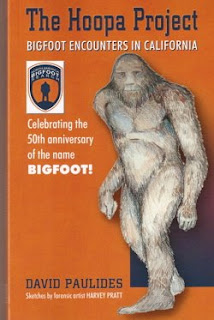 We at BIGFOOT BOOKS thank Mr. Paulides and Harvey Pratt, as well, for their fine book, one that confirms what we hear reported constantly here at the shop: Bigfoot Lives! Also check out the NABS' Bigfoot Sightings Map, a nice supplement to your required US Forest Service Six Rivers National Forest Atlas topos.


 , was a true story. We looked into the matter after reading the tale, feeling that it could not possibly be a depiction of a real event and encounter. What we found, by way of a little Sherlockian investigation, was that the tale had first appeared in a "street-sheet" published in Humboldt County. One bookseller had listed online the booklet reprint published later, under the authorial name of Jim Dodge, not the ostensible author, one "Gordon Langley Ives." We contacted this seller, and found that they knew the publisher who had reprinted the tale at a later date. This publisher confirmed to us that the author was indeed the well-known novelist, essayist and poet, Jim Dodge. The story purports to have taken place in 1975, a time-frame that also corresponds with the time that Jim Dodge was attending Humboldt State University, and was active in the underground poetry and publishing scene in Arcata. These days, after many years down in the Mendocino area, Dodge is back at HSU teaching English. We contacted him, and he confirmed that yes, indeed, he had written the story, and that it was certainly a work of FICTION.
 We provide links to Autumn Williams' fine clarifications of the differences between Fiction and Non-Fiction, as well as her debunking of the latest gossip-mongering rumors.