Showing posts sorted by relevance for query bigfoot days. Sort by date Show all posts

Friday, November 20, 2009

BIGFOOT LIVES? Biscardi's Blight on Bigfooting, Plus ABOMINABLE and SASQUATCH MOUNTAIN. Three BIgfoot Films Considered. The Release of BIGFOOT'S REFLECTION on DVD

FILM REVIEW---NOTE: what follows are the opinions of the author. They are based upon impressions of the movie reviewed and/or oral accounts and internet research that may in fact be based upon hearsay. Though we DOUBT it is wrong. Having never met Mr. Biscardi, we cannot make any final conclusions here. That is up to the reader and the viewer.

NOW, for those with the curiosity, but also the great unwillingness to put money into the coffers of one whom many regard as an irremediable con-man, huckster and bigfooting charlatan, Tom Biscardi's recent film, BIGFOOT LIVES, is now available for free viewing for members on Netflix. Click HERE to watch it on  your computer, if you are signed up. We know, maybe he'll make a very small royalty on this online streaming version, but we doubt it will amount to much. The film is worth viewing, if only to see the flawed methodology and exploitative nature of presentation, or if you are a Bigfoot completist like we are. You may buy it if you like through the title link above--just being fair, Tom!

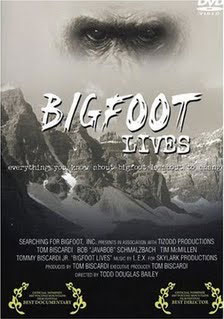
Image: Official product image from Amazon.com... "Best Director" and "Best Documentary"? In WHAT film festival was that, Tom??? OMG.

Now, I don't know the man personally, so who am I to talk? He does seem to have a lot of friends, just not in the serious domain of well-regarded and serious Bigfoot researchers. The first step in any con is the warm handshake, the building of social confidences. Well, what I can tell you about is the kind of thing I've heard from just about every person this man and his past GABRO and current SEARCHING FOR BIGFOOT groups have dealt with over the many years he's been in bigfooting, plus the ridiculous things I've seen from him in the media, the horrid own-horn-tooting quality of his online radio show (complete with constant Bozo horn sound effects every five minutes or so)... and, of course, this terrible DVD he's released.

"There's a sucker born every minute." - P. T. Barnum
"Nobody ever went broke underestimating the intelligence of the American public." - H. L. Mencken

Well, OK, it isn't really ALL bad. There are undoubtedly some honest witnesses in there, with real stories of encounters with the big, stinky bipeds. However, these folks should look out! What we see in this film is NOT Bigfoot, but rather constant Biscardi. From all appearances this man seems to be a classic con artist, one who makes friends to use and exploit, and then discard them. Just ask around Happy Camp, CA, as we have, and you will see the wreckage he left behind there, a bad attitude towards Bigfoot researchers that has surely hampered the reporting of sightings and the formal discovery of the species. We'll just quote the Wikipedia article on Biscardi and the "Happy Camp Fiasco" here:

"2005 hoax: On July 14, 2005, Biscardi appeared on the radio program Coast to Coast AM and claimed he was "98% sure" his group would be able to capture a Bigfoot near Happy Camp, California. On August 19, he returned to say he knew of the location of a captured Bigfoot specimen, and that he would air footage of the creature through a $14 web-cam service. However, on the day the footage was to be distributed, Biscardi claimed he was "hoodwinked" by a woman in Stagecoach, Nevada, and that the specimen did not exist. Coast to Coast AM host George Noory demanded that Biscardi refund the money to people who had paid for the web-cam subscription. Biscardi then offered a refund on his website to those who had subscribed for the service after August 19."

Rumor around Willow Creek has it that Biscardi was from the start in collusion with a couple of good-old-boys who were making faked footprints up there in Happy Camp to draw attention to their town. We don't know if this is true, but we'd believe it. Upon arrival in the area Biscardi immediately began stirring up a media circus, as he seems to do everywhere he goes (television is the real goal of his hunt, we think). From there it just got worse with every step, and many were left behind feeling betrayed or ripped off. The segment on nationally syndicated and globally streamed C2C AM (The "Art Bell" Show) was one of the most outrageous this writer has EVER heard, on any radio show, and that is after listening to the C2C show since 1989. Among all the myriad weird guests on there over the years we've never heard one so excoriated, so discredited by the host, so caught up in lies and a public scam live on the air. And a number of these show guests have actually been thrown off the air over the years. Loren Coleman's THE CRYPTOZOOLOGIST has a great summary of the event in their article, "Coast to Coast AM Keeps Biscardi on Track" and there is a good update HERE on CRYPTOMUNDO.COM.
One Happy Camp Bigfoot blogger won't even mention Biscardi's name on her site, http://bigfootsightings.org/
But she did indirectly imply things about her experiences with the guy and the storm of BS he stirred up. Like something out of Harry Potter, she refers to him as "“he whose name will not appear in my blog,”

Every Bigfoot aficionado and investigator has been hurt by his antics, as the subject looks more ridiculous the more attention Biscardi gets. For every step forward in the battle for legitimization and public acceptance of the subject, media hound Biscardi seems to take three steps toward making it look absurd, uncultured, ignorant and foolish to believe that such a creature exists. One almost cringes to see him in action with such exploitation, knowing full well how negative the impact will be upon one's own bigfooting activities and research. One bombastic buffoon, one clown, one crook in the mix, one seen so publicly, can discredit a whole field of endeavor. Serious bigfooters should not underestimate this impact. Biscardi's show is one of the top-rated among the thousands on the online BlogTalk Radio podcast network. If you hear about Bigfoot on the major news channels it is likely to be another Biscardi confabulation. This is how the general public gets to see Bigfoot: through bogus bullshit, hype and deception. When the Bigfoot "body" was announced from Georgia the whole serious bigfooting world groaned in disgust when they heard who was involved in the "discovery."

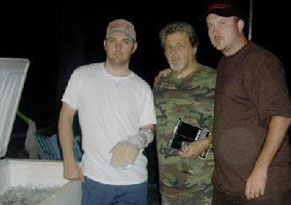
Images: two photos in the press conference release packet for the Georgia Gorilla hoax presentation. Above, Biscardi with the "good old boy" hoaxers (his allies?). Below, the Halloween costume stuffed with animal parts, guts tossed on top, on ice.

Do you remember the Georgia Gorilla Hoax that Biscardi was a part of, and almost certainly originated and encouraged? (Read about it HERE on Squatchopedia if not, or the official Searching for Bigfoot press release HERE.) Well that was not the start of it. Biscardi's bigfooting pedigree goes directly back to the notorious old-time hoaxer and trickster, Ivan Marx. Marx' "The Legend of Bigfoot" (1976) (also viewable on Netflix for free HERE, or on YouTube HERE) is an assemblage of natural historical "documentary" and confabulation, a bunch of made up stories and faked sighting footage showing his wife prancing and stumbling around in a field pretending to be the Bossburg Cripplefoot. This film was made simply to exploit the interest in Bigfoot after the Patterson-Gimlin film was shot. The "Bigfoot" footage in this feature is, in the words of anthropologist Jeff Meldrum, "a transparent hoax." And yet, to this day, Tom Biscardi claims that the ape-suited subject of the film was a 7-8 foot tall Sasquatch and was horrifying as it charged them. He tells the story with fake trembling in his voice and feigned excitement. Give me a break, please, Tom. There is perhaps no more ridiculous Bigfoot hoax film than that one! Biscardi wants so badly to be known to have seen the beast, to be known as the "#1 Bigfoot Hunter in the Nation," that even something obviously untrue is better than nothing. All publicity is good publicity, I guess, when you're operating on this level. If he can't FIND Bigfoot, he'll INVENT it. But you've got to ask, Would you buy even a used car from this man?

We've heard some who've encountered him say they think Tom is just "gullible," that he is overly enthusiastic and believes people's stories too easily. But when viewing a film like "BIGFOOT LIVES" or "NOT YOUR TYPICAL BIGFOOT MOVIE" after the Georgia Gorilla and Happy Camp fiascoes one cannot help but see it the other way around. The cynical, calculating modus operandi, by all appearances and as seen in his own movie, is to go around building confidences in folks who want attention, who want to escape the small town mundanity of their lives, who are perhaps eager for monetary gain, and to USE them. The latter movie shows full evidence of this, where Biscardi is show cultivating a relationship, using it for what it's worth, and then abandoning the poor fellows. Tom got his movie footage, seen in HIS movie, but he left Dallas Gilbert and his poor friend standing around waiting at an abandoned appointment.

So, what IS in this movie? It's a lot of footage of Tom, Java Bob and crew driving around on interstate highways in their big, fancy "Searching for Bigfoot" gas guzzlers. It's basically that and Mr. Biscardi shmoozing with witnesses and potential Biscardi-cult members, or Biscardi taking credit for all the advancements in Bigfooting, or Biscardi propounding his own brand of feel-good philosophy, or Biscardi stomping around in the woods at night claiming to see things that just obviously are not there, or Biscardi just plain making shit up and wrongly interpreting evidence.

First there are a whole lot of suspicious-looking footprint finds. Like: one or two (it was not made clear) prints found in the middle of a muddy marsh bog in Paris, Texas. Tom, where is the TRACKWAY? Did Bigfoot just appear from the fifth dimension to make one footprint in a bog? How did that one print GET there? No attempt is made to show these things, rendering this part of the documentary useless, save if one wants to watch them make a plaster cast of something that sure looks like a faked plant (search Biscardi's van and I'll bet you'll find his footprint stomping mold right there under the passenger seat!).
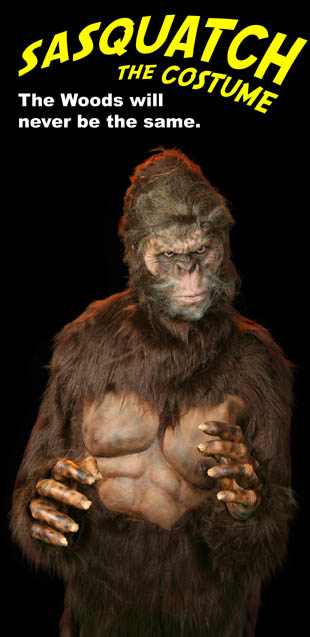
Image: the commercial product used in the faking of the "Bigfoot Corpse."

Then they head to Deer River, Minnesota, where they see a bunch of very fake looking footprint casts. Biscardi finds a white hair superficially attached to the cement-like casting material. Suspiciously, this looks exactly like one of Java Bob's whitened beard hairs, in both length and color. A big show is made of boiling a Leatherman's pliers to remove the hair when it could probably have just been knocked off the cast with a pencil tip, and then while putting it into an envelope they take no care at all not to touch the inside of the envelope and hence contaminate it with human DNA. After all this show we don't get any presentation of the results of the DNA testing. Want to guess why? Clearly, this was Java Bob's or some other human's hair, not Bigfoot's.

Then we get to see the aforementioned Wayne and his friend Dallas in Ohio. Their method? Set up cameras on parts of the forest, take random footage, and then go home and try to find blobsquatches in the images. Very scientific, guys. Very imaginative. Bigfoot? No. This finding of shadows and phantoms not being enough, they present a blurry white thing that, um, could be Bigfoot. Or it could have been a littered grocery sack blowing in the wind! After this a known hoaxed photo of a man in an ape suit is presented. Great evidence!

Then we move on to a hand in formaldehyde, supposedly found in a public trash dump. It looks just about the size of a human hand... or maybe an animal paw. The DNA results, totally ineffectual for a piece of a body sitting god knows how long in preservative chemicals, were presented verbally in the film as "unknown, non-human, not a known primate." A little further research we did and proper wording reveal the real result: "inconclusive, due to degradation." This approach that seeks to bend the words of a lab report is seen again in the testing of some hair found by a Native American cop in Arizona. One of his samples was shown to be synthetic. The other, as seen in Biscardi's reaction where he interprets it: "Here it comes again, one more time," meaning that he thinks it is "non-human, unknown primate." But, IN FACT, the camera pans right onto the actual lab report, and the viewer can read it. There, before the viewers' very eyes, is the actual laboratory conclusion: "non-human, animal origin"!!! What does this mean, folks? That the hair came from... AN ANIMAL. Well, duh! But that is NOT proof that they came from a Bigfoot. It doesn't prove anything save for the fact that Biscardi couldn't give a damn for the truth, or that perhaps he can't even read. This clearly shows the non-scientific and obviously dishonest or delusional nature of the Searching for Bigfoot methodology.
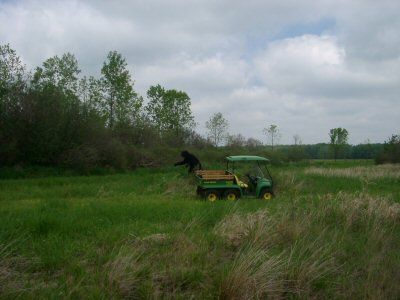

Image: The fakest BF photo this side of blobsquatches in a LONG time. Sourced from: http://www.webjam.com/biscardi_exposed, where they say this about the photographer, "a local reporter confronted a local costumer and identified Mobius as buying a gorilla suit a few days before the media cabal. But Biscardi, as usual avoids the boring true story and heads right for the sensationalism...".

From there we get to hear mysterious music playing as Biscardi walks around in some fields. He knocks a stick against a tree, and then superimposed audio that could have come from anywhere is spliced in, as if it were Bigfoot's response to Tom. Then we see the fakest looking Halloween costumed "Bigfoot" ever, standing next to a golf cart. We see a leg with some meat hanging off of it that was dug up by a dog. It could be from any animal, but being only a couple of feet long I am not sure why they seem to think it came from a Bigfoot.  At the end we see an excavation of a human body in the woods in what looks decidedly like grave-robbing of a Native American. Biscardi steps in and with no evidence at all of his claims states that the bones are from about 500 BC. How did you "know" this, Tom? They measure the grave-scattered bones and conclude that it could not be human because the thing is about seven feet tall. Um, damn, I'd better just stop here. In short, there is not one single piece of evidence in this video that even comes close to being convincing.

Far from revealing that "Bigfoot Lives," this mock-you-mentary clearly shows that it certainly exists in Biscardi's mind, and it is there in the interests of his pocketbook and ego. With all of that expensive technological gear and rhetorical hoopla you'd think they could have gotten at least a decent thermal image of the Creature, or maybe at least a piece of scat or something that could be honestly tested. Instead, the viewer is left feeling, in the end, like a big Bigfoot turd has just been dropped on his or her head. Biscardi should at least not go around claiming that he's the inventor of concepts like Bigfoot migration. That idea is as old as the hills, and credit for it should probably go to John Green, we'd say. He even claims he is the first to say that Bigfoot is nocturnal. Oh, please, come on. Tom! Can't you find a job at a casino or something? Leave Bigfoot Alone. Where is the BFRO when you need them most?

An AMAZING website exists to analyze (I should say DEBUNK) Biscardi and his so-called evidence and highly questionable methods. It also includes his "Bigfoot Business Plan" fully documented. Go there now: http://www.webjam.com/biscardi_exposed.

Curious about Biscardi's point of view? Want to see some really bad faked Photoshop Bigfoot photos and Blobsquatches? Go HERE, to the Searching for Bigfoot site, if you dare. Go ahead, listen to Bozo toot his own horn on the Bigfoot Live Radio Show on BlogTalkRadio.

If YOU or someone you know has had an encounter with Tom Biscardi we invite you to leave COMMENTS, below. All comments, pro and con, will be tolerated and approved by this bLog, save for those that are demonstrable Spam.

***********************************************************
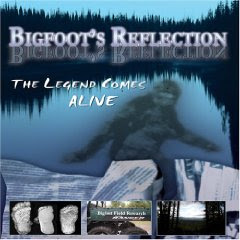
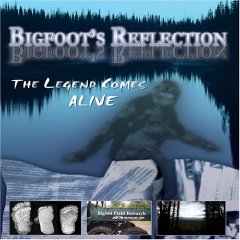
NEWS FLASH---ANNOUNCEMENT: Just out is a new documentary called  BIGFOOT'S REFLECTION. This one features good, solid, reasonable researchers, in distinct contrast to the other one we've just covered. Featured bigfooters are John Bindernagal, Robert Pyle, John Green, Bill Miller, John Kirk, Thomas Steenburg, Richard Noll and Mel Skahan. Check out the trailer HERE on the Bunbury Films site. They're sending a review copy to us here at BIGFOOT BOOKS, so expect more detailed coverage on this blog soon. If it's really good we'll be carrying here in the Bigfoot Books shop in Willow Creek.
***********************************************************

MORE BIGFOOT FILMS:
In great distinction to the really bad  fictional Sasquatch films reviewed previously HERE on this blog, we're pleased to announce that there are a couple of good ones out there. Bigfoot films are in a genre unto themselves, but the following two are clever genre-benders, featuring not only two quite good Bigfoot-suited monsters (going beyond the usual cheap gorilla costumes), and introducing intriguing pastiches and borrowings from other horror films. These both demonstrate meta-critical positions of self-aware bad genre film-making, transcending the bad with good production values and humorous in-jokes. And, of course, there is always the need to compete with all the other Bigfoot films from the past, to beat them in the savagery and gore departments, all whilst using the usual arm-through-the-window, shadow-across-the-wall tropes so familiar to slasher flick fans.

*****************************************************
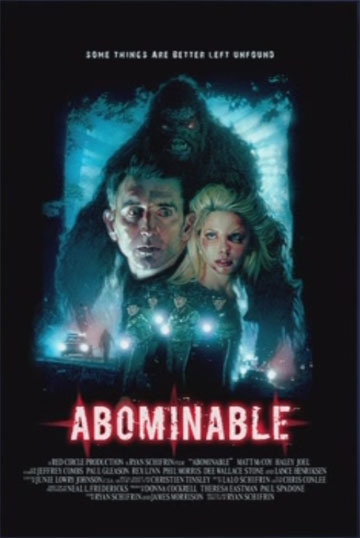
ABOMINABLE (2006), directed and written by Ryan Schifrin, stars a very competent Matt McCoy as a paralyzed guy returning from a mental hospital in an attempt to recover from the death of his wife in a climbing accident on the mountain behind his remote, forest-surrounded house. Next door, the same day he arrives, the usual clichéd hot babe co-eds show up for a pre-wedding bachelorette party. It gets juicy fast.
Needless to say, it isn't just the recovering protagonist who is annoyed with their loud hip-hop music, valley girl chatter, and pot smoking. No, there is also the real resident of this area--Bigfoot--and boy is he pissed. And he's hungry for hot human blood. Why Bigfoot likes to eat young co-eds is still not explained by this film. But hey, they must be tasty or something. Or maybe it was the rap music? Bigfoot really, really hates car horns honking here, too.

In a scenario right out of Hitchcock's Rear Window, the man who is trapped in his wheelchair on the second story with his annoying orderly witnesses a young woman attacked and dragged into the woods. Her compatriots do not even notice. The man cannot communicate because the phone line is down. Then he sees Sasquatch playing peeping Tom from the forest's edge as a young woman takes a shower. From there things only get worse, and in the most ghastly and gory ways. If you like gruesomeness you will love this film.


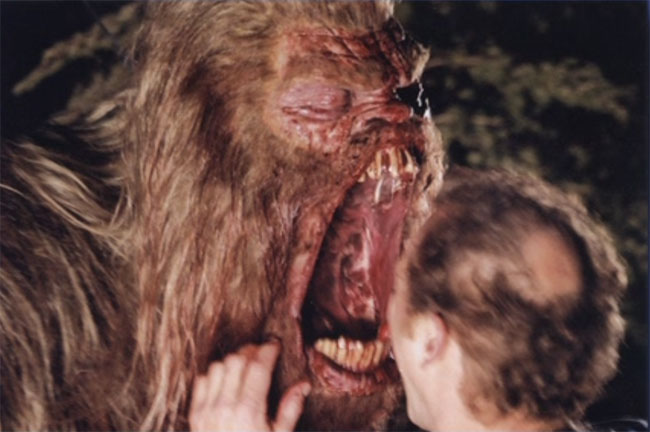
And to be fair to both genders--though we don't want even to begin to spoil the hideous fun for you--we do have to say that at one point the obnoxious mental hospital male nurse hurls a large axe into Bigfoot's back, and he is subsequently given the high honor of having the entire front part of his face and head bitten off in graphic detail, from upper mouth to upper forehead. Lovely!
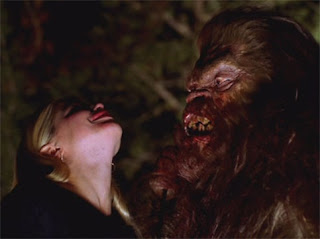
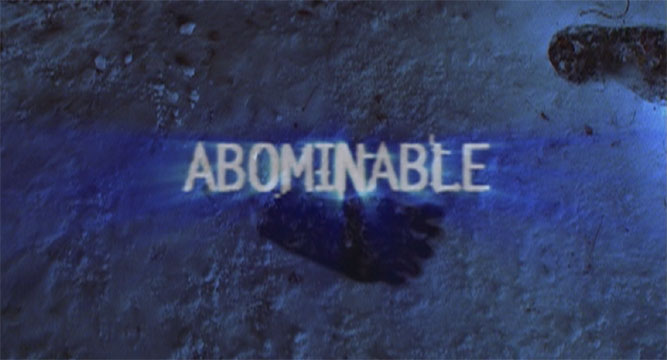
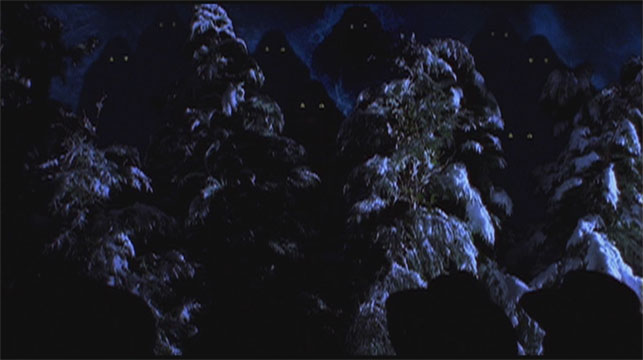
Images: Poster and titles screen, the latter being footprints in the snow left after two horses were slaughtered outside a rural cabin, and then the dog was smooshed. Next: Bigfoot hates cars! Next: Bigfoot in Love, or something like that. Next: the inimitable Squatcher, Lance Henricksen. Next, more savagery, plus Eyes in the Dark.
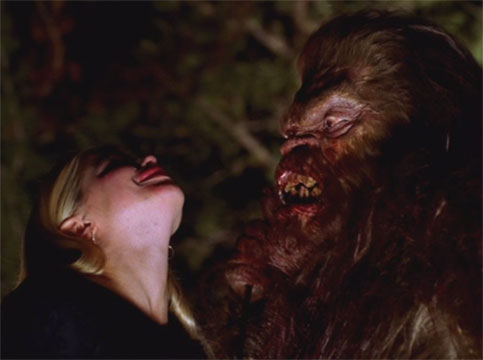
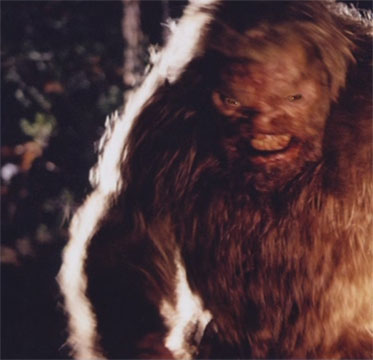
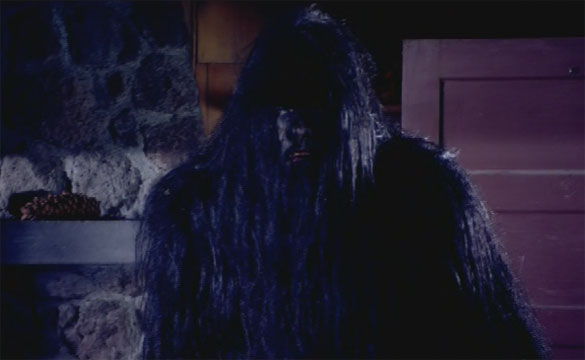
The Bigfoot in this film is a strikingly believable one, standing at around seven and a half feet tall, but not a totally stereotypical one. It's visage is truly interesting and disturbing, its eye and facial movements in particular, done with electric servos, are convincingly done. This sure beats the CGI crap seen in SASQUATCH HUNTERS. That's part of the reason this is a good film--it eschews the newfangled and sticks with the tried and true modes of the genre.The creature moving around in the dark, as well as killing in the light, moves and behaves like one would think a living Bigfoot should, and it's convincing enough to be both cool for a Bigfoot believer and scary for all.
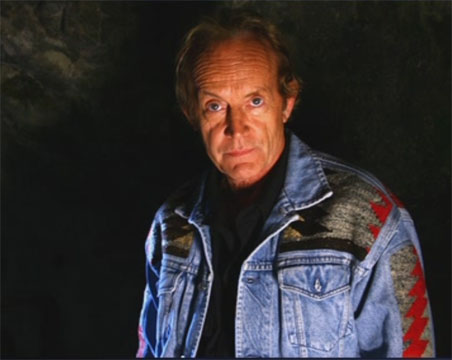
Lance Henricksen, whose post-MILLENNIUM career is rapidly becoming defined by Sasquatch Slasher films, makes a fine cameo appearance as a Bigfoot hunter who enters a cave pursuing the beast, and is promptly shredded. What IS it about Henricksen and Bigfoot? He's been in like four of these now!

We won't try to spoil the ending, save with the picture below, which shows that skeptical, scoffing sheriffs should never let themselves appear in a Sasquatch movie. Bigfoot gets the last say here, and I'm all for that. Plus the good guy and one of the co-eds escape alive, and the promise of a seriously age-disparate love affair is vaguely suggested.
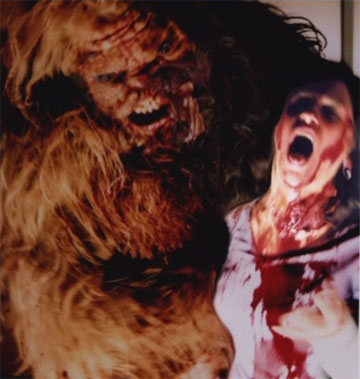
This film was shot in the mountains around Idylwild, CA, in the San Jacinto Mountains, a pretty good piece of Sasquatch habitat. And if you liked Scream or Friday the 13th and all the rest of them, and also have a liking for the Nature-Strikes-Back film, then this one is for you.
Watch the film on YouTube HERE, though it won't be as cool as on the bigger screen. Or if the legal guys take that one down, view the cool official trailer HERE.

***********************************************************

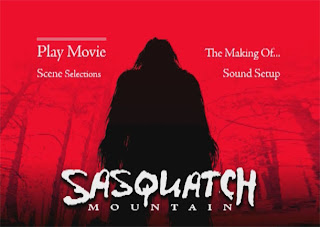
SASQUATCH MOUNTAIN (2006) stars Lance Henriksen again as a stone-tough and gritty, yet sensitive, ex-Nam vet whose wife was run down and killed by a car in an accident caused by a Sasquatch crossing the road. But by the end of the film he is the one who prevails, reaching some kind of peace with himself while bonding with the dying, bullet-riddled Sasquatch. Written by and co-starring the clever Michael Worth, this film incorporates all the old horror themes and combines them with the escaping bank robber trope. Some funny Tarrantino-esque criminal slapstick occurs, even a "Mexican standoff."
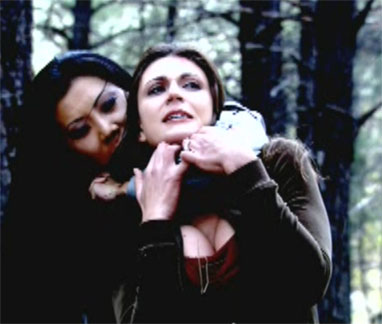
The bank robbers escape into the woods, pursued by some Sheriffs and a good-old boy Nam vet posse. A young woman escaping an abusive relationship is just passing through the area, but gets caught up in the action, ironically, as a hostage. This role is well played by the ever-bosomous Cerina Vincent. The bad guys are an amusingly motley crew of characters, including a very-Kill-Bill tough-ass Asian woman who gets in some intense girl-on-girl fighting action with the main star. Cameo roles among the goofy posse are classic, including one from Ron Howard's father, Rance Howard.
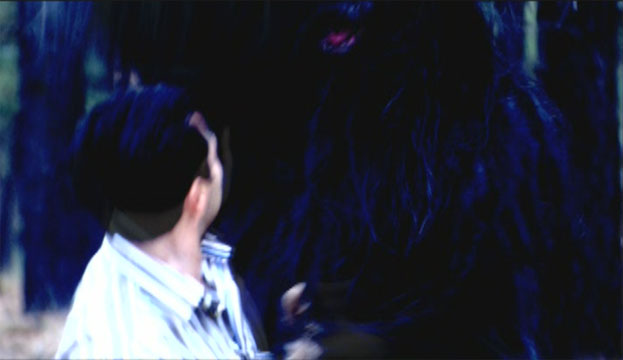
This film operates around the usual pissed-off Sasquatch theme. Here, an old man had been feeding a Bigfoot family for years from his remote ranch. His mummified, long-dead corpse is found. Then some bloody afterbirth is found. Apparently, Bigfoot is a newly-become daddy. He's mad, and he's hungry; and true to the formula limbs and blood do fly. In the end, the death howls of the Bigfoot are answered from the deep woods by a more feminine response, and then the howling crying of a Sasquatch baby. A tragic end. Tragic, too, though probably just, is the fact that they bury the Bigfoot out in the woods, and tell the world that it was a bear that killed all of those folks. The message again: Respect the Big Guy.

This film was made in the forested mountains of northern Arizona, and the habitat appears to be acceptable for a Bigfoot, if a whole lot harder for a human, to survive in. Watch the trailer for SASQUATCH MOUNTAIN on YouTube HERE.


***********************************************************

ANGRY BIGFOOT SPEAKS!: Me let hu-man be angry this week. Me leave fake toenail for Biscardi Tom to find. Ha ha!!! ME not mad at him, he is good fun, me play joke, me like it when hu-man look like stupid naked ape. Me trick or treat in hu-man suit costume, me leave big bag of burning Bigfoot poop on Biscardi house doormat. Me take his Hummer truck, drive over his grass yard. If I a joke in hu-man television, no one ever, ever find me!
***********************************************************
All images are public product images, or used for promotional purposes,  part of an official press release, or in one case sourced from another internet site. Text copyright 2009, Bigfoot Books, and may be quoted or used with full citation including a link to this blog. Thanks!
***********************************************************
COMING SOON! The M.K. DAVIS INTERVIEW is about halfway done. Look for it, hopefully next week!

Friday, February 20, 2009

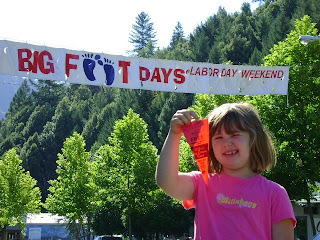
Call for BIGFOOT Speakers, 2009 Willow Creek Bigfoot Days


Hello all,

I've been asked by the Willow Creek Bigfoot Days Committee to put out an invitation to all Bigfooters to speak or present at the Bigfoot Days event here on Labor Day weekend, the first weekend in September. There has long been expression of a desire to see the event become more of a Bigfoot-related thing, and not just a small-town community parade and celebration. Perhaps this year we can bump it up a little, advertise that we'll have speakers and a more visible presence of Sasquatch in the event, and put this event on the Bigfoot map in a real way.

Since we don't always have a 40th or 50th anniversary of something BF-related, perhaps this can be a yearly meeting opportunity for the Bigfooting community. Also, it could be a first step out for you on a trip up to Bluff Creek.

This would not be a paying job, but it may be possible for some travel expenses to be covered, budget permitting. This is a small, not-for-profit event run by local volunteers.

However, any of you with books or merchandise, or web sites and research programs you'd like to promote (or just for the fun of it) can pay the low fee of $25.00 to get a vendor table in the after-parade festival event down in the park. There are normally large crowds, music, food, a car show, and lots of vendors at this part of the celebration.

If any of you are on the various BF forums, or have a blog or website or BF contacts list then please pass this invitation along.

More than likely Al Hodgson will again participate this year (health permitting, of course). He'd probably be willing and able to introduce any speakers. To my mind it would be great to have more than one speaker, presenting differing views on the subject, perhaps leading up to a debate of some kind. The presentations would be given in an outdoor park situation, with a PA system and small stage. It is almost certainly going to be a beautiful, warm and sunny day at that time of year here in Willow Creek, CA.

DEADLINE FOR SIGNING UP WILL BE LATE JUNE-EARLY JULY.
All official, business-related contacts regarding participation can be directed to Samantha Brown, member of the committee, using her cell phone number: 1-707-845-5083.
Or, if you just want to chat generally about BF and the event, feel free to call me at Bigfoot Books, 1-530-629-3076.

It would be great to see at least some of you make it up here!

Best, in the name of Sasquatch,

Steve

*******************************************

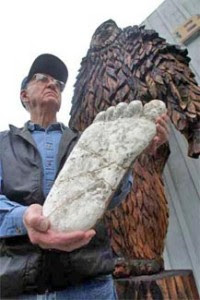
Promotional photo featuring Al Hodgson in front of the Willow Creek-China Flat Museum and Bigfoot Collection, 2008

http://bigfootcountry.net/home/bigfoot_collection

http://bigfootcountry.net/home/bigfoot_collection/bigfoot_exhibit.html

http://redwoods.info/showrecord.asp?id=3689
(Official Travel Site of Humboldt County, Home of the World Famous California Redwoods)

Thursday, April 1, 2010

Reading THE HOOPA PROJECT: A Study in Contrasts and Confusion

THE HOOPA PROJECT: A Fact and Logic Check and Close Reading, Section One. (A Book Review.)

It was on April Fool's Day that Skamania County made its Bigfoot Ordinance, Mr. Paulides.

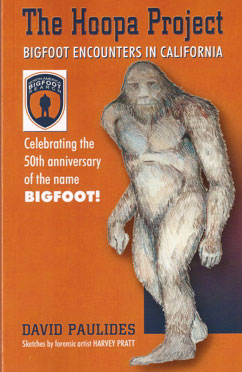
Paulides, David; Harvey Pratt, illustrations. THE HOOPA PROJECT: Bigfoot Encounters in California. Blaine, WA: Hancock House Publishers, 2008.

First, don't take this review the wrong way. The Hoopa Project is, despite certain flaws, still a fascinating book. Say what you will about David Paulides and Harvey Pratt, they have done some interesting work, some of it unique. NABS decided to focus on one limited area of Bigfoot activity in this book, and also focussed on a particular cultural group, the Hupa Indians. This gives the book a certain strength and distinction. When we first read it upon its release we barrelled through it in just a few days, drawn on by intrigue to the end. However, as we went along there was a certain feeling of unease. We found ourselves repeatedly asking, Did he really say that? Isn't this or that point just plain wrong? That is not even begining to mention all of the typos and poor general editing. The redundancies in the book, with affidavits repeating the narrative for each sighting report, prove to be highly tedious, and hence the book could have been reduced to nearly half its size--but that is for another blog entry.

Here we cover just the first section, and think it will be clear if you read to the end of this part of our review, that the book sits on rather shaky foundations. In saying what we say below, please note, we are not trying to debunk Bigfoot, but rather to debunk the statements and methods found in this particular Bigfoot book. Hence, we do not necessarily question or doubt the Skookum cast or various hair and scat DNA finds, but Paulides' use of these in his narrative. It is our feeling that he and NABS are so eager to conquer the field and the issue at hand, so confident in their own investigative abilities, so concerned with outdoing all the other Bigfoot groups (especially the BFRO) and researchers, that they get going right from the start on the wrong foot, so to speak. If we are to prove Bigfoot to the world, or to make the field at all respectable to the general public or the scientific world, then we simply MUST have solid methodological foundations, and our analyses of evidence and reports should be sound, not fraught with gross errors of logic and procedure. If the story isn't straight to begin with, then everything that follows is corrupted in sequence, and the errors compound multiplicatively upon those that preceeded them.

After Paulides came out as being in support of the "Bluff Creek Massacre Theory" (blogged about earlier by us HERE and HERE, and the MK interview HERE and HERE) we really had to revisit those misgivings. We decided to go back and do a review. What follows is a close reading of the book's first 51 pages, with an eye bent to ascertaining fact, fiction, and error in the book. The sightings reports which constitute the majority of the book are best left for later. Despite minor errors and glitches of methodology and assumption in this later part of the book, the reports are still good, and need to be appreciated for what they are--personal stories, anecdotal evidence, and at least suggestive of certain traits of the Creature and of a particular Native American culture in Northwestern California. We particularly appreciate this part of the book, despite misgivings about the introductory part, as we, too, live in the same region, and we receive the same kinds of reports from locals constantly.

All of us make mistakes--that is for sure. Even Bigfoot's bLog does, we'll admit it humbly if and when it happens. We are here to learn, after all, not to dictate. However, we feel there is a real need to run through parts of this book in order to show how egregious the errors and illogical assumptions can be in a Bigfoot book. It would do us all well if we learned to fact-check, edit, and think correctly before we publish these things. If we bigfooters can't get the story straight, the media and public surely won't, either. Since the people outside of the world of Bigfooting cannot or will not look more deeply into the evidence, it is clear that they will evaluate the topic based upon what they can see: the behavior of the researchers, and the consistency of their productions.

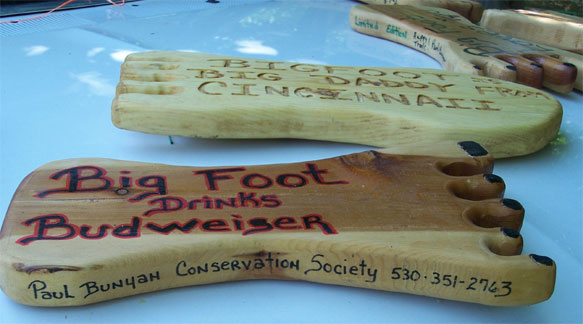
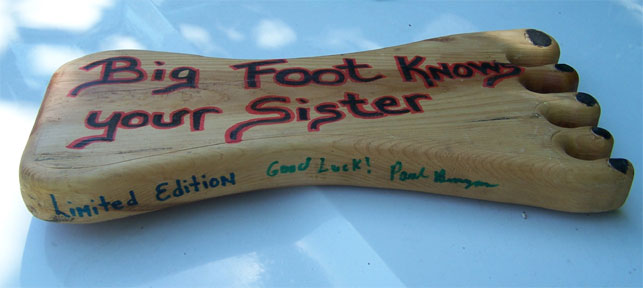
Image: "Paul Bunyan Conservation Society" footprint stompers, sold at Willow Creek Bigfoot Days festival, 2007. Photo by Steven Streufert. Rant Mullens and Ray Wallace would surely have envied these desigtns!

Introduction. On pp. 9-12 we find out how Paulides got his start hunting Bigfoot: in logical error and imaginative leaps. He tells of going out with his father into the mountains in Lassen County. They find a fire down in a creekbed, "made of fifteen to twenty small twigs broken into equal pieces approximately one foot long... placed on the sand in the shape of a teepee." Now, what this is doing in a Bigfoot book is a mystery, as there has never been a convincing report of these creatures utilizing fire. He notes that there were no footprints around the fire in the sand. If so, how could it have been a Bigfoot? Why assume it was made by a Bigfoot? He then acknowledges that this is odd, and admits that he doesn't really think it was a Bigfoot. OK, so will he say it? Maybe it was a pot grower? A hobo? No, he then proposes an even more extreme idea: maybe, he says, it was one of the "Little People" spoken of by Natives. But Dave, you then say they live in caves and underground, and that they only come out at night. And if there were no signs of footprints at all, what made the fire, a levitating elf? Occam's Razor would say that he should, logically, propose the simplest solution, not go from one presumptuous assumption to an even more wild presupposition. This may have intrigued Paulides about Bigfoot, or whatever; but as the first section of the book all it does is convince us that he is a guy who is prone to leaping to odd conclusions first, rather than the simplest and most rational ones. This, then, sets the logical tone of the book.

On pp. 12-14 he speaks of the "Whistler incident," up in B.C., Canada, in 2002. What happened? Nothing. He went to Canada, hired a guide to take him fishing, and then the guide told him a story about a roadside sighting of Bigfoot, told to him after Paulides asked him a leading question about "strange, outdoor wildlife experiences." Dave says he was "mesmerized," as if he had never heard of Bigfoot before; but just a page earlier he is talking about hearing about it way back in his childhood. Why would anyone be so entranced by the most common kind of Bigfoot story: "it walked across the road"? We've all heard this a million times on TV and elsewhere. Also, later on in the book, he himself devalues such sightings as being not substantial enough.

On page 14 he mentions that he then "read everything" he could about Bigfoot. If so, then why does he not give ANY credit to previous researchers on the pages that follow throughout his own book? If one is conducting professional research and scholarship and publishes a book or monograph one is ACCOUNTABLE to the field and other scholars that have gone before one, and one is required to give citation of their works and conclusions. Rather, Paulides goes on to claim nearly all of the following pages' contents as solely his own, as if they arose only from his own original "experienced police" investigation; but he has already admitted that they did not. As we shall show, he takes credit for other's work as if these were new discoveries, effectively stealing their ideas. Plagiarism is not just the exact quoting of someone else's written words; rather, in a scholarly sense, it is the lifting and appropriation of ideas and theories, without due credit given, as well. To follow such shoddy scholarship with public arrogance and grandiose statements is even less palatable.

In Chapter One Paulides covers what he calls "Government Acknowledgement" of Bigfoot. It is HARDLY that. No official support of the Sasquatch's existence is ever released by The Government. That Skamania County, Washington (pp. 19-22), issued a declaration about Bigfoot, in Ordinance No. 69-01, on APRIL FOOL'S DAY (of all days!), 1969, is obviously part good humor, and also partly related to the desire to prevent obsessed would-be Bigfoot hunters from shooting other hunters out in the woods. This was, notably, only a year and a half after the Patterson film was shot, and Bigfoot Hunting mania was at full steam. Yet Paulides takes it as a wholly literal statement of government belief in Bigfoot.

The ordinance specifically states,
"Whereas, publicity attendant upon such real or imagined sightings has resulted in an influx of scientific investigators as well as casual hunters, many armed with lethal weapons, and... Whereas, the absence of specific laws covering the taking of specimens encourages laxity in the use of firearms and other deadly devices and poses a clear and present threat to the safety and well-being of persons living and traveling within the boundaries of Skamania County as well as to the creatures themselves...".

An amendment to it from 1984 also states, "Should the Skamania County Coroner determine any victim/creatures to have been humanoid the Prosecuting Attorney shall pursue the case under the existing laws pertaining to homicide." Isn't it clear? This ordinance has been set down to hopefully prevent murder of humans, and is NOT a clear recognition of there actually being such a creature as Bigfoot out there. Rather, it only says that IF the creature exists, then the killing of one will not be considered to be murder, and will be subject to a fine. By "Victim" they obviously mean "human," so if someone is shot (i.e., Homo sapiens) during a Bigfoot hunt, then it will be considered to be murder. Clearly, the focus is on homicide, and discouraging it, not the acknowledgement of a Creature out there. All that the ordinance says is that it is "possible," that it is "possibly" out there in the hills--hardly a bold declaration of belief and support. We bigfooters believe, sure, but Skamania County is obviously hedging their bets and playing it safely.

Paulides claims that this declaration was found when he did "an internet search for Bigfoot/Sasquatch legislation," implying (given all of his claims of an extensive professional investigative background) that he was somehow searching "official" government information sites. Rather, obviously, he just up and GOOGLED IT. One does not have to be an "Investigator" with "30 years experience" to do this. Furthermore, he must have already known about this ordinance, as it was WIDELY noted in the Bigfoot literature, in many books that he must have read if he read "everything" he could find on the subject; and it has been presented in a few television shows and Bigfoot documentaries, such as Sasquatch Odyssey. Let's just pick a few books off of our own shelf and take a look. Oh, look! Here the Skamania ordinance is in John Green's book (1978), and here it is in Peter Byrne's book (1975), and here it is again extensively covered in Robert Michael Pyle's book (1995), and here is Murphy's book (2004) with photos of the official documents and everything! Surely the author has read at least one of these major tomes, since he read "everything on Bigfoot." This is NOT, then, original research. The Hoopa Project author is not proving his big-time cop abilities, but rather just doing what any Bigfoot internet geek does. Why does he do this and not credit prior researchers? It is, it seems to us, to build up the narrative trope that he is some special kind of researcher, not just some guy reading books on Bigfoot and surfing the 'net. It is, it seems to us again, largely a fictional construction. Here comes Paulides, a guy in the field of Bigfooting only a couple of years, and already at the start he claims to be the only professional, full-time, serious Bigfoot researcher out there? Come on, and go figure.

Images: NABS/ public commercial product promotional images, found on Amazon.com.

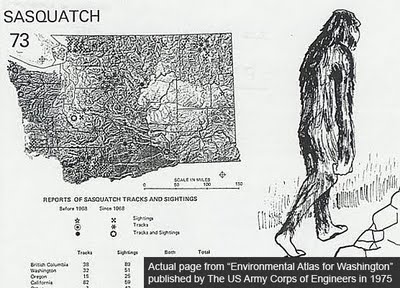
The book brings up the Environmental Atlas for Washington, or “Provisional U.S. Army Corps of Engineers Environmental Reconnaissance Inventory of the State of Washington,” published by the Army Corps of Engineers in 1975. A lot is made of this publication, as if it proves official government recognition of the Sasquatch as a real animal. Rather, it can be taken as a slightly tongue-in-cheek presentation, but also seriously as a declaration that the creature has been REPORTED to be in Washington. The Atlas does not present this topic mockingly, and does indeed take it as a possibility that there could be something to all of the reports. It is clear, however, that the “very existence of Sasquatch… is hotly disputed,” as the Atlas states. From this point it refers repeatedly only to ALLEGED Bigfoot hair, “alleged sightings, tracks and other experiences.” It says these reports CONJURE UP the image of Bigfoot, implying a phantasm. It does not come out and SAY that the creature is actually KNOWN to be 8-12 feet tall, and so on. It is a PROVISIONAL statement. Other qualifying words used throughout this report include, “reported,” “apparently,” “if” and “generally considered.” It is also clearly reporting on what is, to the author, generally considered to be folk mythology or cultural belief particular to the region, which MIGHT have some basis in fact—might, only, is what they are saying: “If Sasquatch is purely legendary, the legend is likely to be a long time dying…. Legendary or actual, Sasquatch excites a great popular interest in Washington.” See, this Atlas includes cultural dimensions, and not just environmental facts. Also, this Atlas is not an official production of the entire USA government, nor a statement of official governmental or institutional policy. It is a regional side-project, done by a certain and limited agency of the government only. It is no more official policy than a particular wildlife study or environmental impact report done by someone working for the government.

Paulides, though he at other points in his larger work is clearly suspicious of government cover-up (especially with his belief in the "Massacre" conspiracy theories, and his recent belief that an Oregon lake was closed by authorities because of Bigfoot activity), here places great credibility in government: “If you believe in your government and you believe they have the best evidence, laboratories, and tools available, then I believe the government is taking a bold step forward in the authentication of Bigfoot/Sasquatch as a creature.” (p. 19) However, there is no real original study being done in this Atlas, and its imprimatur is limited. It is a short summary of previously known aspects of the issue only. There was no new testing done officially in this project, though there is a mention of some hair having been analyzed at some point by the FBI with inconclusive results: “no known animal” does not necessarily prove Bigfoot. If one actually reads this brief bit from the Atlas one can clearly see that it is nothing official, scientific, nor comprehensive. On page 17 Paulides goes to great length to say how “extremely competent, intelligent, and technical” the US Army Corps of Engineers is, how “cautious” they are. But does he not recall how the Corps was largely blamed for the poor design and management of the levees that broke and inundated New Orleans during the Hurricane Katrina debacle? If we know one thing for certain about the government, it is that it is a vast, compartmentalized bureaucracy, one often at odds with itself, and in a great many instances incompetent and self-contradictory. Again, Paulides claims he found this Atlas in his “personal search of the United States government records,” but it was well known for years, seen or spoken of in many Bigfoot books and websites. We are sure he just read about it somewhere, and then wrote to the Corps to get a copy—no P.I. work necessary there; and no credit is given for previous work on the Atlas Bigfoot article. Oh well.

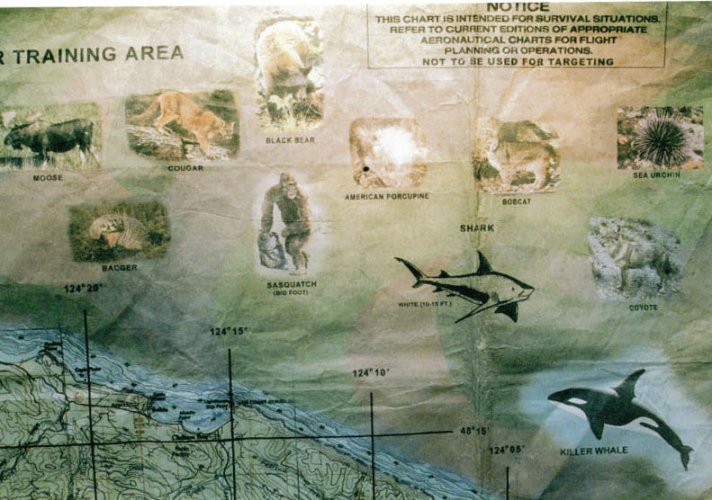
Images: From the Corps of Engineers Atlas of WA, showing Sasquatch in both. Click to Enlarge.
What does the Corps really say? The BFRO asked and here is what they say: “But whenever they are questioned by reporters who seek clarification on the issue of whether the Corps or the state of Washington officially acknowledges the existence of bigfoots, they steadfastly claim that the listing in the Atlas was an ‘error’ or a ‘joke’ that was not corrected prior to the printing of the atlas.” And this appears on the BFRO Blue Forum: "A biologist/writer was assigned to put together the WA state atlas. The criteria was defined broadly as environmental elements of interest to public (because the atlas was made for the public). The writer spent some time determining what things were of great interest to the public, that [are] broadly environmental in nature. The sasquatch was one of the items that came up consistently." So, this project was for popular consumption, not official, and was mainly (apparently) written by one biologist, not the entire Corps or US Government! Personally, we think it is cool that Sasquatch made it into the Atlas, and we think personally that the Creature does exist; but this Atlas IS NOT proof that the government agrees with us bigfooters. Why is Bigfoot in the Atlas, then, you ask? Because BIGFOOT IS COOL.

Anyway, let's ramble onward....

The next section, starting on page 28, deals with how NABS (Dave, that is) "started the search," and found the location where they (he) would search for Bigfoot. Obviously, this is mostly a foregone conclusion--just look at the maps in John Green's old books and you'll have every clue you need. He proceeds to try to make his choice seem quasi-scientific, but again just runs through all of the basics already covered by Green and others decades earlier; and he glaringly does not give one bit of credit to Green or anyone else. He says he spent "weeks of working the Internet and deciphering graphs and charts," but then jumps immediately into talking about the area around Hoopa, CA. He does not really explain at this point why he chose this area save that basically he kind of liked the look of it. It had the Patterson-Gimlin film site nearby, and lots of Native Americans. What more could one hope for? It is only later in the text, presumably narratively after he had decided on Hoopa already, that he begins to try to build a data structure to explain his choice. Almost all of this basic data was contained in John Green's books and SASQUATCH DATABASE, now available online (click the highlighted text).

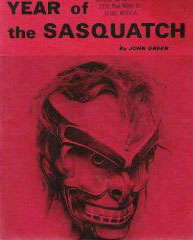
Image: One of John Green's early pamphlet books, predating and pre-configuring Paulides' research by over three decades.

Fact checks, pp. 28-34:

• He says that Hoopa Valley is one of only two valleys in this region. He is wrong. Basically every river has some kind of valley somewhere, Willow Creek has a valley. There is the Eel River valley, the Mattole valley, and on and on...

• He says the creature in the PGF is "running across Bluff Creek," but actually the creature WALKS away from the creek on a sandbar.

• He says that Louse Camp is on Bluff Creek, six miles south from the P-G film site, but it is NOT. It is 2.5 miles as the creek flows, west then southward, and even less by direct line.

• He says that there have been "few actual sightings in the new century" in this area, but we know and have heard of many, many of them, and know some who have seen Bigfoot right up from Louse Camp in recent years. Several BFRO researchers, as well as NABS-affiliated researcher Sean Fries of Weaverville, have reported constant wood knocks, vocalizations and other signs of Bigfoot activity in the area. Paulides is utterly WRONG when he says about Bluff Creek, "The weather can be treacherous, the trail is very tough and you won't see Bigfoot. You had a chance of seeing him in this region in the 1950s and maybe early 60s, but not now." Huh, what now Dave? This is just not true, based on no real research at all, and is a statement made simply off the top of his head. He uses it to make Hoopa seem like a more active zone. Also, there are roads in the area, not trails, and they are mostly fairly well graded and leveled. Bigfoot activity in the area is reported regularly, with new sightings and reports each year that goes by.

• He uses the name "Hoopa" to describe the people of that tribal group and reservation affiliation, though their official name is HUPA. Hoopa is the name of the city and reservation, not the people. This is a fundamental error that should never be made by someone who has supposedly spent two years living among these people.

•  He states (pg. 29) that the Hupa received their reservation in 1876, but in fact it was 1864 when the treaty was ratified and the reservation "comprising 90% of their original homelands" was established. (Source: Hutchinson Encyclopedia article). He says that it was established under President Ulysses S. Grant, but Grant was only in office March 4, 1869 – March 4, 1877. This "official occupancy" recognized by the US government came only after the millennia-long homeland had been disrupted by the coming of European-Americans and the consequent decades of genocide, colonialism and "Indian Wars." It is a fact, though, that as remote and resilient as they are, these Natives never lost their traditions and connection to the land that they share with Oh-Mah.

• On the same page he says that Highway One is on the coast from Hoopa, but it is known as Highway 101. He speaks of the "Bald Mountains," but the name used for those is "Bald Hills," traversed by Bald Hills Road from Weitchpec to the coast near Orick, an area important to Bigfoot history.

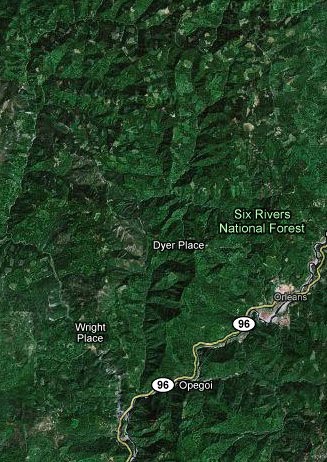
• On pg. 30 he speaks of the "Go Road," more properly called the G-O ROAD, or Gasquet-Orleans road. He mentions it as if it is the same road as the famed Bluff Creek Road. He conflates the G-O project with the Bigfoot track-find and equipment vandalism events of 1958, but the Bluff Creek one was a logging project road starting considerably south of Orleans. The G-O road was to end in Orleans, not down near the mouth of Bluff Creek, nearer to Weitchpec than Orleans, where the road Jerry Crew and Ray Wallace made famous starts. The Bluff Creek road runs past Louse Camp up into the dead-end of the creek's headwaters area for logging access. As evidenced by the Notice Creek bridge, which bears the marking "1958," built by Jerry's crew, this is the road project that the Bigfoot events happened on, not any of the G-O Road projects.

Image: Bluff Creek Basin on Google Earth. The Bluff Creek Road starts way at BOTTOM, Orleans and the G-O Road turnoff are at right. They are NOT the same road. Way up to north and west is the PGF site, where the creek bends eastward into the  basin's headwaters.

• He claims on the same page that it was the "Hoopa" and Yurok Tribes that fought the battle in court to end the G-O Road construction before it entered Native sacred mountain peaks in the Siskiyou wilderness area. In fact, it was the Sierra Club and the passage of NEPA that got that ball rolling, and then a remarkable alliance of Native and environmental concerns later combined to assure the protection under the Indian Religious Freedom Act and eventual declaration of an official Siskyou Wilderness Area and also the Smith River Wild and Scenic National Recreation Area. Combining these two areas, plus the cost of fighting legal battles, eventually closed the road project only seven miles short of completion at its middle. One source says "The GO Road battle was won on environmental grounds, not on grounds of religious freedoms. As one Yurok stated, to establish the area as wilderness is to completely miss the point." (See article HERE.) 

• He says that Patterson and Gimlin came to Bluff Creek to film a Bigfoot, but their stated intention was to film tracks of the creature found recently. He says, wrongly, that they “left the area of the Go Road and started to slowly make their way by horseback down into the Bluff Creek region. Just as they were about to reach Bluff Creek they each saw movement in the creek…,” etc. ACTUALLY, no. They DROVE up Bluff Creek Road from down near the mouth at the Klamath, up from the Bluff Creek Company on the road to Louse Camp, where they camped just upstream from the campsite and Notice Creek. They were in the area for DAYS or WEEKS before eventually spotting the creature, and were riding up and down the creek a lot. Where Paulides gets his version of the story is surely a source in thin air, not actual research of documented sources.

• Furthermore, speaking of the filming (pg. 31), Paulides says they were using a 35mm camera, but it was a 16mm camera.

• Speaking of the Creature he says experts have determined that she was 7-foot, 3-inches and over 700 pounds, but ACTUALLY, no one has really been able to finally agree on or conclusively prove these measurements, and there are many theories out there that differ pretty widely. There are whole books written about this subject, but which Paulides has simply not bothered to read and absorb.

• Speaking of the film he says that the Creature was carrying "something" (a stick), as if this is an established fact. Actually, it is pretty much only M.K. Davis who sees that stick. We can't! This is verifiable proof that Paulides was under the sway of Davis’ odd and conspiratorial thinking even at this early, pre-Bluff Creek Massacre Theory stage of things.

• He speaks of muscles moving in the right thigh and right shoulder of the Creature. In fact, muscles can be seen moving ALL OVER the Bigfoot in the film, especially in the back and buttocks. This is why it looks real upon close inspection. Why does he select only two limited spots? Odd.

• He speaks of the creature "on tape," but actually, it was on FILM, from a real movie camera, not a video tape machine (which did not exist in the consumer market at the time). He also states that the film has been declared by "professors" and "experts" to be impossible to fake; but the sad fact is that way more such figures think that it IS a hoax. The film has never been finally or credibly debunked, but Paulides should say that there is still much disagreement on that topic.

• He speaks of Willow Creek’s Bigfoot Days as being “a huge event that draws university professors, professional Bigfoot hunters and a variety of amateur explorers.” Has he ever BEEN to this event? It is not some kind of academic conference. In fact, it is a small community parade with a festival of vendors and a car show down in the park. It has very little serious Bigfoot content, mostly consisting of gorilla suits, or knick-knack sellers hawking novelty goods.

• He says Willow Creek area itself has “relatively few” sightings “compared with other regions in Northern California,” but in fact, as evidenced by reports in the Bigfoot Books store and around town there are MANY sightings right around this area, every bit as much as on the Hoopa Reservation. This stuff is in the historical records and books, and even gets reported in Paulides' sequel, Tribal Bigfoot. Living here in Willow Creek, we ourselves pass by a large number of Bigfoot sighting areas every single day, and new ones continue to be told to us.

• He says (pg. 32) there are no public campgrounds anywhere in the Hoopa region, but in fact Tish Tang Creek, which he mentions, DOES have a public camping site. In fact, he MENTIONS “Tish Tang Campgrounds” on the very same page, in his sightings chart.

• Astonishingly (pg. 33), he says that “the Hoopa Valley has been an area with significant human habitation for over 250 years.” In another place he says "almost 200 years." IN FACT, the Hupa people claim residence in the area for over 4,000 years! And this is just what they remember. Archaeology probably proves or will prove an even more ancient occupancy--we need to look into this further. (See the Wikipedia HUPA article.)

• He speaks of a finding of an animal bed, and then another instance where some scientists found some bedding material. Apparently they found it slightly odd, and found some deer bones near by it. Paulides leaps to the conclusion that it simply must have been Bigfoot, as what other animal would make a bed and leave bones around? This is NOT proof of Bigfoot, but just proof that some bones and a bed were found. A-hem! As Ray Crowe used to say, "Keep your Skepticals on."

Getting the picture yet??? Well, that was JUST A FEW PAGES of the book! Read on for more.

The next section, "By The Numbers" (pg. 34-45) is a somewhat lengthy attempt at statistical accumulation and analysis. It is interesting, but it almost exactly replicates (WITHOUT credit given) the same work that John Green has done over the decades. Green was the first Bigfoot researcher we know of to attempt serious data accumulation and systemization, and to put it into a properly constructed computer database. This was back when computers still had the green, text-only screens, folks. Anyway, the conclusions Paulides comes up with completely mirror Green's in terms of the conclusion that Sasquatch/Bigfoot creatures generally tend to live in moist, rain-prone, forested and mountainous regions. Nothing new there!

He'd already decided to study the west coast, so he immediately excludes sightings hotspots such as Ohio, Florida, Texas, Pennsylvania, and northern Michigan and Wisconsin. This is unfortunate, but understandable--after all, he wanted to do his research in Northern California, fairly close to his home, right? So, his sightings research is initially biased in that he only searched for sightings in the far western, coastal states.

Also, one notes that his list of research sites is rather limited. He said he had read "everything" on Bigfoot earlier, but here there is only one book (Bigfoot Casebook) and the Track Record newsletter (known to be up, down, and all over the place). The rest of the list consists of eight web sites. The first two sites on his list are in fact NABS web sites! Did he REALLY think he could sneak this by us as ostensible research? Nabigfootsearch.com and CaliforniaBigfootsearch.com... that's odd. How could he create and gather his statistics for this analysis from his own web sites if he had just gotten started in accumulating data? That would be, um, impossible. You can't build a database without... building it! Anyway....
BFRO.net--great! A fine database there. But then the GCBRO.com site?
You've got to be kidding. That site on our checking today had only TWO sightings for all of Bigfoot-infested Humboldt County! OregonBigfoot.com has a nice database, and a site which we highly recommend--another good choice. However, Bigfootinfo.org had only 17 sightings for all of California. Next comes "Home.clara.net," which is not even a Bigfoot site, but rather an internet service provider's home page! Ugh. The last, BigfootEncounters.com is a great general site, but their sightings reports are not in any proper database format. The California list has no source citation. They are basically just long lists organized by location, of often non-attributed or unverified, and quite often very brief sightings.

These latter type of sources do NOT live up to the criteria Paulides lays out on pg. 35, where he says that he eliminated all reports that did not have enough information: "In order to be considered significant, a sighting had to include information other than just 'Bigfoot sighted, Highway 37, 9 a.m., 1966.' I looked for dates and times, a narrative describing the circumstances, a description of the creature, and possibly the chance that the sighting was investigated to some degree." Fine, Dave, but really, nearly all Bigfoot sightings are like this stuff you want to rule out. The really good ones are all the more rare than the already rare fleeting ones. Now, when trying to accumulate raw data about a creature's distribution, it is NOT an effective method to just willy-nilly exclude sightings that do not live up to an arbitrary standard. For raw data you want... DATA! That means any credible sighting should be counted. If, however, you are seeking later to define what the best source sightings for a description of the creature are, then fine, use the best; but do not exclude data at the start--that is called BIAS.

So, whatever the results of his ten pages of analysis, we can say that at the start the data was corrupted by his bias for Northern California and Hoopa in particular. Also, some of his sources are good, but the others are simply bad or non-existent. Basically, he must have data-mined the BFRO database at that time, with a sprinkling of Bigfoot Encounters backgrounding. This would explain Matt Moneymaker's displeasure at Bigfoot Books' stocking of the NABS Bigfoot Sightings Map in our shop. A quick check encouraged by Matt revealed a huge data piracy from the BFRO site, though at least the map gives credit to the BFRO.

Paulides has gone to great lengths in this selection to at least read all of the sightings he could find in his limited selection of sources, and then to assemble it into graphs. This is a good idea, but as it is deeply flawed initially and in methodology in its selection bias, we're not sure what in it can be counted on to be reliable. Though it demonstrates clearly what was already widely known about Bigfoot and Sasquatch habitat in sightings, it fails to establish firm grounds outside of bias. He admits that there are problems, as Bigfoot is seen all over the country, and is reported to survive in some quite unlikely places which don't fit his assumptions, such as Arizona. Rather than trying to reconcile this, he just rules out the entire USA that does not fit into his presumptions. He then arbitrarily rules out any sightings or reports from before 1940. Then he declares that he only wants first-hand reports, even though a huge number of Bigfoot reports in the books and records are second and third- hand. He shows no stable criteria for his selection or de-selection of sightings, as if it is just up to how he feels about a report. This is not scientific. Then he goes even further, this time entering full illogic: "A Bigfoot incident in this book (for affidavit reasons) constitutes an occurrence that can be directly related to accepted and known Bigfoot behavior." So, we take it from this, only those reports that correspond with David Paulides' ASSUMPTIONS about what Bigfoot is like or how it acts will fit in to his modeling. In this regard, if one thinks Bigfoot is "human," then one will SEE Bigfoot as such, and it will turn up in one's reportage and forensic illustrations. This does not make sense. Bigfoot is NOT an established creature yet, though many have seen it or seen signs that may have been made by it. Bigfoot is a cryptid thus far because we DO NOT yet know all of the facts about it. Sure, patterns of behavior and size and shape arise, but they have not been absolutely verified. Therefore, it stands to reason that we should remain open-minded about what a Bigfoot is and what it can do. We assume that they are bipedal; so should we rule out ALL quadrupedal reports? They are supposed to be brown in color; so should we rule out any that are grey or silvery in color?

Already Paulides has ruled out sightings that don't include more than a date, place, time, any that are just fleeting road crossings, any that don't fit into his standard model (another bias), any that occur outside of his selected study area, etc., etc. So WHAT IS LEFT? It seems to us that the vast majority of Bigfoot sightings occur outside of the parameters Paulides has selected. Most are brief, many are vague, there is great uncertainty in some where the witness might be unsure of what they saw, and there are many that are told to only a few people often years after they happened, with details perhaps vaguely documented. Also, we cannot forget that perception is relative, so that how one person sees a Bigfoot will differ from how another sees one. Some of the sightings are surely misperceptions. Some of them are tall tales. How does statistician Dave decide which are which? As he does not make this very clear, all of his data, though interesting, is basically useless as statistic or science. It is ten pages of confirmation bias glaringly delineated.

In the end he selects Humboldt County, CA, which should have been obvious to begin with; but then he chooses Hoopa for nearly completely arbitrary reasons. "Hoopa seemed to be a natural location to set up my office and hang a shingle as it was set in a valley with all the amenities of home." So, after all of this work trying to find where Bigfoot lives, he opts for comfort. Then he repeats his false presumption that Hupa heritage goes back "almost two hundred years," when in fact it goes back thousands. He mentions the climate of Hoopa, but just about anywhere in Humboldt has that climate, with rain, a body of water, mountains, wilderness and parks. He even mentions that the "Bigfoot capital of the world," Willow Creek, is right nearby, as is Bluff Creek, where the PGF was shot. So, why not set up shop in Willow Creek, or Orleans? It is clear from what he says here: The area (Hoopa) also comes with an interesting history, a reservation, and a region that is almost completely surrounded by wilderness areas. So we see, rather clearly, that the selection that was the basis and foundation of this whole research and book project was based upon personal interest in this particular Native American reservation, and also upon the convenience of the researcher. This is bias, pure and simple, and hardly follows logically or necessarily from the preceding statistical analysis. Hence, we can call the whole process a distortion or a sham. His “Decision” was in fact no more scientific or credible than if we were to just up and say, hey, let’s go camp at Mount Shasta and look for UFOs and Lemurians!

Paulides goes on to talk briefly about the local Natives' "Sacred High Country." He puts it "by coincidence... directly in the middle of the Bluff Creek region, but in fact it is to the north and west of Bluff Creek. He speaks of "tribal elders" making the trek into this high, mountain peak area, but in fact it is mainly reserved only for the tribal groups' medicine men or shamans to make this pilgrimage. He rather superficially describes this quest, in what we feel are fairly ethnocentric terms, saying they go there to "pray to their gods." This is the general dismissal that old anthropologists always made to describe the "strange beliefs" that people they did not understand practiced and followed. In fact, this point demonstrates what is perhaps the greatest deficiency in The Hoopa Project--that of true ethnographic exploration. There is almost no real description of this cultural background so vital to understanding these people, and nearly all of the conversations are with younger tribal members, non-elders, dealing with events of the day, not the deep and rich reality that would give substance to any book about these issues. Despite all of his time spent in the Hoopa Valley, among the Hupa, here (pg 49) Paulides goes to "court documents" go get to the idea that this area was the "center of the Indians' universe." OK, but what does it MEAN? We get no real insight into this realm from this book, sadly.

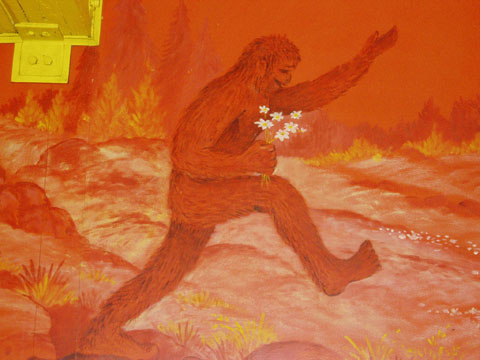
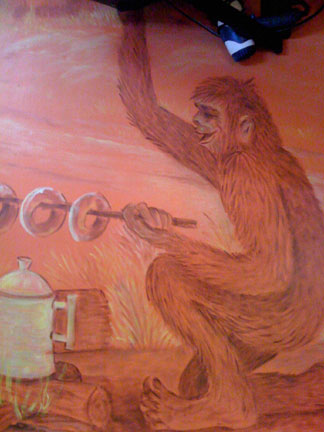
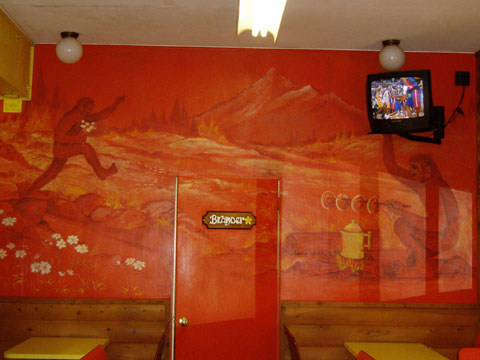
Images: Above and below, the Bigfoot Mural at the Early Bird "Bigfoot Burger" restaurant. Photos by Steven Streufert.

He then concludes the section we are analyzing with "Best Bigfoot Evidence, Past and Present." He speaks of the camcorder as revolutionizing the documentation of sightings, but in fact there are very few videos of Bigfoot, as opposed to the Patterson-Gimlin Film, that have any real quality or credibility. Well, maybe the Freeman video.... He talks about newspaper reports, but didn't he already rule these out earlier as unreliable and not first-hand enough for him? He speaks of DNA from hair and scat being "classified" as Bigfoot, as it often comes back as "not on file" and close to primate. However, the fact is that though these results are intriguing, they are often inconclusive, and often are not on file because the supposed DNA has been corrupted or degraded. DNA of a Bigfoot has never been verified AS from a Bigfoot because there as yet is not a standard set example of what a sample of Bigfoot DNA really is. This is a topic that constitutes interesting possibility, but has yet to prove much. He glances over a few historical bits at this point, with great superficiality and preconceptions.

Odd parasites have been claimed to have been found in some crap that was supposedly from a Bigfoot, but no one knows if Bigfoot made that pile of scat, and no one has to our knowledge actually seen Bigfoot take a dump. Despite this, Dave seems to know that Bigfoot scat looks like "a giant human scat, very large." He speaks of the more recent analyses of footprints done by Jeff Meldrum and Jimmy Chilcutt, but he fails to credit them in particular, and rather just proceeds to use general terms that exaggerate the number of academics and scientists who have looked into the issue and found the evidence to be convincing. In actuality, very few scientists find the evidence credible. This is what makes Meldrum special, and he should really be named and cited here, not just vaguely alluded to. He speaks of the Skookum cast, which may very well be an imprint of a Bigfoot butt, but he totally disregards the fact that there is still hot dispute over this artifact, with many claiming that it is clearly an impression made by an elk. Despite this inconclusive status, Paulides is ready to make the leap into self-validation: "This cast has validated much of the information about the physical aspects (size, weight, body structure, etc.) of Bigfoot." In fact, it really does not do this, but it is still a very interesting piece of possible evidence.

The last paragraph in this section reveals even more. "I am purposely avoiding an extensive description of the Bigfoot evidence because that is not what this book is about. There are many outstanding books in print that offer exhaustive insights into evidence that will satisfy anyone's craving in that area." Well, if this book isn't about evidence, then what IS it about? We'd really like to know. Sightings are evidence, and throughout the book he makes claims to various remains as evidence for the creature. We'd argue that without the analysis of any evidence we are left only with anecdotes. They are stories. Surely an ex-detective police investigator would know this. The stories are great, that is for sure. Some of them are very credible. But don't we want something that could "hold up in court" or convince others that this stuff is real? We need a convincing set of evidence to do this, complete with a logical and coherent system of investigation and methodology. Also, if Paulides is not going to quote or cite any of the researchers or authors of these "outstanding books" on Bigfoot, could he not at least have a Bibliography or Works Cited section? For all of its intriguing and very interesting accounts, The Hoopa Project simply comes up lacking in the end, and leaves any intelligent reader scratching his or her head in skeptical confusion on nearly every page we've reviewed here.

In Bigfooting we need to establish historical consistency, along with logic in methodology, or else we are a rudderless ship that will look like its foudering (or floundering) to the masses at large. Bigfooting needs to become more professional and serious if it is ever to gain the respect it deserves. We need PEER REVIEW, people. It cannot survive solely upon egotism and wild theoretical speculation. Sadly, with so many who just jump into it, without earning their bones and polishing their chops, it often looks like a circus. And human, all too human....

We will continue with this project on The Hoopa Project sometime in the future. Up to this point we have covered the major section of the book preceding the sightings reports. These reports are good, but soon our critical axe will fall in their direction, too. Look for our Part Two coming soon!

BIGFOOT'S BLOG interviewed David Paulides of NABS in 2009, when they released Ray Crowe's newsletter THE TRACK RECORD on CD.
Read that here:
DAVID PAULIDES, of NORTH AMERICA BIGFOOT SEARCH, Interview and Discussion with Bigfoot Books

************************************************************
ANGRY BIGFOOT SPEAKS!

Me so mad, me speech-less! Me fume. Me fester. Me boil over and make stink from here to Weitchpec! Me go roll more rock down in road now. Keep Bluff Creek closed all summer long!

***********************************************************

This weblog, website, soapbox, or whatever you call it is copyright 2010, Steven Streufert, Bigfoot Books Intergalactic. Sharing and borrowing is allowed (and often practiced by us, too) if you give full credit and a fair and nice link back to our page. Thanks!