Showing posts sorted by relevance for query gps. Sort by date Show all posts

Thursday, November 17, 2011

PATTERSON-GIMLIN FILM SITE REDISCOVERED... and DOCUMENTED. The BLUFF CREEK FILM SITE PROJECT Reaches Preliminary Conclusions re. the Location of the True PGF Site.

BIGFOOT'S BLOG
Mid-November 2011 Edition
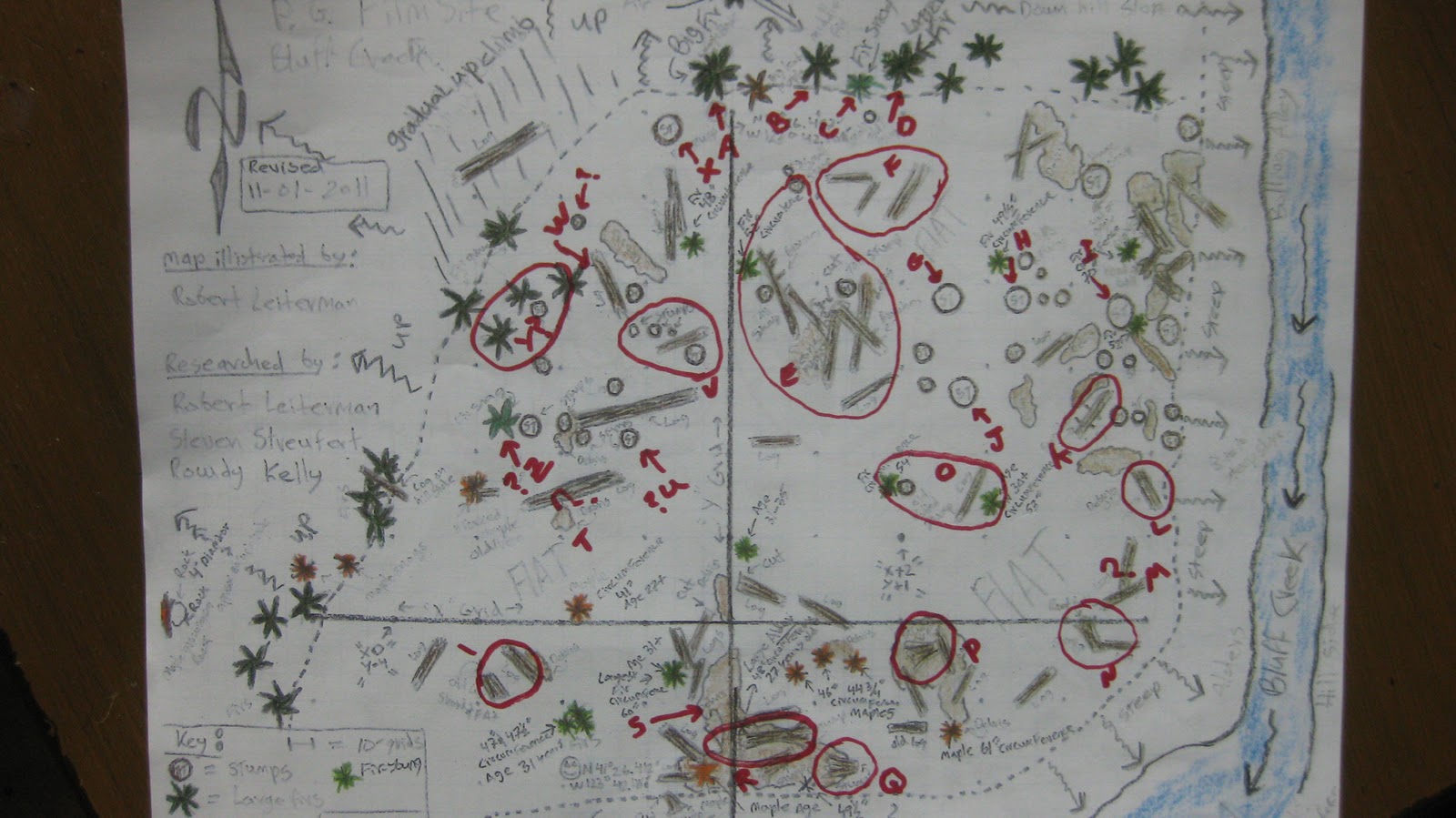
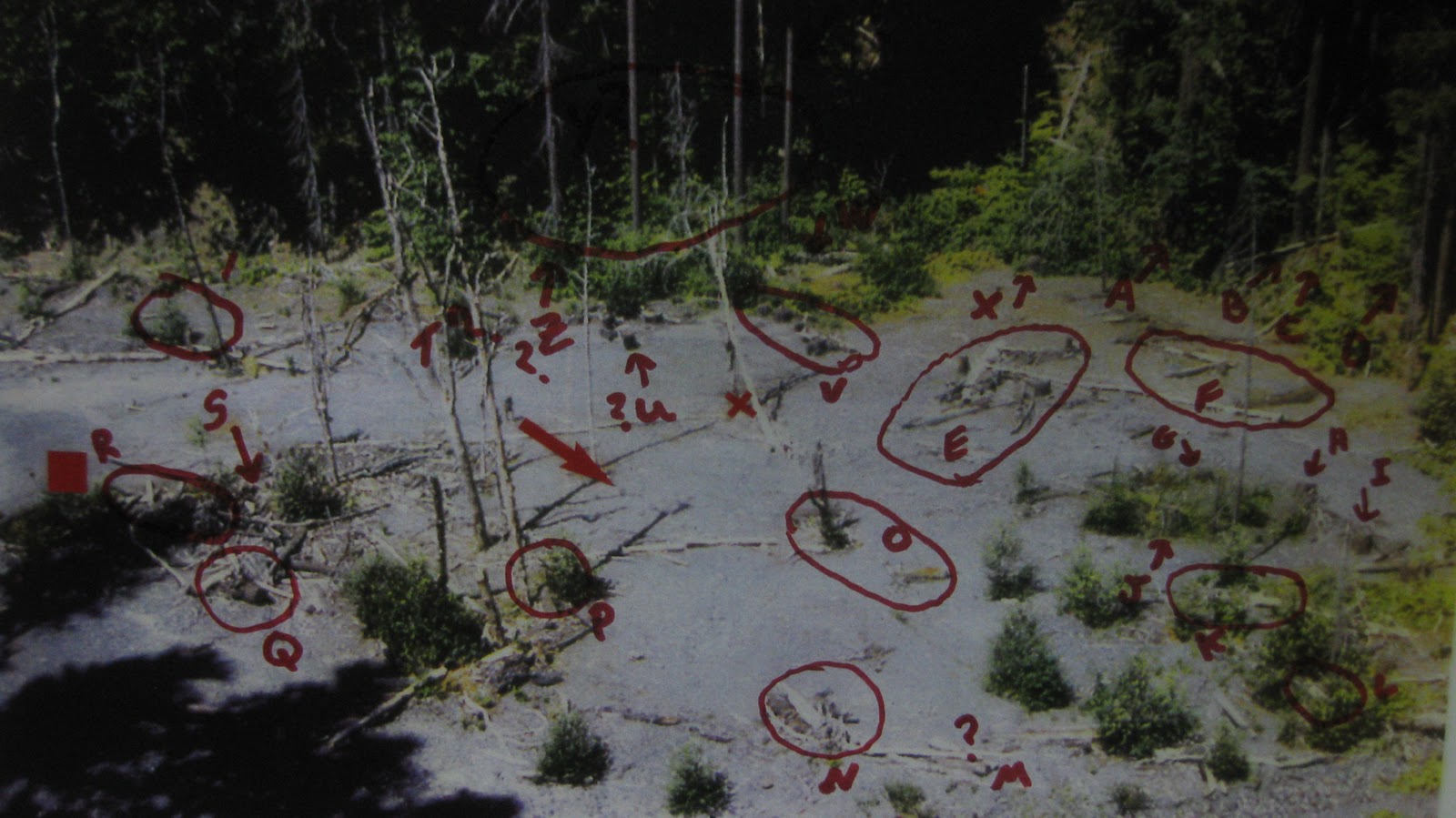
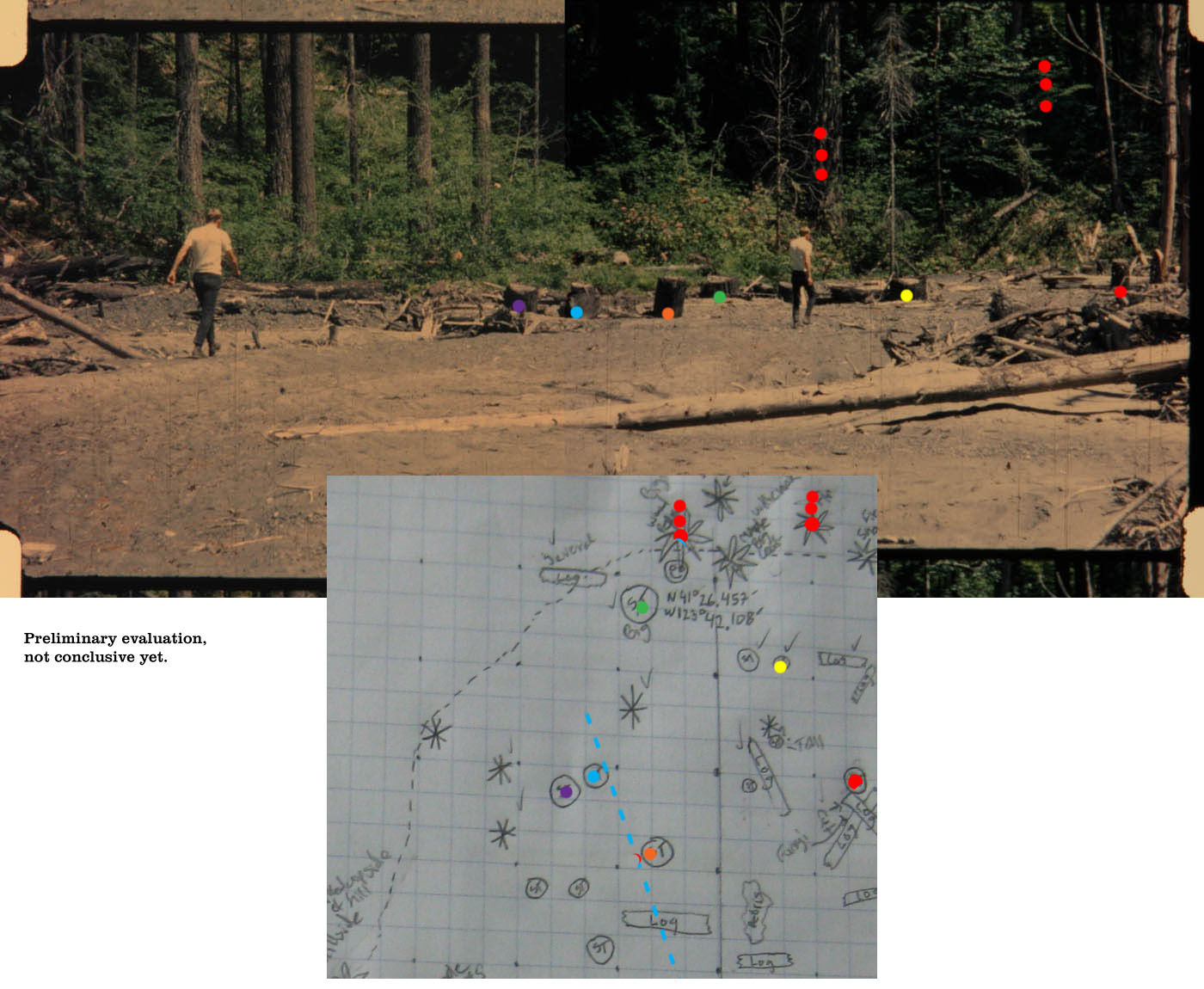
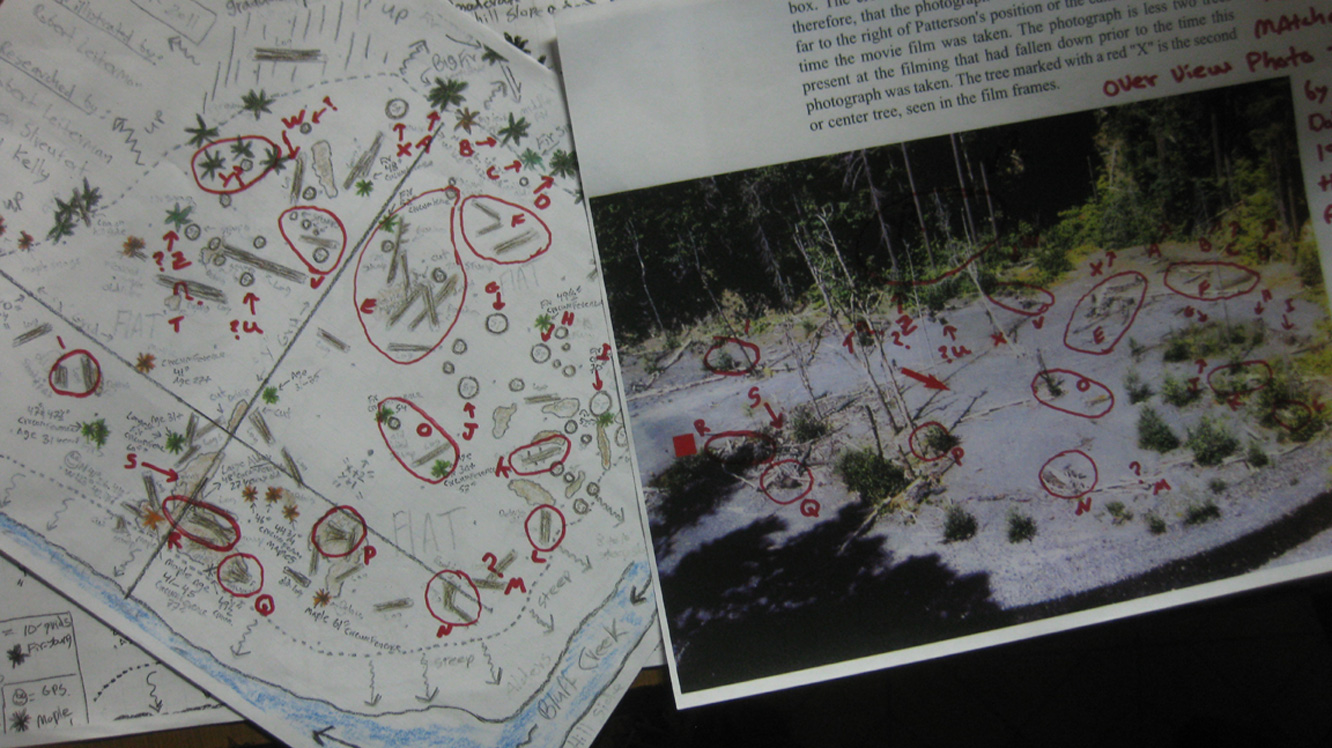
Site Survey Draft 3 compared to a page from Christopher Murphy's book
showing the 1971 PGF site "aerial" photo. Red marks show I think very
clearly that a high level of correspondence exists between features found
on the site today and in 1967.
RIGHT CLICK IMAGE TO VIEW IN MEDIUM SIZE.
Map and marks COPYRIGHT Robert Leiterman, Bluff Creek Film Site Project.

THIS IS THE TRUE PGF SITE.

After four years of investigation, two seasons of serious on-site research and filming, having looked into this mystery of geography and history since 2001, I am very, very convinced that we have finally found and documented the site of the filming of the Patterson-Gimlin Bigfoot Film in Bluff Creek. Though the proof is not officially final and professionally analyzed yet, and one member of our team still has some reservations (this is Ian, who was unable to attend this year's work on the site save for one appearance before our site survey work was begun), we have found enough correspondence to offer this to the world with very high certainty that we have indeed found the site and are able to show it.
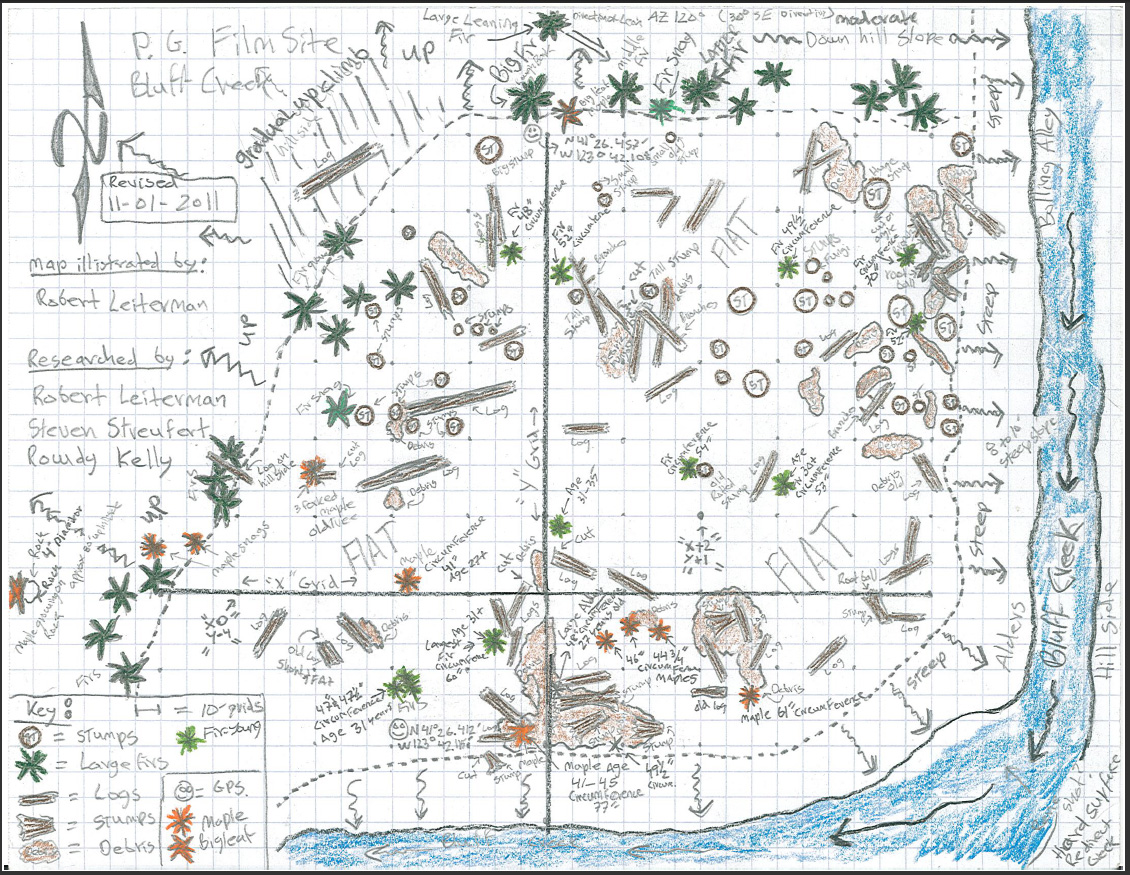
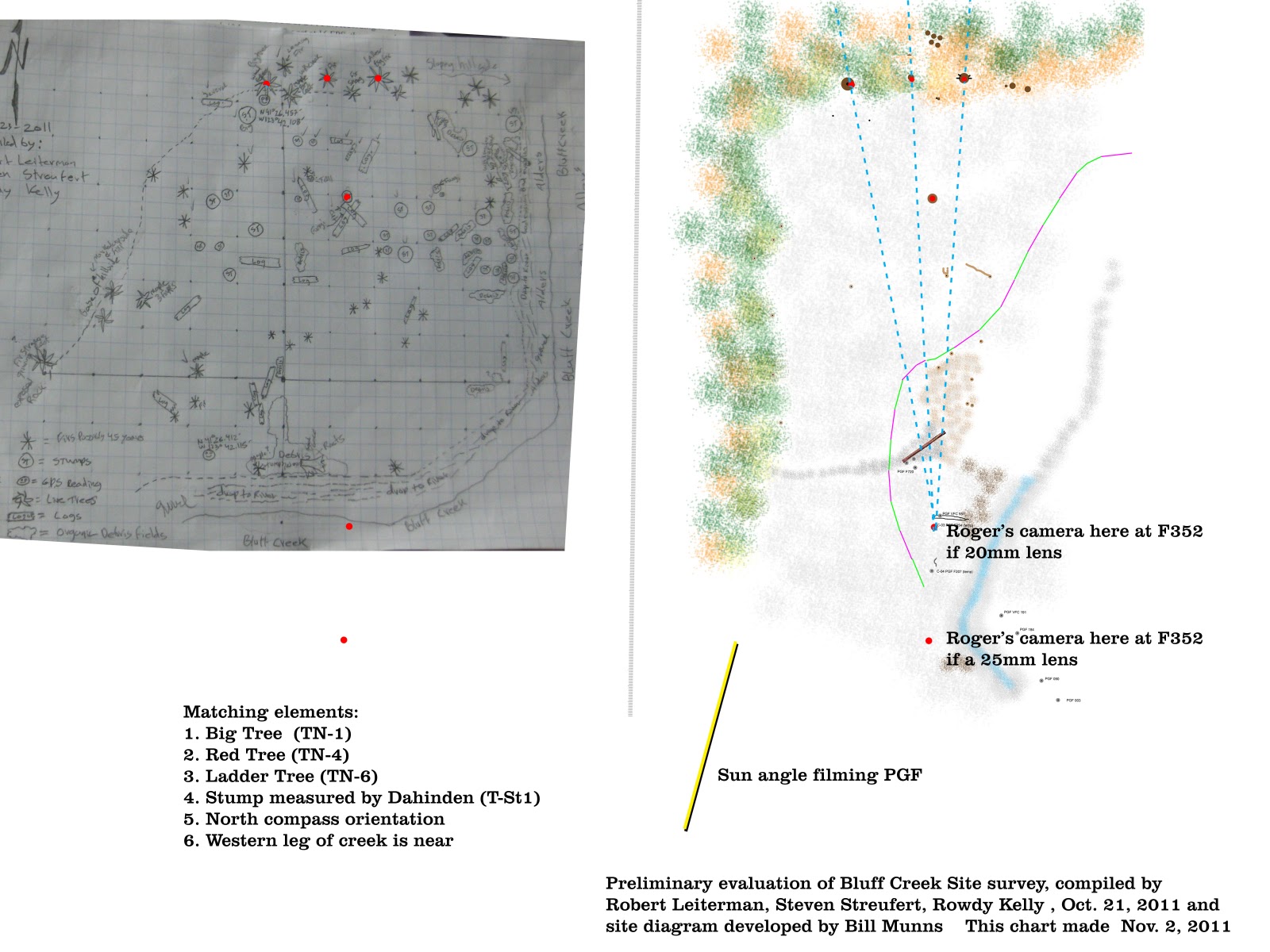
The November 1st corrected and revised map, drawn by  Robert Leiterman.
Copyright. Right Click to Enlarge and Save, for Research Only Please.
Large, half-size image of our map, drawn by Robert Leiterman and copyright.
Right Click to Enlarge and Save, for Research Only Please.
Large, half-size image of  the 1971 (or '72) Dahinden "aerial" shot, matched
with our map. Red pen features drawn by Robert Leiterman and copyright.
Right Click to Enlarge and Save, for Research Only Please.
We did a full (though admittedly a bit amateur) survey grid of the site on the upper sandbar of what we'd been calling the "General Consensus Site Area." Having ruled out so many other untenable "theories" of where the site was, we had determined to give this area good, full and true look. The upper sandbar was the only spot that even came close to having the features found in the film, despite its modern-day appearance as a temperate jungle. This summer we'd found that the lower sandbar area did not match our current information, and ruled it out. However, on the upper area we found a very large tree, one that bore an uncanny likeness to the one seen the the PGF. This last month we determined a true north-south axis from the spot Gimlin had noted as that of the first sighting, and then gridded out the entire sandbar in ten-yard increments, noting all features found in those grids. Lacking Ian, we found Rowdy Kelly, whom we had met during the filming of the Animal Planet series, to be of immeasurable help and film intelligence. This data, all of the older features found on-site, along with the big trees in back and the creek position, was then translated onto a to-scale ten-foot per square map by Robert Leiterman. Folks, this is the PGF site.
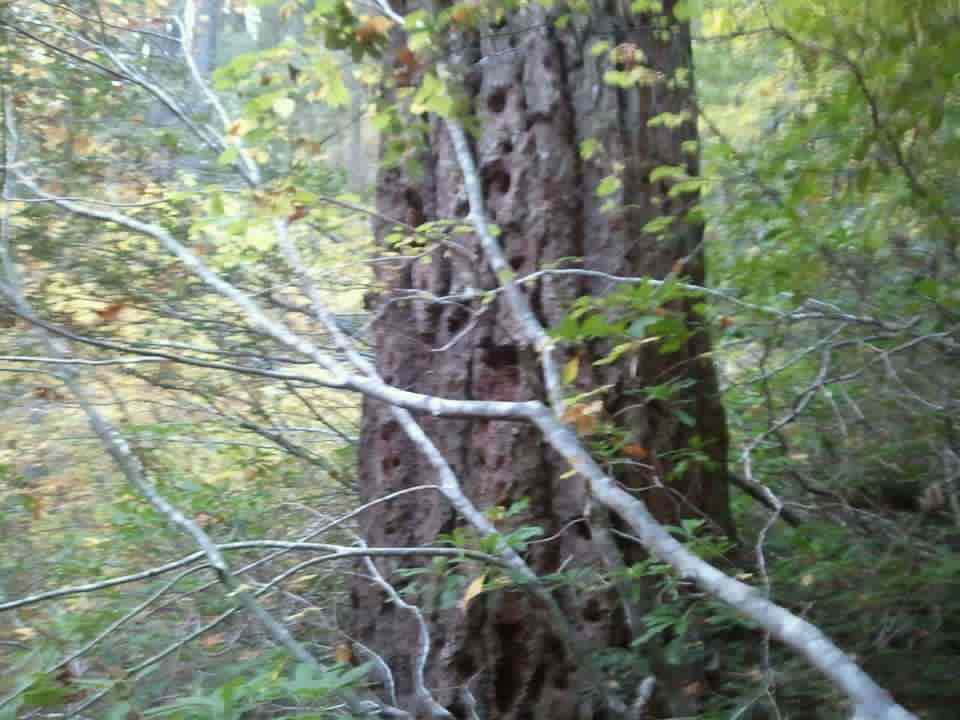
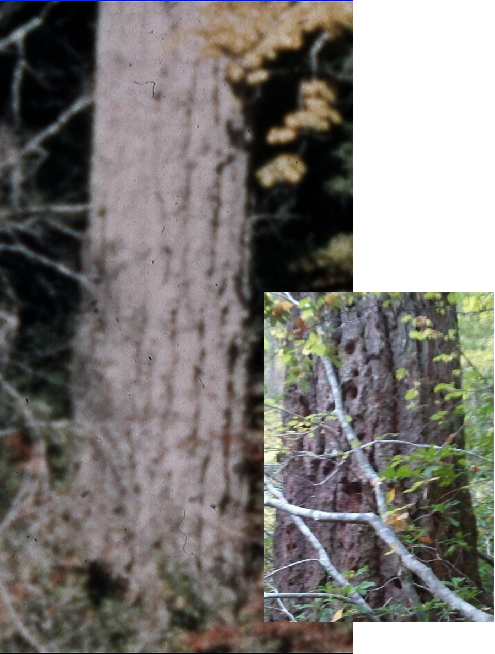
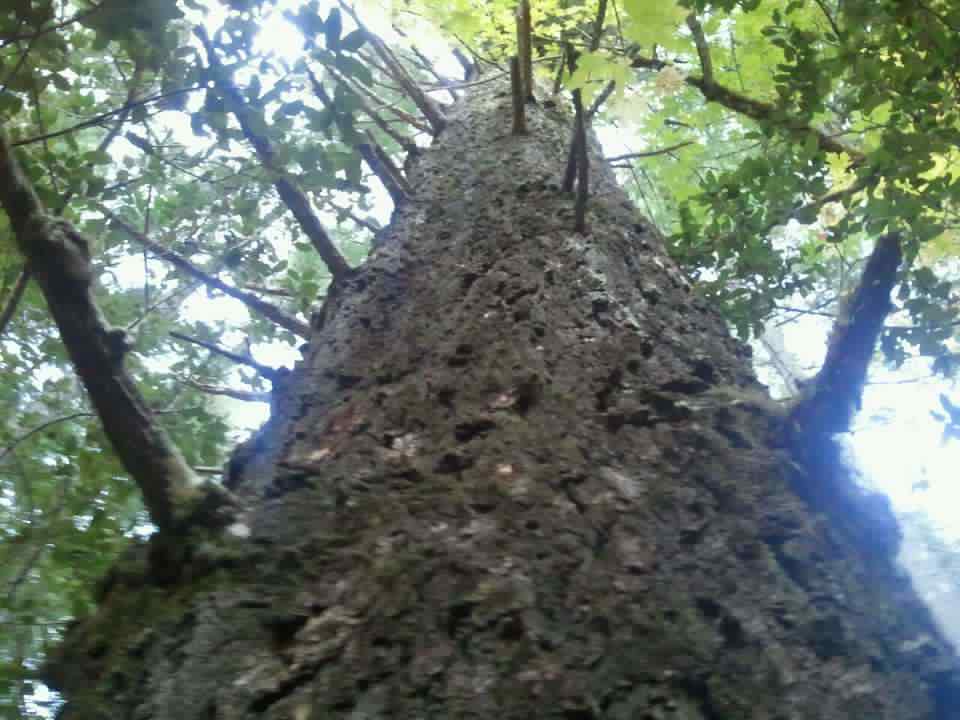
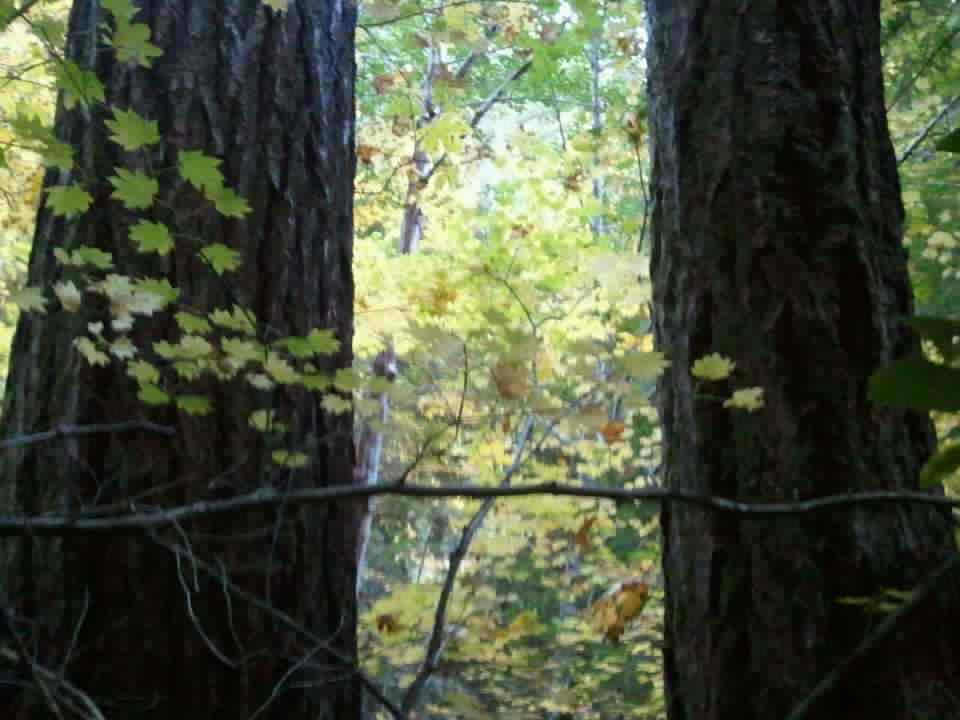
The Big Tree, directly north of the Gimlin first sighting spot on our grid map.
It sits right on the sandbar level, and is the biggest tree in the area.
Note that it bears a large number of woodpecker holes, as recalled by Peter Byrne.
Photo by Steven Streufert, 2011. See very top of map grid for location.
Comparative image from the BFF, my photo is from an angle
slightly to the right.
Some, such as MK Davis, have made claims to the contrary over the years since the 1977 Rene Dahinden/Barbara Wasson/Walter Leeds photos were taken. They are wrong. These photos, provided to us by Daniel Perez (not publishable here until we finally get his permission to do so) are the last images that we have been able to find showing the site recognizably before it became an overgrown jungle of new forest. Since then, no one has to our knowledge demonstrated the location of features readily seen in these images and in the film from 1967. Many have tried to show the location on Google Earth, with flawed GPS coordinates, and photos on web sites and in books that bear no resemblance at all to the site as it was in 1967. We, in the course of our studies on-site, were able to rule out all the sites proposed by other researchers, save for one, the area identified by Bob Gimlin to James "Bobo" Fay, first told of to us by Cliff Barackman. This is the spot marked by Rene Dahinden on Daniel Perez' map.
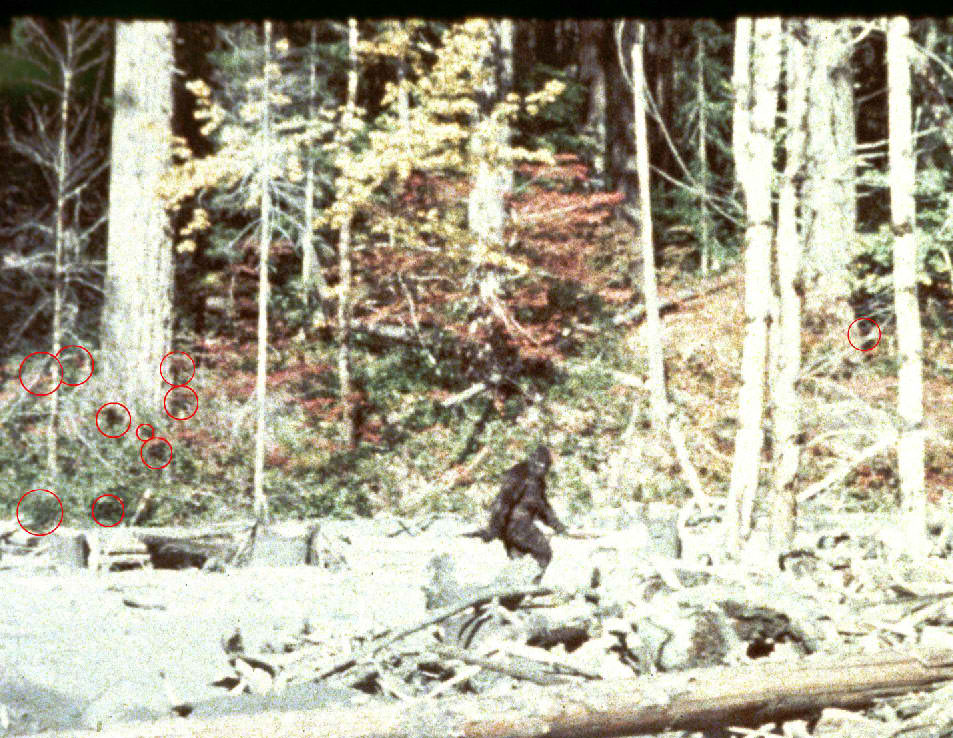
Detail of 1971 photo showing the site before it became an overgrown jungle.
These stumps and large logs are still to be found on-site. We documented
all of them that could be found.
Big Trees cluster detail. Note the leaning tree behind the middle tree, as well
as the spiky snag beside, both still present and documented on-site today.
Rene's "X" in Daniel Perez' booklet BIGFOOT AT BLUFF CREEK.
The compass shows magnetic north, explaining again the diagonal course
of the film action across the sandbar area.
It was not, ironically, the site chosen by Daniel and others present on the general site area in 2003, with the group from the Willow Creek International Bigfoot Symposium. At that event NO ONE could agree. Christopher Murphy published images of the wrong location in his books, John Green could not recognize the site at all, even Bob Gimlin had trouble remembering it, so changed was the appearance of the vegetation in the creekbed. At the end of that trip, however, Gimlin turned to James Fay and said, "This is the spot, Bobo. This is where we first saw her." He had recognized the canyon walls, and settled in his mind that he was in the right spot. Still, no one could agree; and at that point no one could walk up and touch the true "Big Tree" of the film. Well, finally, we have.
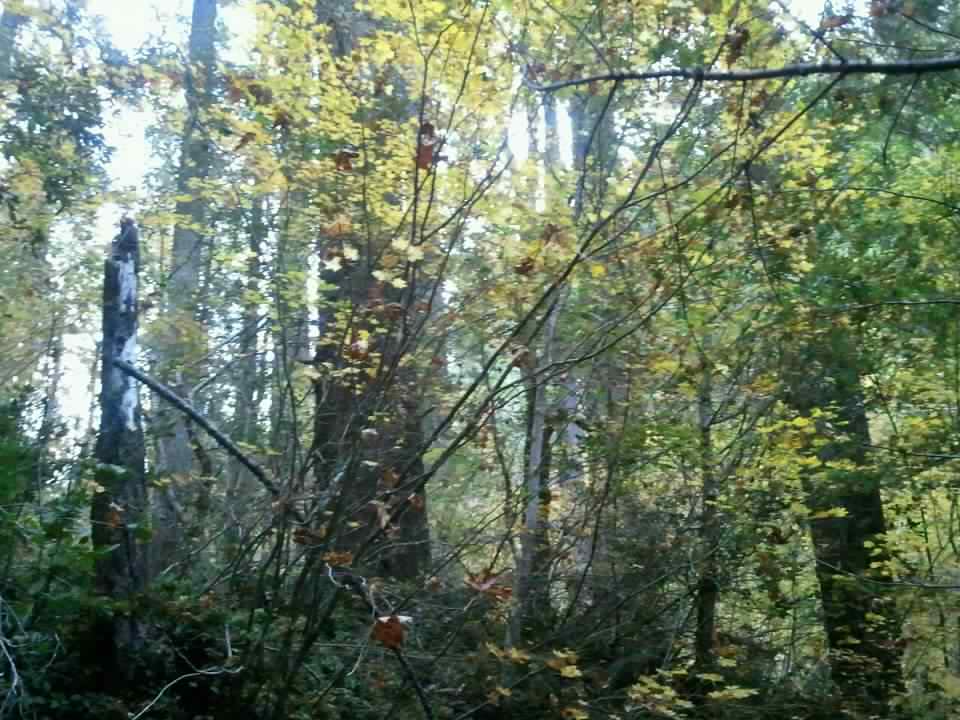
Middle Tree and what is left of the "spiky snag" fir, missing its top.
Note how the tree on left sits higher on the hill, as in the image below.
Photo by Steven Streufert, October 30th, 2011.
Frame 352, showing the Big Tree, the yellow-leafed maple, the middle tree,
the "spiky snag" and then the "ladder tree," from left to right
The "spiky snag," "ladder tree," and background tree clusters.
Photo by Steven Streufert, October 30th, 2011.
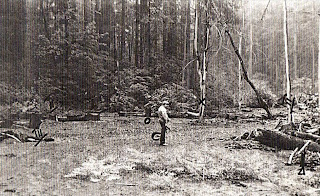
Crucially, we came to realilze, someone had to find the big trees as seen in the film; but not only that, given the long endurance of stumps and large logs on the ground, one should be able to locate those as well. Many, during the course of our investigation, uttered assumptions such as "You should be looking for stumps of those trees, not the trees themselves." Well, we found that the last logging that had been done in the actual creekbed of Bluff Creek in the area where the film was shot was done after the 1964 flood, salvage work conducted in 1965 and 1966. Investigating, we found clear signs of this, with old stumps still there in the ground since that time. No site, however, had the stumps in the right configuration, along with the big, old-growth Douglas fir trees as seen in the film itself, save the upper sandbar of what we've been calling the General Consensus Site. Due to a couple of observations this summer I, with Robert Leiterman, was able to ascertain that the lower and middle sandbar area simply did not match new information and images that we had received since our first season of investigations the previous year. We set our sites on finalizing our site investigations, and finally spending enough time on that overgrown upper sandbar to measure and document it properly.
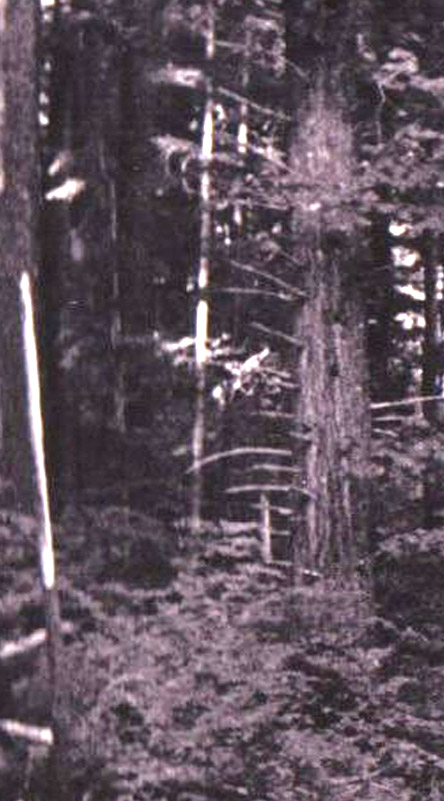
The so-called "ladder tree," still showing its retained lower branches, not
a common trait in old-growth Douglas fir.
Photo by Steven Streufert, October 30th, 2011.
The same tree, in 1972, with the "spiky
snag" to its left.
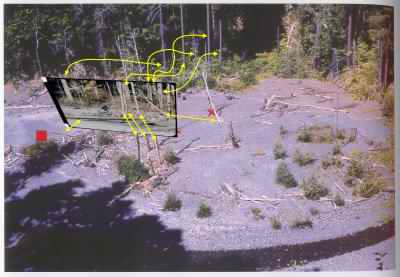
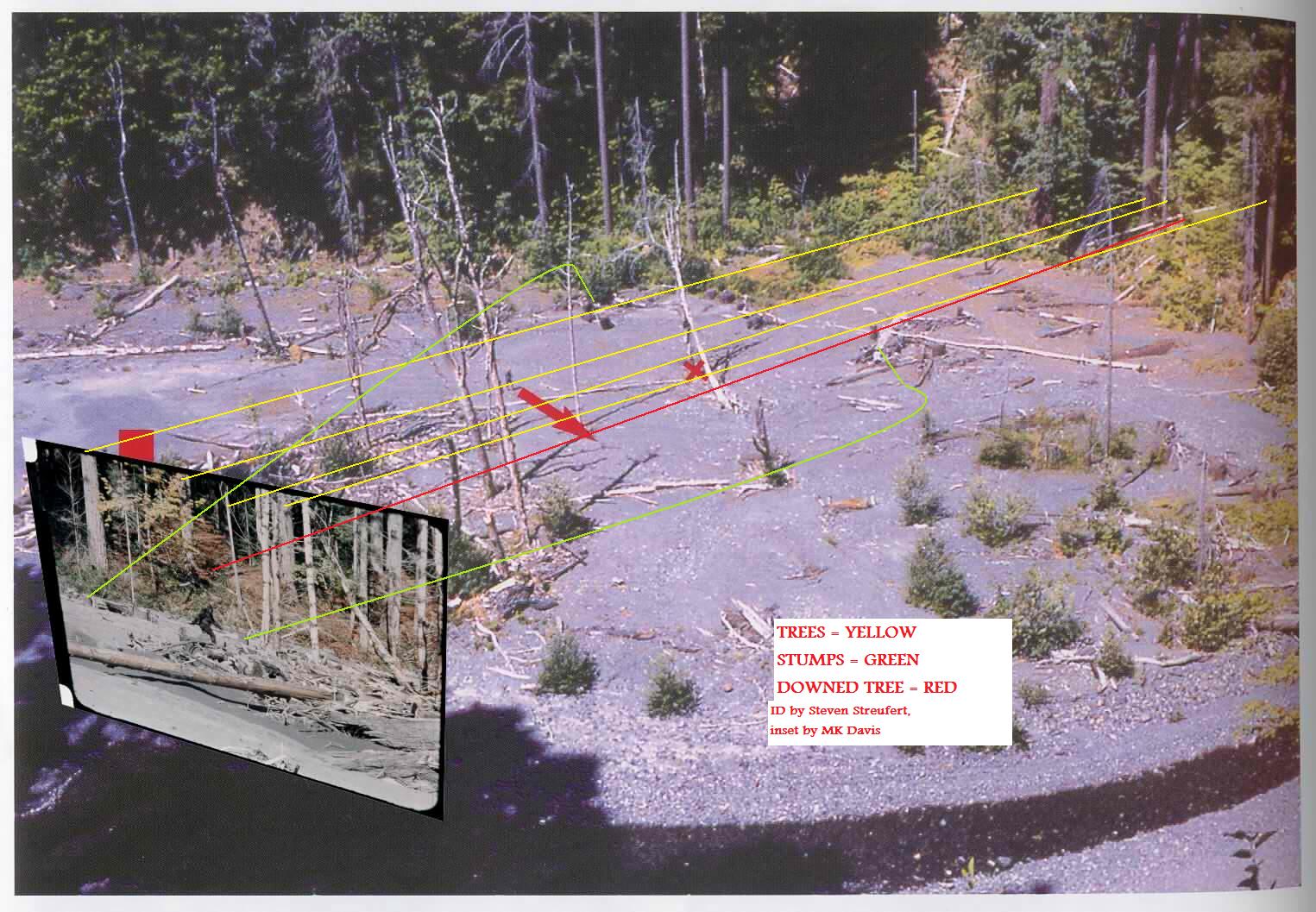
Having had Bob Gimlin return to the site this last summer and reconfirm his 2003 feelings about the location added fuel to our suspicions that he might just be right, even after all of these 44 years since the filming. Then the digital site model work of Bill Munns came in, and my mental image of the site and camera perspective in the film was changed forever. Like an epiphany, old images of the film site fell away, and we were able to look at it as it really was. The camera position had changed greatly during the course of the film, as did that of the moving subject. We realized that the film was shot diagonally ACROSS the sandbar, and it was a moving viewpoint that one sees in the film. It was not as if within a square box, as Christopher Murphy's fine but limited site model diorama represented. One had to overcome the optical illusions of camera perspective and film image flattening. At one point MK Davis published a completely incorrect image with lines drawn to represent the film perspective from Frame 352 superimposed upon the 1971 Rene Dahinden "aerial" photo of the site. I was able, with knowledge of the site, and a little common sense (I am certainly not a "film expert"), to draw in the proper perspective lines (as seen below).
The Incorrect Perspective as represented (and later retracted) by MK Davis.
Perspective corrected by Steven Streufert. Image overlay altered by MKD,
upon Rene Dahinden's original 1971 "aerial" photo of the known PGF site.
Confirmed by Bill Munns.
CLICK IMAGE TO ENLARGE.
Bill Munns, film professional and PGF researcher, fully confirmed this understanding. Hence, we were ready to return to the site with a new mental image. And lo, upon returning to the site with my daughter during the summer, I was able to look to and consider trees way off to the "right hand" side of the site as true and viable candidates for the "Big Trees." We had written off these trees in the past, as they seemed way too far east of the main action of the film, considering the location of the creek and the size of the sandbar. Given our new understanding, it was very clear to me that this site WAS indeed big enough. All we needed was 400 feet from sighting to the end of the film, about 300 feet of actual film action, and that was readily apparent as possible within this spot (and was confirmed by our grid map). Conferring with Robert and Rowdy Kelly, it was decided we would return to the site and not only measure these rough distances, but also do as accurate an amateur survey, grid and map as we could. The map images seen in this blog entry were done from our initial ten-yard grid and flagging work, done with a correct north compass reading for each square, translated into a ten-foot per square map describing the older items present on the sandbar, things that could plausibly have been present in the 1967 film. We were, in effect, removing the new-growth forest, and were able at last to "see the trees from the forest." We were stunned at what we found.
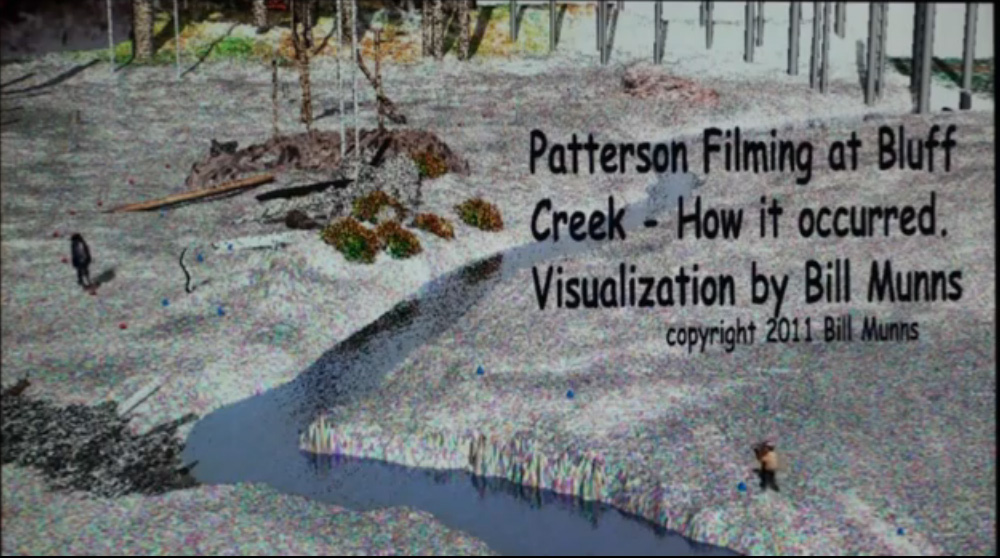
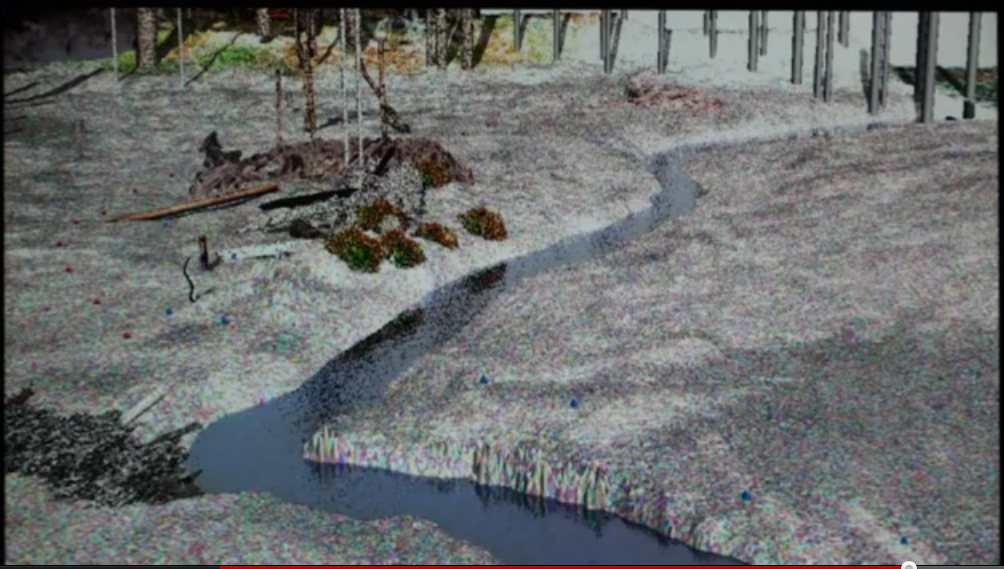
Bill Munns' digital site recreation, as seen in screen captures from his
YouTube presentation. These were derived solely from data contained in
the film itself, showing the curious starting point and creek position that
has puzzled seekers of the site for decades.
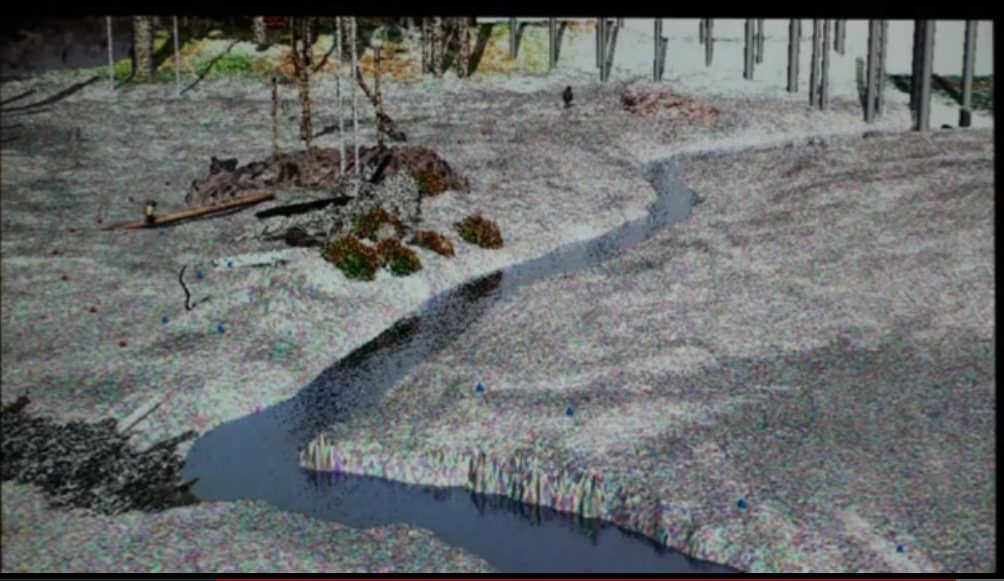
The animation by Munns showing the postion of Frame 352 against the
background trees, with the subject  paralleling the creek.
The later part of the film as depicted by Munns. Note how much the positions
of both subject and cameraman have changed through the process of this film.
When Leiterman took the data home and made two drafts of the map, we saw that nearly every major stump and debris pile we marked as presently on-site could be found in the 1971 Dahinden "aerial" shot. It was simply too much confirmation to be coincidence. The first line we drew in the survey was a direct north axis from the claimed Gimlin first sighting spot. this course led directly to a cluster of old trees, and most notably the biggest darn fir we had found up there at the creek level. Upon consideration, with the photos of the film site in hand, we found the middle tree, the "ladder tree," the spiky fir snag seen between them still standing though with a broken top. Many other features were found. The scales of history fell from my eyes and I was able to clearly see: this WAS the spot. So, we finished our grid, marked out all that remains on the site, and now we feel that we will soon be ready to show more or less exactly where the creature in the film walked, and where Roger Patterson, ran, stumbled, stabilized and filmed the subject.

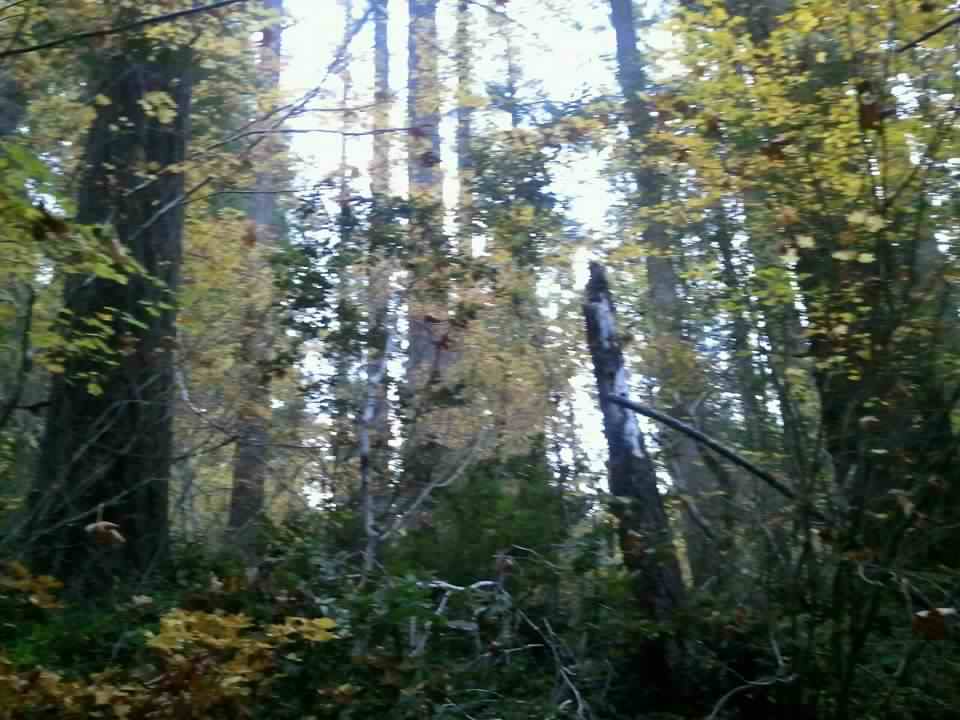
The sloping hillside behind the big trees, letting the light come through.
Photo by Steven Streufert, October 30th, 2011.
The same feature as seen in the 1972 Dahinden photo.
Bill Munns has our full data set and images. Much of this has been posted by me on the Bigfoot Forums (BFF), in the Munns Report thread, under "Film," and the "Patterson-Gimlin Film" subcategory. While he is busy on a job, we await his professional analysis. Should anyone out there with professional qualification wish to aid us in truly confirming and proving that this is the actual site, we'd be happy to establish a working exchange wherein the full, high-resolution images of  our map and map details, complete with measurements and GPS coordinates will be provided. We don't want to "own" this data, but rather are eager to share it with the world. We are hoping that professional analysis will be undeniable and FINAL, at last proving the site location and verifying this special spot on the earth for all of time and history into the future.
Stumps and old sawed log debris, remnants
of the 1964 flood and post-flood salvage logging,
as may be seen in the PGF. Still there today.
Photo by Steven Streufert, October, 2011.
Stumps that were there when Patty walked, still there today. These are the
sort of durable features that we sought to place on our survey map.
 Photo by Robert Leiterman and copyright.
One thing I'd like to say: BOB GIMLIN WAS RIGHT.
Gimlin on the first sighting area, with Finding Bigfoot cast.
From promotional trailer.
Next time on this blog we will have a lengthy guest blogger appearance by BLUFF CREEK FILM SITE PROJECT member and videographer, ROBERT LEITERMAN. He has written a fine piece on the whole process of our "Journey of Re-Discovery," and the frustrations, excitement, controversies and fascinations all along the way. This blog entry today is just the first step, the tip of the iceberg, in revealing all of the data we have gathered.
Bill Munns' PRELIMINARY study based on our first generation grid map.
CLICK TO ENLARGE.
Another Munns' PRELIMINARY study based on our first generation grid map.
CLICK TO ENLARGE.
We would like to thank especially Bob Gimlin, Cliff Barackman, James Bobo Fay, Daniel Perez, Christopher Murphy, John Green, Jim McClarin, Thomas Steenburg, Peter Byrne, Rip Lyttle and Al Hodgson for their help along the way in this research. Thanks to Tom Yamarone and Scott McClean, too, for being the ones who first showed me how to use 12N13H to access the PGF site (else I'd have been lost on Lonesome Ridge Road!). Also, we'd like to extend a full, spitty raspberry to Mr. M.K. Davis, who was of no help whatsoever, would not provide us with his claimed site location, and who generally has spread more mystification and stupefaction than knowledge on the PGF since he veered from his fine original work. Also, to Bobbie Short, sorry, but you were just plain wrong, but it would have been nice to have that map you promised us. Oh well. To all the anonymous commentators along the way, thanks for your input, too.
Old firs, to right of PGF big trees.
Photo by Steven Streufert, October 30th, 2011.
A full new set of our BLUFF CREEK FILM SITE PROJECT videos will appear soon on YouTube. We'll have the links for you here, and through the blog's Facebook wall. These videos will not number up to 45 like the last set, so tune in to see all the things described here and in the maps we've made as they are now, on the ground, in reality and not in myth and human imagination.
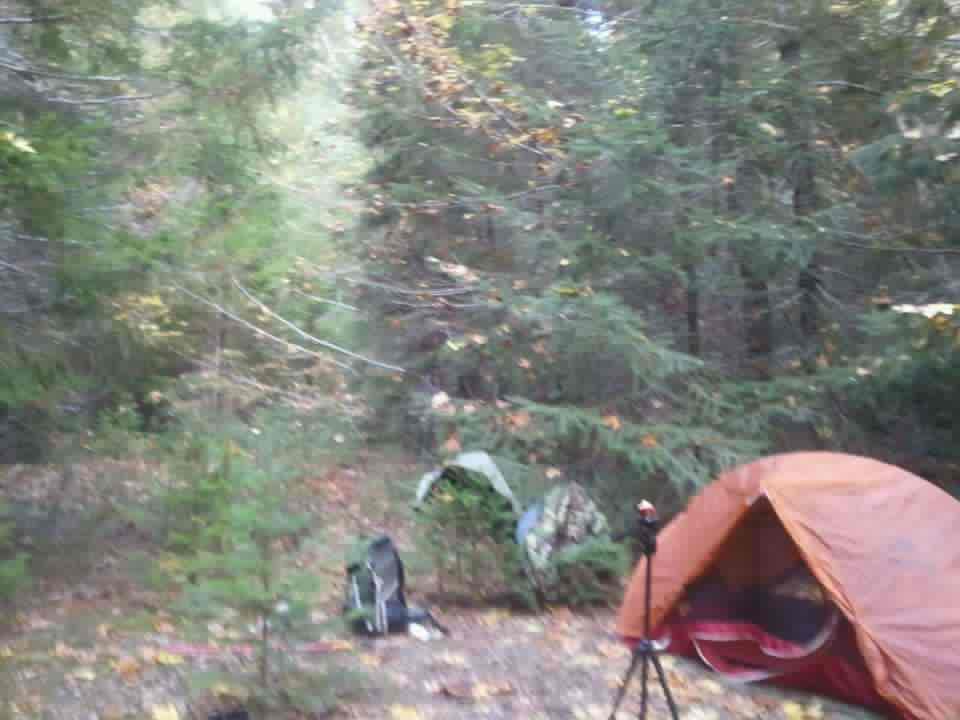
Leiterman's camp, right about where Patterson filmed Frame 352.
Photo by Steven Streufert, October 30th, 2011.
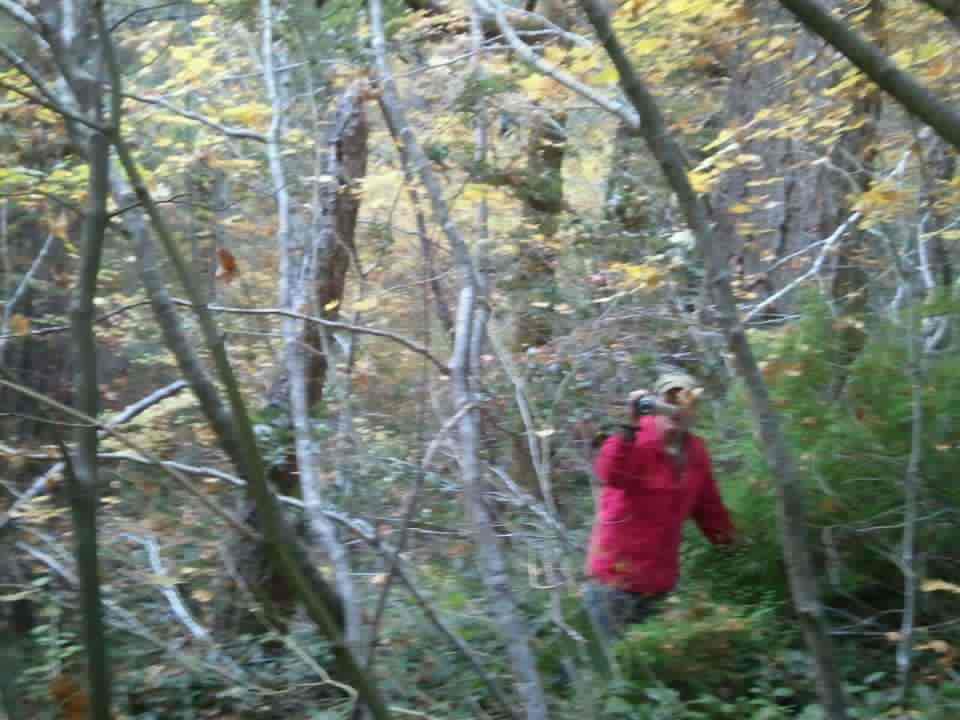
The "jungle" of the film site, right in front of the "Big Tree."
Here is Robert shooting the BLUFF CREEK FILM SITE PROJECT videos.
Photo by Steven Streufert, October, 2011.
(Click the link above or the one below to view all the previous videos we've done on the Bigfoot Books YouTube page. Look under "Favorites" and "See All.")

Best to all ,
Steven Streufert,
Bigfoot Books, Bigfoot's bLog, Willow Creek
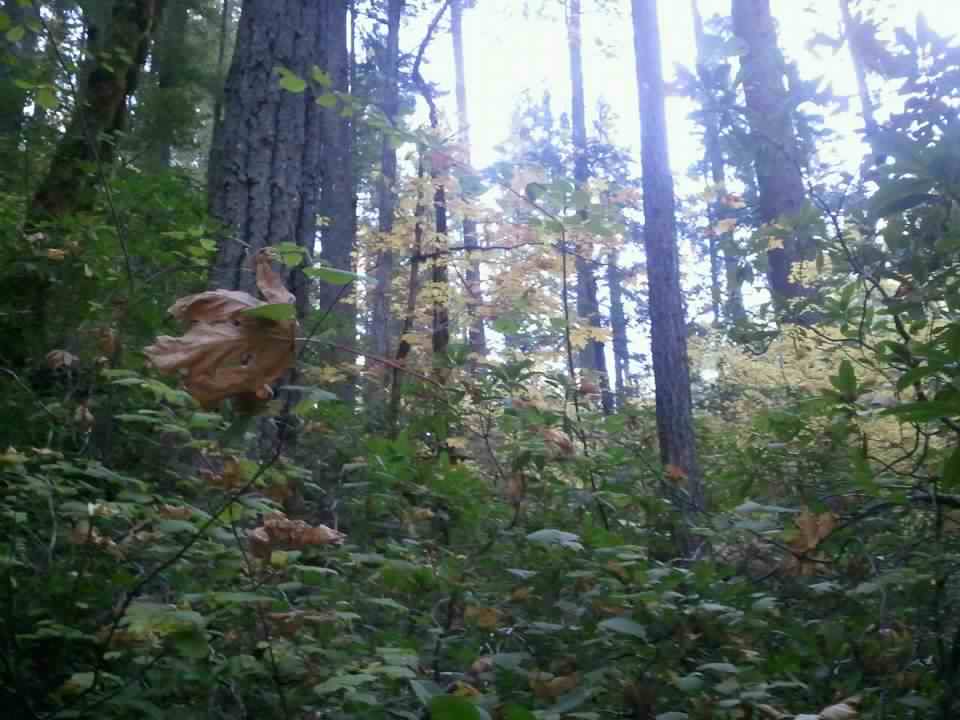
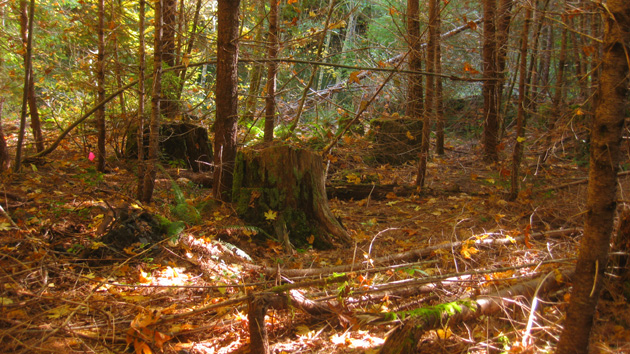
Vine maples, the source of the red color seen in the PGF, still not turned red,
and this on October 30th. So, naysayers, how was it that there was red in the
film if it wasn't shot in mid to late October, or even later?
Autumn on the hill behind the PGF big trees.
Some orange-ish red starting to show.
Photo by Steven Streufert, 2011.
PS--Mr. Marlon Keith Davis, in obvious response to our work, has posted a blog trying (futilely) to make the case for his utterly incorrect film site. Read it HERE.

Here is my response to him:
"Au contraire, MK. We have found the true site, upstream from your location. The proving is ongoing, but the documentation is done. We surveyed and gridded out the sandbar and found not only all the main trees, but also the majority of old stumps and aging log debris piles. What is more, we have made our grid map starting at the very spot Gimlin himself identified in 2003 and again this summer. Having pursued this since 2001, and living near the locality of the filming, I am hardly a "debutante." Not one "expert" has, in our lengthy investigation, been able to identify extant landmarks as seen in the film. Now we have, and there is no doubt remaining."
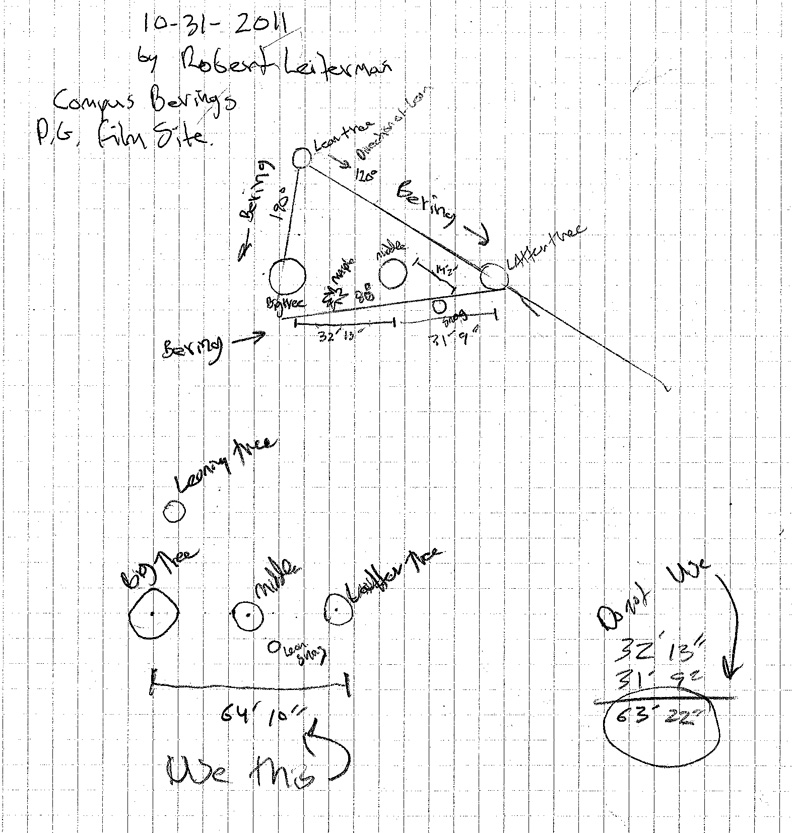
Measurements taken by Robert Leiterman and Steven Streufert on-site.
These show the distances between the big trees, with spiky snag, bent
maple, middle and ladder trees and leaning tree in back.
CLICK TO ENLARGE. Drawing is Copyright Robert Leiterman.
EXPLORE FURTHER: There is much on the BFF through this link to the... Munns Report Thread. We've been working with Bill on this, and he has allowed us to post some preliminary analysis here. The images above were done using the uncorrected first draft of our site grid map. Robert Leiterman has since refined, confirmed and in minor ways corrected the map to the versions seen above. As I said above, we are currently working with Bill, but we will consider a working relationship in the future with anyone out there who would like to work with our images and data.
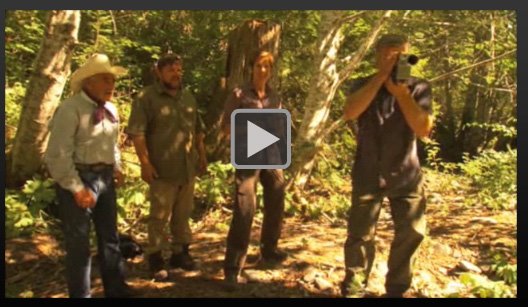
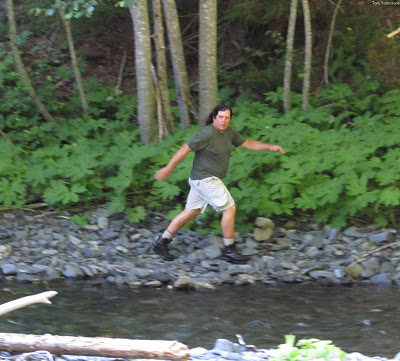
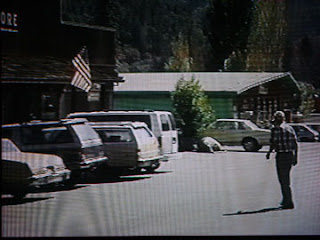
James "Bobo" Fay, a vital link in the PGF site rediscovery process, is seen
here walking in front of the Bluff Creek sandbar. They filmed their recreation
there as they could not get good lighting for the cameras up on the actual
film track-way location. Bobo knows this, but its what you have to do for TV.
(I think this image came from the Finding Bigfoot video, but if you took it,
do notify me and I'll give credit.)
**********
In case your didn't see it, "Bigfoot Books" and myself appeared on a recent episode of FINDING BIGFOOT on Animal Planet. Here is a video clip of that segment someone made.

http://www.youtube.com/watch?v=R2jY-djy-xA

****************************************************
ANGRY BIGFOOT SPEAKS!

Me glad hu-man finally learn to look, like hu-man Sherlock Holmes, and find one real place in woods. Me tire of trying to trick them and them lead to wrong spot. Me think now that they done, a Sasquatch might get some peace and quiet at my Bluff Creek home.

****************************************************
This blog is copyright and all that jazz, save for occasional small elements borrowed for "research" and information or satirical purposes only, 2011, Bigfoot Books and Steven Streufert, with some images copyright strictly by Robert Leiterman. Borrowings for non-commercial RESEARCH purposes will be tolerated without the revenge of Angry Bigfoot, if citation and a kindly web-link are given, preferably after contacting us and saying, Hello, like a normal person would before taking a cup of salt. No serious rip-offs of our material for vulgar commercial gain will be tolerated without major BF stomping action coming down on you, hu-man.

Saturday, February 20, 2010

Interview with AL HODGSON, Mr. Bigfoot of Willow Creek, PART TWO


PART TWO OF OUR INTERVIEW WITH WILLOW CREEK'S BIGFOOT GO-TO GUY, AL HODGSON,
CONDUCTED AND TRANSCRIBED BY STEVEN STREUFERT, WITH ASSISTANCE FROM "C.I." ON FEBRUARY 4th, 2010:
PART TWO, OF THREE.

This being the second part (of three) of the interview, the reader should really read Al Hodgson Interview, PART ONE and Introduction HERE.  Need PART THREE? Go HERE.

This is the second fifty minutes of an interview that lasted over two and a quarter hours. The rest will be posted here soon in one more segment. View Part One through the link above first! This interview was conducted with Al in his Willow Creek home, off Hodgeson Road, by Steven Streufert, with assistance from “C.I.” (who wishes to remain anonymous). Preparation of question background was assisted by “K.A.,” also anonymous, and aided by the ever-perspicacious Daniel Perez. Our investigation of the film site location was also aided by Cliff Barackman, James Bobo Fay, the above two, and many others on the ground and along the way.

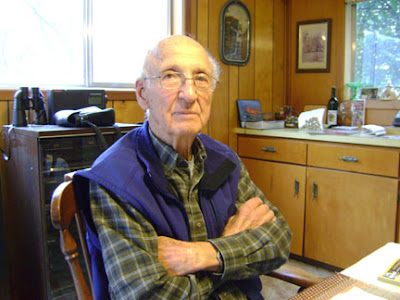
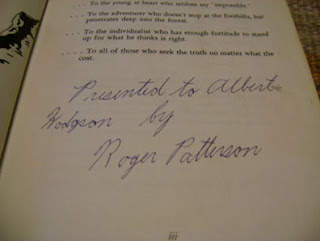
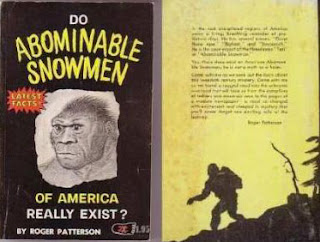
Images: Above, Al Hodgson in his home, 2010, a bottle of "Bigfoot Red" wine in the background; below, the presentation page of Roger Patterson's book, inscribed personally to Al by the author (the dedication lines: "To the young of heart who seldom say 'impossible'; To the adventurer who doesn't stop at the foothills, but penetrates deep into the forest; To the individualist who has enough fortitude to stand up for what he thinks is right; To all of those who seek the truth no matter what the cost." Photos by Steven Streufert. CLICK TO VIEW ENLARGED.

When we left off we were discussing the early events in the history of Bigfoot in the Willow Creek and Bluff Creek areas. We’d asked…

BIGFOOT BOOKS: But, you were running the store, and probably got a lot of reports coming in at that time?
(40:38 of 2:17:11) Now continuing….

AL HODGSON: I did, and I….What really got to me, or how I really got into this thing—I’m sure you heard about Betty Allen?

BIGFOOT BOOKS: Betty Allen the journalist?

AL HODGSON: Yep.

BIGFOOT BOOKS: She was a stringer for the Times, the Humboldt Times, right? Willow Creek correspondent…

AL HODGSON: Yeah. What she did was… there was a column in the Times, it was called “R.F.D.”

BIGFOOT BOOKS: What did R.F.D. stand for? I’ve never been able to figure that out.

AL HODGSON: Well, that was a name for a post office… R.F.D., what was that, it was a name on the post office.

C.I.: I think it was “Rural Free Delivery.”

BIGFOOT BOOKS: Yeah, yeah. Didn’t Andrew Genzoli write that after, later on?

AL HODGSON: Yeah, it was his column. But Betty was a reporter, but she was also a guest on his column. So, she was the one that got to me, she kept after me.

BIGFOOT BOOKS: And she lived up here in Willow Creek?

AL HODGSON: Oh yeah. And see… Did you know Lincoln Martin?

BIGFOOT BOOKS: Heard the name. Yeah, I…

AL HODGSON: Nice guy. I knew his folks, and…. Anyway, she was staying and taking care of Lincoln’s mother, up here at South Fork Bridge, on this side. Lincoln lived across river, and this was on this side of the river, where Lincoln was born and where he lived. Anyway, she [Betty Allen] kept after me... one day she come to me and she said, “Al, there’s been some tracks up there. Would you take me up there?”

BIGFOOT BOOKS: And she didn’t want to go by herself, there was that old story that she was with… [Involving Bigfoot/Oh-Mah abducting human women.]

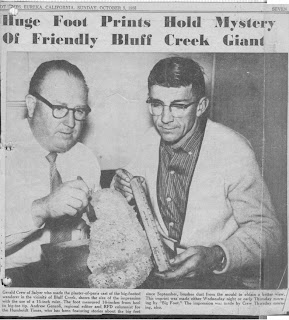
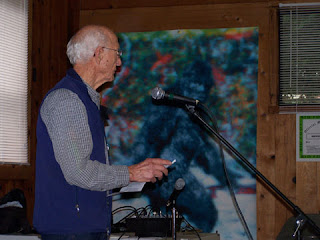
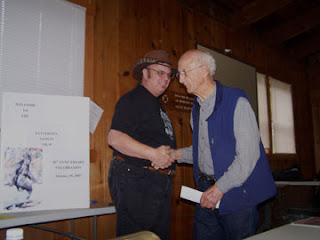
Images: Above, Genzoli with Jerry Crew and footprint cast, archival, Humboldt Times; below, Al Hodgson with the Patty creature, speaking at the 2007 PGF Anniversary Celebration in Willow Creek. Photo: Steven Streufert.

AL HODGSON: I think somebody else was taking her up there before, but she didn’t want to go by herself. But anyway, she talked me into taking her up, and I got hooked to it. I saw some tracks. Well, they knew there were some tracks there, and they had them covered in big pieces of bark, so that, the trucks'd go by they just dust them out, they get covered in dust. They just covered them with bark so that the tracks would be there. So, anyway, we went up there and made casts, and then I found some tracks down in the creek. And Francis [Al’s wife] always will say that they’re fake.

BIGFOOT BOOKS: And she still doesn’t believe. I always heard that she was a hard-core skeptic.

AL HODGSON: She was.

C.I.: And when were these first tracks found?

AL HODGSON: Sixty-seven or something like that. I can’t remember. I can’t remember now.

BIGFOOT BOOKS: So it took you almost a decade to become more interested in the Bigfoot stuff?

AL HODGSON: Yeah, she [Betty Allen] pushed me into it. And I took her up there. And I had a cast laying on the counter there at the store and, at the second store, you know where the pool hall is today?

BIGFOOT BOOKS: Yeah. Oh, you were over there?

AL HODGSON: That was the second store. The first store was on the other side. [Chuckles]

BIGFOOT BOOKS: Well, the first, the store I know is the one that is now the Clinic. I don’t remember what year it closed, but I remember when I first started coming to Willow Creek, I saw the Hodgson’s Department Store…

AL HODGSON: Ah, and the third store, we had that…. But anyway, it was in there, and the cast we had made up there, anyway, I had it laying on the counter. And a lady came in and she said, you know, that’s the same thing we had over at our house, ten years before. OK….?

BIGFOOT BOOKS: And, so, it started drawing those stories in and…

AL HODGSON: Yeah, that’s right. I didn’t believe it! Anyway, same time, got all those things, they sparked the interest. That time, I don’t know who came by the first time. John Green came down and they had the… Northwest… what they call it?

BIGFOOT BOOKS: Pacific Northwest Expedition?

Image: The Pacific NW Expedition crew at their base at Louse Camp, Bluff Creek; Tom Slick second from left, with Rene Dahinden, Bob Titmus and others. Archival.

AL HODGSON: I wasn’t… It was just across the street [Wyatt's Motel, where the PNE met], but I….

BIGFOOT BOOKS: You never met Tom Slick, or anything?

AL HODGSON: No, I wasn’t interested.

BIGFOOT BOOKS: Kind of famous guy, millionaire, globe-trotting, and uh…

AL HODGSON: Yeah. That’s right. John told me that he was, that he had them with the rifle at ready all the time, they was out there, it was like they would be shot, like next to this, and uh… [Chuckles]

BIGFOOT BOOKS: Do you think they were out to shoot a Sasquatch, or were they just afraid they might have to defend themselves?

AL HODGSON: Well, I think, what he was saying was that they’re dangerous, they’re liable to kill ya!

BIGFOOT BOOKS: Like maybe on the streets of Willow Creek, hmm?

AL HODGSON: Yeah yeah right. But anyway he was, I didn’t know any of the guys at the time. Now, Peter Byrne his brother was here. I remember him, but I don’t remember seeing Peter. And after Betty Allen got me interested, and they got the word out, then they started stopping in the store to look. Well, first off it was Roger Patterson.

BIGFOOT BOOKS: When did you first meet him?

AL HODGSON: I don’t know. I can’t tell ya.

BIGFOOT BOOKS: Was it ’66, or sixty…?

AL HODGSON: All I can tell you is that it was before his book was printed.

Image: Passing the torch between two generations, Al Hodgson with organizer Tom Yamarone, after speaking at the 2007 PGF Anniversary Celebration in Willow Creek. Photo: Steven Streufert.

BIGFOOT BOOKS: That was ’66, right. Now, I think he got started in 1963… or something?

AL HODGSON: Well he had to have… As a matter of fact, he gave me this book.

[Al shows his copy of Roger Patterson’s book, and the inside where it is personally inscribed to Albert Hodgson. Photos are taken, see above.]

BIGFOOT BOOKS: That’s amazing. That’s great…! Yeah, it’s so sad that Roger passed away so early, I never got to see him alive, I was just a little kid when all this stuff happened…

AL HODGSON: But you know, I was surprised that he lived that long. See, he had the Hodgkin’s disease.

BIGFOOT BOOKS: Yeah, he was looking pretty ill and thin in some of those later pictures…

AL HODGSON: Now, I know about Hodgkin’s disease. Francis’ grandmother had it. Terrible, terrible death.

BIGFOOT BOOKS: It’s a form of cancer, it’s debilitating, how is it, in the lymph system…?

AL HODGSON: Yeah. From what I can recall they said she had bumps, all over her body.

BIGFOOT BOOKS: Roger was such a strong guy, known for his physical performance in rodeo and acrobatics and things like that.

AL HODGSON: Oh yeah, yeah yeah, oh yeah...

BIGFOOT BOOKS: And he really lasted a long time. He was ill before the movie was even shot.

AL HODGSON: And what they did, and he told me was, and, I didn’t ever expect to see him again. Because of knowing what happened to Francis’ grandmother. But then, John Green told me was, he had this chemo, and he thought he’d die, almost did die, from the chemo, but it brought him through it, and after that, he got the film after that.

BIGFOOT BOOKS: And he was kind of a health nut, drinking lots of juice, and nuts and berries and stuff. He just wanted to cure himself. He was a really determined guy, and… Everyone likes to think of him as either a hero or a hoaxer. What was your feeling about Roger when meeting him, as far as his character and his honesty, or his sense of humor, or whatever you want to say about him?

Image: Roger Patterson with the Bluff Creek Patty footprint casts. Archival. Some say this photo was taken by Larry Lund, in Yakima, WA after their return from Bluff Creek... is it true?

AL HODGSON: I never seen a bad side to him at all. That’s not to say that he wouldn’t be the guy that would, might have a good time with a joke sometimes. Most of us would. But serious things like that [Bigfoot], I’d say NO. I don’t think he would have, or from what I seen…

BIGFOOT BOOKS: And he was serious about finding Bigfoot, too…

AL HODGSON: Oh yeah, he was. That’s right.

BIGFOOT BOOKS: He wasn’t out to do something fake. He believed in it.

AL HODGSON: And you can see all of the evidence, that research that went into his book, there’s quite a lot there.

BIGFOOT BOOKS: And especially in that time, the Abominable Snowmen [Legend Come to Life] book by Ivan Sanderson came out in 1961, and this [Roger's] was pretty much the next book. And they’re still calling it the "Abominable Snowman," not "Bigfoot." Even though Bigfoot got started in 1958, that’s when that word got out, from here…

AL HODGSON: Anyway, it was, now, I never had any reason to think that Roger was not up and above board. Now that doesn’t mean that I know it all either…

BIGFOOT BOOKS: But you had conversations, too, and he came in and talked to you a lot about Bigfoot and…

AL HODGSON: Yeah, many times.

BIGFOOT BOOKS: He was down here how many times, like before the film? Do you remember?

AL HODGSON: I can’t remember.

BIGFOOT BOOKS: It’s several?

AL HODGSON: Yeah, several.

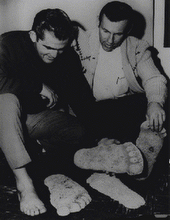
Image: Historical, Roger and Bob Gimlin pose with the casts they made at the site of the Bluff Creek film.

BIGFOOT BOOKS: There were at least three that I read about, that he was down here. And Bob Gimlin, too, did you meet him?

AL HODGSON: I can’t say I remember seeing Bob before the film. Now I don’t say, or didn’t, I don’t remember.

C. I.: Had you met Roger and Bob in town that October before that night they came in with the film? Had they stopped in previously on that trip?

AL HODGSON: No, no. See, what I think they did... I called, and then I didn’t see them until afterwards. The reason being, they came down from the north, down the 96, I-5 from Yreka down the 96. So they didn’t have any reason to come out here, and I didn’t see ‘em until afterwards.

BIGFOOT BOOKS: But you are the guy who called, after the Blue Creek Mountain tracks? And John Green had talked to you, right, and had left and gone back to Canada. That would have been late August to early September, according to John Green’s book.

AL HODGSON: Yeah, I think so. It was still summer.

BIGFOOT BOOKS: And after that you called?

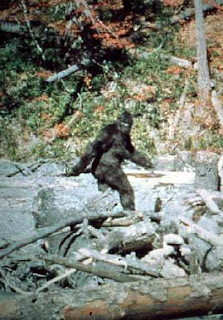
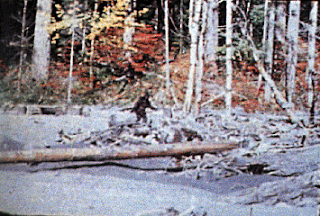
Images: Above, one of the BCM trackway prints (looking suspiciously like one of the footprint stompers that Ray Wallace made--or did Wallace copy these?) Below, Patty on Bluff Creek. MK, if you want to see RED just look at those red leaves in the background--you don't NEED "three clicks" of exaggeration.

AL HODGSON: Yeah, he asked me to call, and I didn’t know John and Roger’s--they might be at each others’ throats or something else--and so I didn’t want to call and talk to ‘em. So I waited until John left and I called Roger, and Roger said, well, I said they probably left the area by now. And he, Roger, said, "Well, I think I’ll come down anyway. I’ve been wanting to come down anyway," and he came down. I understand that, and I didn’t know this, but Gimlin had to make arrangements, because he’d been working. He couldn’t just take off and go. So, he had to make arrangements before he could go, and so that delayed them coming down a little bit. And that’s one of the reason it wasn’t until October that they finally got the film.

BIGFOOT BOOKS: Apparently he said he had an on-and-off job, like he would work two weeks, and then have two weeks off, or something?

AL HODGSON: Yeah, yeah. And he had to have someone cover for him. I don’t know.

BIGFOOT BOOKS: So, definitely, you called and it was in September by then, and they came down probably a few weeks later?

AL HODGSON: Well, I don’t know exactly when they came down…

BIGFOOT BOOKS: You don’t know, they didn’t call you when they came in? They definitely called you on October 20th, after the film. When you called, if you remember, when you called did you talk to Patricia Patterson at first or was it Roger at home? You’ve probably heard this question before.

AL HODGSON: I don’t know. I don’t remember.

Image: Promotional photo of Al from the Willow Creek-China Flat Museum, home of the Bigfoot Collection Al helped to establish. It houses the Bob Titmus materials, and current rumor has it that it may also hold the John Green archives someday (hopefully that day is a long ways off).

BIGFOOT BOOKS: I think that’s one of the ones that Bill Miller asked you from our questions list…

AL HODGSON: Yeah I just don’t remember. I can’t say. I’d like to say “yes” on the phone, but I just can’t do that.

BIGFOOT BOOKS: Yeah, because… there’s that issue that, you know, that people want to prove that Patterson was there at the same time as these guys, and that he participated in “The Massacre,” and…

AL HODGSON: I know, I know. Well, you know, see, they’re trying to, for whatever reason… I don’t know why they’re trying to do this!

BIGFOOT BOOKS: Well, it’s accusing them of murder, isn’t it? Because they’re the very same people that believe Bigfoot is human, MK and Dave Paulides, they’re both “Human” believers.

AL HODGSON: Ah yeah, Paulides is. But that’s just because of what Paulides has seen and heard, down the river [in Hoopa], that’s where they get that idea; but that doesn’t necessarily mean that it is. But, besides that, no one knew that before, either, at that time. They didn’t know what Paulides knows now. And so, if they killed one, it wasn’t necessarily because of, premeditated, in other words, it wasn’t a…

BIGFOOT BOOKS: A self-defense kind of thing. MK likes to say it was not a massacre, it was more like self-defense. But then in June, this last summer, he told me that they were hired by a logging company to go and kill the Sasquatches because they were getting in the way...
AL HODGSON: Ohhh boyyy. [Groans]

BIGFOOT BOOKS: …and so this story has changed on several occasions, its kind of slowly evolving. And now it’s just gotten out of hand. The GCBRO guys have a video [interview] that MK took of you, and they’re presenting little clips of it, like where “Al Hodgson proves that this dog was an attack dog and vicious” and…

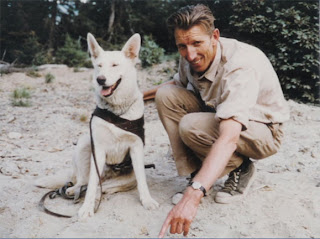
Image: John Green on BCM, with the "killer" dog, White Lady. Yeah, right, MK! That smiling dog John is petting sure looks vicious to me.

AL HODGSON: I didn’t prove it, but when I, I don’t know where he got that. We met the plane, up there [in Orleans, in August 1967], I took my station wagon up and we met the plane. My oldest son, Mike, he and the handler, I guess, was in the back, and then, maybe there was three of them back there. John and I, I was driving, and then Dahinden. Four adults and one….
BIGFOOT BOOKS: Then this guy [showing the pilot photo, see image] wasn’t with you at the time?

AL HODGSON: Ah, I don’t think so. I don’t know who he is! [It is known that the pilot stayed in Orleans for the first part of the trip, and was only up on the BCM site later, after they returned to Orleans for phone calls.]

BIGFOOT BOOKS: John Green says “Thanks to Al Hodgson we were met with provisions at the Orleans airport.” And then it doesn’t really say whether you actually came out or not.

AL HODGSON: Well, John doesn’t remember it that way. He doesn't remember that I... He said that Pat Butram came with a Jeep for him. Well, Pat Butram didn't even know that this was going on at the time. My brother, well, Pat Butram was a school teacher, and my brother was a school teacher, and they knew each other, they were friends. And anyway, apparently, what happened was that Butram and my brother, and my brother's passed away so I can't go back to him, they... I don't know about Butram, he was up in Canada and so I don't know whether he still is or not. But anyway, they apparently went up the next day and they had a Jeep, and Butram went back with Jack, and left the Jeep for John. And that's where it comes in, the Jeep. But I took them up there. In fact I talked to them, I...

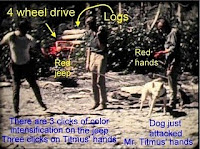
BIGFOOT BOOKS: Would that be their Jeep right there? [Shows the image MK Davis uses, with the truck and red Jeep in the background.]

AL HODGSON: I don't remember. I don't have any idea. But, I talked to my son the other night, and I said, Mike, tell me, do you remember the incident of us going up there in Orleans, and picking them up, and taking them up there. And he says, the only thing I remember is going up to the airport, because that was such an uphill airport. You had to land uphill. And they used to kid about it, because, they kidded about flying into Orleans, because you landed there straight up, coming in. Taking off, you had to fly around the barn!

BIGFOOT BOOKS: It was kind of a narrow approach, wasn't it?
AL HODGSON: Yeah, yeah. Anyway, he was impressed with how steep it was. He remembered that. And I think that's about all he remembered. And I said, I'm not giving out your name. Now, he has kind of a sensitive job. He's in the software industry, and he doesn't always get paid to be a...

BIGFOOT BOOKS: "Bigfoot-associated"?

AL HODGSON: And I said, I do not give your phone number out, I tell them whatever information I can, but I will not give your phone number out. I just wouldn't do it.

BIGFOOT BOOKS: So, basically, you went back to Willow Creek after that. You didn't go up to Blue Creek Mountain and look at the tracks that time?

AL HODGSON: No, I had the store to run, and I went back down. And that night Francis closed the store, and the next day I had to open it up and, no, so I was busy. And I did not go back up. Now, I remembered, and I can't even think of the guy's name now, that came down from the Museum, and I can't even remember now, Provincial Museum, or something like that...?

BIGFOOT BOOKS: Oh, Abbott? Don Abbott, I think.
AL HODGSON: Yeah. Abbott, yeah.

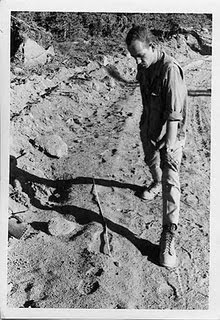
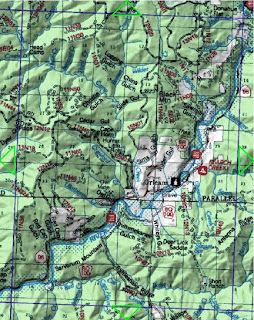
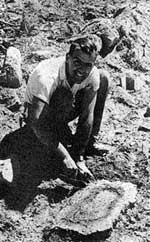
Images: Above, topo of the Orleans area, CLICK TO ENLARGE. Also, Don Abbott on the BCM site, removing a track that has been solidified in the ground with glue.

BIGFOOT BOOKS: He took a few days to get down, from B.C.

AL HODGSON: They had to get a hold of him and they, it took some time.

BIGFOOT BOOKS: John Green says, kind of vaguely, two days or so, Don arrived, and while they were waiting they heard about the tracks that were down on the sandbar, that were supposedly a few hundred yards downstream from the PGF site that... was going to be filmed later. So, then what happened after that...? Where were we?

AL HODGSON: I don't remember.

C.I.: We're still at John Green's second trip, in the summer of '67.

BIGFOOT BOOKS: Yeah, well, just going back to the timeline, in late August he came down here for the Onion Mountain stuff, and then left after, I assume, a few days. He doesn't say how long he was down here.

AL HODGSON: I don't even know if I saw him, when he was down, or not.
BIGFOOT BOOKS: It just says late August. He came down with that dog [White Lady, the tracking dog], then, and he said he met you...

AL HODGSON: Well, he might have.

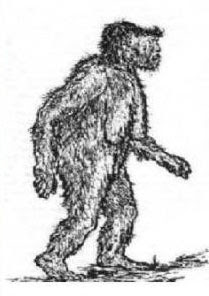
Image: One of Roger Patterson's pre-PGF illustrations of a female Bigfoot creature.

BIGFOOT BOOKS: At that time, meets Al of Willow Creek, and also meets Mrs. Ryerson, and then drove back to Canada.

AL HODGSON: It's possible that I seen him, that, they were coming, those guys came into the store quite often...

BIGFOOT BOOKS: Well, my bookstore, I don't do that either. Eventually it starts to sink in, you get to know enough people, it starts to sink in, so that, oh, that's Ken, the Bigfoot guy, who has a Sasquatch on his property over in Oden Flat. After seeing him about ten times, he's slowly starting to tell me more and more.

AL HODGSON: True.

BIGFOOT BOOKS: But from this point I want to have a tape recorder, and record all these stories...

AL HODGSON: [Laughs]

BIGFOOT BOOKS: ...because, maybe somebody's going to ask me questions when I'm 80 and I'm going to go, I don't remember that! What are you talking about? I don't always remember the day after it happened, always, and...

AL HODGSON: It's hard to remember, and I'm amazed I remember as much as I do!

BIGFOOT BOOKS: Well, you're sharp as can be, I think.


AL HODGSON: Well, I don't know about that [Laughs], but I know I'm, it's, I dunno...

C.I.: It's great to have this opportunity, to get some more questions on record, for the future. And these, these crazy stories on the internet... will come and go.

BIGFOOT BOOKS: Ohhhhh! Well, some of those things I don't even mess with.

C.I.: Well, some of them are just based on the silliest of minor technicalities. It's almost not worth the time.

AL HODGSON: Well, those are people that have nothing to do! That's why I say, I got more to do than to mess with...

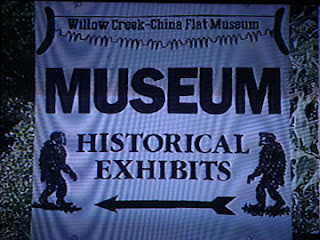
Images: Above, Al Hodgson walks in front of Hodgson's Store, Willow Creek, before it closed and the building became home to a clinic. Below, the Museum's sign proclaiming Bigfoot and Historical Exhibits. Al was a curator, and is still involved. Taken from an A-and-E television documentary.

BIGFOOT BOOKS: Now, MK did such good work with the film analysis...

AL HODGSON: I know!

BIGFOOT BOOKS: And you could say the same thing about Dave. Paulides did such great work with interviewing all of those people out in Hoopa. I don't understand, like this email that was sent to you. All of a sudden. He said something along the same lines to me, about the Ray Crowe archives and the film. But this got leaked out, you know, from Dave Paulides to you, from June, this last year. Anyway:
“I actually got my hands on a fairly old copy of the P-G film, full-framed, with segments on it nobody has seen...” (except for John Green, or people who saw the documentary), “...It is in the hands of experts, and many of our impressions of what occurred is [sic] playing out.” But he says that, “I actually believe that John Green and Gimlin are harboring a very, very dark secret, really.”
AL HODGSON: Yeah, I, I, leaked that to John Green...

BIGFOOT BOOKS: So, you're the one he sent it to...

AL HODGSON: And that's when the fires started flying.

BIGFOOT BOOKS: And what did you feel when you got that email from him? And was there any precedent for it?

AL HODGSON: I told him, it was wrong. I told him that that's not right. There's no way. And I told him why. But you know, sometimes you can get something in your mind that's so tough it is hard to, regardless. But I know better. But I, MK was somethin'... he had the habit of coming here late at night, ten o'clock in the evening, at night, and wanting to talk to me.

BIGFOOT BOOKS: All the way from Mississippi?

AL HODGSON: And it was OK, but not all the time, you know. There's times you cannot help. But this last time he was telling about how, they killed one and this is a skin over here, and it was buried, and uh.... And I said, in the first place, what did they do with the skin? What did they do with it? They buried it. But why? Why skin it if you're going to do something else with it. And what about the carcass? They buried it. With what? A backhoe! And I said, wait a minute. There's no backhoe down in that creek. And I said, I was there the next spring and there was no tracks.
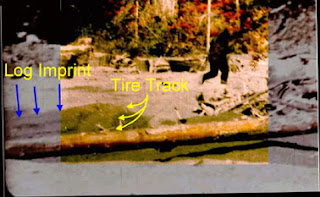
BIGFOOT BOOKS: MK sees like one rut, that's near a log, and he told me that that's the tire track, and I'm saying, where's the rest of the tire tracks...

AL HODGSON: That's right.

BIGFOOT BOOKS: And why didn't anybody else report all of this construction activity when they went...

AL HODGSON: But that's, that picture, beginning with, that's Blue Creek Mountain, and the film site was down in the creek.

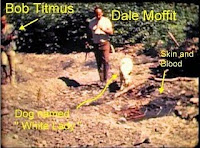
Images: From Dahinden BCM film and the Patterson film, lettering applied by MK Davis.

BIGFOOT BOOKS: So those pictures you saw earlier, they're on the Blue Creek Mountain, and you're going to be seeing road conditions like that out there, with the tire tracks and all. But in the actual film [the PGF] he sees blood on the ground, and...
AL HODGSON: Yeah, I know.

BIGFOOT BOOKS: And also, this is all green foliage in these pictures, but they’re claiming that the P-G film was taken in an earlier period. But as a local you’ve obviously seen the color of the leaves, like, there’s yellow and red and brownish…

AL HODGSON: Well, John was going to call me about that, let me know about that time of year, was there frost, we got, was it leaves turning at that elevation. What I did, I went and checked the elevation up there, and then found a place here about the same elevation.

BIGFOOT BOOKS: That’s about three thousand to five thousand feet, approximately…

AL HODGSON: Well, the creek is not that high.

C.I.: The creekbed is about twenty five [thousand feet] or so…

AL HODGSON: Very similar. Not quite three thousand.
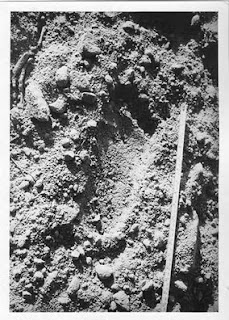
Image: One of the OM-BCM tracks in dirt roadway conditions. Archival.

BIGFOOT BOOKS: So we’re talking pretty close to our local hills here.

AL HODGSON: Yeah. And at early October the leaves are turning red up there.

BIGFOOT BOOKS: Yeah, and yellow. And anyone who has traveled on the 299 or lives here you know that fall has come. I mean, September and August are really summer, and all of a sudden in October, with the first cold snap, those leaves suddenly start turning yellow…

AL HODGSON: That’s right.

BIGFOOT BOOKS: And NOT before,

AL HODGSON: No, September they really don’t. It seems like it’s October, and now, some years, it might be a little later.

BIGFOOT BOOKS: Plus or minus a few days, or weeks or…

AL HODGSON: That’s right.

BIGFOOT BOOKS: I’ve been living up here, or coming up here, since ’93 or so, and I always remember the fall leaves. It’s always October.
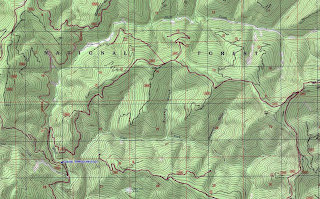
AL HODGSON: I like this map here. [Looks at the Six Rivers Forest Atlas] You got it down at the station?

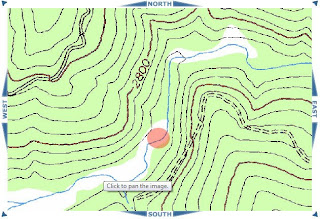
Image: Bluff Creek headwaters area, image from C.I.'s GPS unit. CLICK TO ENLARGE.

BIGFOOT BOOKS: Yeah, from the ranger down at the station. Since we’ve mentioned the ranger, can we talk about that night of October 20th, 1967? There are all these questions about the timeline, and apparently Roger came and told you that they went over Martin’s Ferry Bridge? And there’s questions about whether you could go over the Bald Hills Road, or go to Eureka over the 299, coming down the 96. And also, these other things, whether there was an airport used or a post office…. I’m sure you’ve heard this a million times, but it would be really good to clear it up, I think.

AL HODGSON: Well, I try to; but the thing of it is, I can’t. You know one thing, the road was open. You could go over the Martin’s Ferry Bridge at that time. You go Bald Hills and go out to Orick, and then you go to Eureka. They used to go into Eureka that way, but I don’t know if they would save any time, or not. They told me, Roger told me they mailed the film at the post office, it was the main post office at that time. It’s there on, ah…

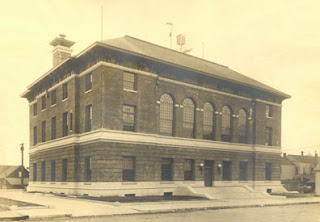
BIGFOOT BOOKS: In Eureka, that big red brick building there? It’s like three or four stories tall.

AL HODGSON: Yeah, it’s on 4th Street. It’s on H Street, and I can’t remember what, maybe it was 5th or 6th or…. Yeah, anyway, he told me he mailed it there.

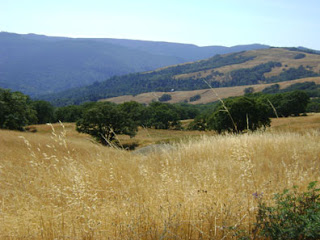
Image: historical, the Eureka Post Office, 1910, where Roger told Al the P-G film was mailed. Below, Bald Hills, Humboldt County, photo by Steven Streufert.

BIGFOOT BOOKS: Now how could… I’m not saying he’s lying or making up something, or you’re not remembering correctly, but I’ve always been puzzled by that. The post offices probably closed at 5:00 then, as they do now. Right? How could they have done that if they left around 3:30? Is what Bob Gimlin says…?

AL HODGSON: It wasn’t three thirty. [Talking over interlocutor]

BIGFOOT BOOKS: …and came into Willow Creek…? Oh, they left from Louse Camp area where they were camped, and got out over the road and into, well, over Bald Hills Road or else over the 96 coming into Willow Creek. And Gimlin in his 1992 interview with John Green says he came from the film site to town to see Al Hodgson, which I assume, “town” meaning Willow Creek first. Is that how it happened?

AL HODGSON: No, no. Now, I should say, I don’t want to say that wasn’t how it happened, that wasn’t what Roger told me. Roger told me that they went over Bald Hills, over to Orick, and then to Eureka. Now, could they make it there before the post office was closed. Yeah. I think, but whether they could make it there, and then over to Willow Creek by that same time, well, I don’t know. By shortly after 6:00?

BIGFOOT BOOKS: Well, it took me almost two hours to from up near the Bluff Creek Bridge or whatever, to go up over the Bald Hills Road over to Orick, it took me like an hour and forty minutes. And then it’s like forty some [more] miles from there into Eureka. And probably out from the film site to the 96 it’s got to be at least a half an hour, I would estimate closer to an hour to get out on those dirt roads. So, I mean, it’s like 3:30, 4:30, 5:30… they’re not getting into Eureka until it’s like 7:00 or something, on that route. Whereas if I come down by Willow Creek, it’s only about thirty miles from Willow Creek to Weitchpec and the Bluff Creek area there. But, right by the road to Fish Lake, it’s 29 miles.

AL HODGSON: I never tried it. I thought, how can you make it down there and back to Willow Creek, and make it back by shortly after 6:00?

BIGFOOT BOOKS: Well, you were working and you went home. You came home and it was like 6:15 or so, and you were cooking hot dogs on the barbecue, and…

AL HODGSON: Well, I, that’s again, I started to build a fire. But that was, I don’t know exactly what time. I’d usually close the store at like 6:00, and it takes me a little bit of time to close, and get mopped up, and take the money to the bank, and then came home. It probably was 6:30 by the time I got home. That’s a guess…

BIGFOOT BOOKS: Well, that adds fifteen minutes, because a lot of people say 6:15…

AL HODGSON: Well, it’s possible, see. I don’t know. But I have no way of knowing.

BIGFOOT BOOKS: You don’t know, aside from what Roger said about going over Bald Hills and stuff, is it possible that they came to see you first?

AL HODGSON: No, I don’t think so, because, unless they went back after… See, what they told me was, they were anxious to get back to the horses. And when Syl McCoy called and wanted to meet with them, and we talked then for some time, oh, I don’t know, and hour, maybe two maybe.

BIGFOOT BOOKS: And they had already delivered the film at that point…

AL HODGSON: That’s right.

Image: The Byrne film site photo, featuring Mike Hodgson, Al's son. The two below the maps are by Green and Dahinden, respectively. Historical.

BIGFOOT BOOKS: So maybe Bob Gimlin’s recollection isn’t correct.

AL HODGSON: Well, I wouldn’t say that is wrong. It’s possible. It’s possible that Roger, that Bob’s time when they left up there is a guess. Maybe no, maybe he’s wrong? I don’t know.
BIGFOOT BOOKS: Things are tricky in that canyon, too…

AL HODGSON: That’s right.

BIGFOOT BOOKS: …you can be down in there at the film site and feel like it’s much later.

AL HODGSON: Yep.

C.I: Personal experience there, boy. I think everyone who’s been up that creek…

AL HODGSON: Well you’re down there, that canyon’s so steep…

C.I.: Exactly. It’s deceptively steep, and the sun disappears very quickly.

BIGFOOT BOOKS: And it was getting dark, he [Gimlin] said it was already getting dark when they left. I mean, starting to, but that could have been in the afternoon with the sun disappearing behind the canyon wall.

AL HODGSON: And it doesn’t take long when it starts getting dark in there.

BIGFOOT BOOKS: And it was also Fall, and the days were shorter. I don’t know if there was daylight savings back then…

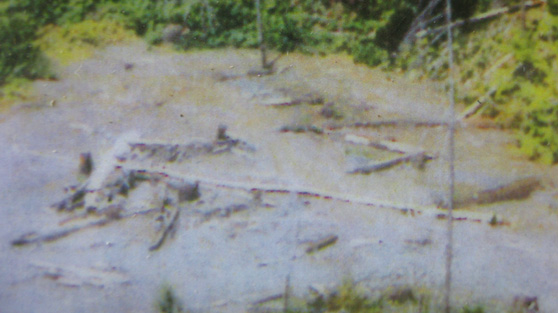
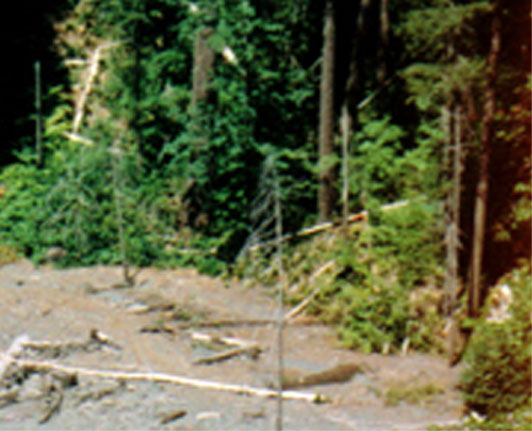
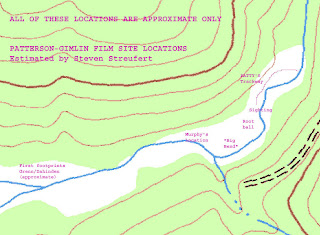
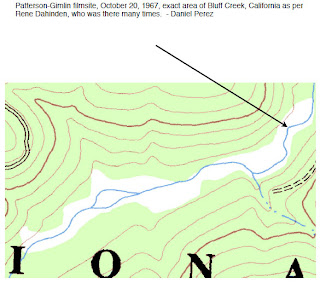
Images: Three film site location estimates, Perez after Dahinden, from Barackman, and our own rough estimate, below. Estimate only! CLICK TO ENLARGE.

AL HODGSON: Yeah, but I’m not sure how long it lasted at that time.

BIGFOOT BOOKS: I’ll have to do some research and…

AL HODGSON: It used to be that it wasn’t quite as long as it is today.

C.I.: Now, we spend more of the year on savings time than on regular time. It had changed over the years and ah… We’d, several of us had discussed that question a few years ago, when we were there on the anniversary of the date. So the sun should be in the same position… at that point, thirty-eight years later, I guess

AL HODGSON: Yeah, that’s true.

C.I.: Now, the area we were in, the north bank would be in shadow before 2:00, and at that point it wouldn’t look like the film does. But we were operating probably more upstream than the area you’ve showed us on the map and talked about. So the light could be a lot different. We were in an area that was basically running almost due east, due west to due east. And the sun was pretty much behind us, being blocked by the ridge.

AL HODGSON: Oh yeah…

C.I.: And if we were further downstream, where the creek is more north-south, then there would be more light. It wouldn’t be blocked quite as soon.

AL HODGSON: There’d be more light late…

C.I.: And that makes the location a little more important for finding the exact time this thing happened…

AL HODGSON: And then you know… And then another thing that I found out, too, and I didn’t find this out until, I don’t know if too many people know it either…. There’s this man up here, he was a logger, and he had a cabin down near the bottom of there where you come out there onto the highway, down Bluff Creek. They had a trailer, they were fallers, this guy and another fellow had a trailer, because they lived here down in Willow Creek, or Salyer rather. And so they stayed in this trailer over the week, while they’re…. And they said that Roger Patterson and Bob stopped at their trailer and asked them if they could take a shower. Apparently it was because they was all muddy from getting that, pulling the truck out, up there, when it rained there that next night. Now that isn’t the timeline that they took the film in, but they left out there and they come out. Now I don’t know if this will make any difference to anybody. But apparently this happened. By the time I found out about it, he and his partner had both now passed away, so I…

BIGFOOT BOOKS: You can’t really verify it.

AL HODGSON: I knew him very well, in fact I knew his brother, his twin brother, and his twin brother told me about it. And before that I didn’t know. So anyway, for what it’s worth, that’s apparently what happened. And that was the reason they had got that backhoe that night, to get themselves out, and they were filthy. [Laughs]

BIGFOOT BOOKS: The backhoe was up, not where MK Davis supposedly says, not down on the sandbar; but from my understanding they got out across the flooded creek, where they were camped on the opposite side of the road, and it was going up the hills toward Onion Mountain Road—there’s constant mudslides and stuff in there—that was my understanding of where they had [to use] the backhoe, up on that road there. It was used in the Blue Creek Mountain construction, not down in the creekbed.

AL HODGSON: Yep, oh yeah, not, definitely not. And like I said, there’s no evidence of it being in there the next spring at all. Period. And I say I was there. I know it wasn’t. And you know something? I don’t know, some people will never be satisfied.

BIGFOOT BOOKS: Yeah, they won’t. Especially the skeptics, though.
AL HODGSON: Yeahhh!

BIGFOOT BOOKS: Like, I believe Roger and Bob were telling the truth. And I also look at the film and I see a real-looking creature. It’s hard to imagine it being faked.

AL HODGSON: I don’t know…

BIGFOOT BOOKS: But the skeptics write books about this stuff, and they say it must be a hoax because the timeline is wrong, or because the timeline is wrong they must be lying and therefore they massacred Bigfoots.

AL HODGSON: [LOL]

BIGFOOT BOOKS: You know, and all these confusing, all these uncertainties lead to false ideas. So I just try to look at the simplest thing. To me the simplest thing would be to drive to Willow Creek, talk to Al, and then drive to the airport. Because the post offices would have been closed, wouldn’t they? How could they send it from the post office?

AL HODGSON: Well that was something I… All I ever say is what they told me.
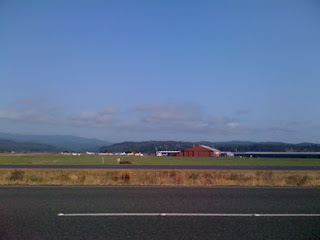
Image: Or was the PGF sent from the airport? Here, Murray Field just outside of Eureka. Chris Murphy and Thomas Steenburg confirmed in 2003 that they did have 24-hour courier services available there in 1967. Photo, Steven Streufert.

BIGFOOT BOOKS: But do you remember though if the post offices were open until five, or six, or perhaps a little later?

AL HODGSON: It’s possible, that one down there…

BIGFOOT BOOKS: Oh, the main office may have been open late?

AL HODGSON: That’s right.

BIGFOOT BOOKS: Because it’s the city center and…

AL HODGSON: Oh, you know, there’s something else, too. They used to have mailers for that, you could just take your film and put it in a sock, and it would go out.

BIGFOOT BOOKS: A bag? A little bag to hold it?

AL HODGSON: Yeah a little bag, a little thing, and you put it in this package thing... In fact that post office there had one of those there, because I’d used it.
BIGFOOT BOOKS: And how would you pay for it, I mean if you were using Air Mail or Air Mail Express it must have cost a bit of money?

AL HODGSON: Those bags were pre-printed, they had pre-postage on them.

C.I.: Right.

BIGFOOT BOOKS: Oh, so you would get them from a machine, or something?

AL HODGSON: Yeah, you would get them where you got your film.

C.I.: A lot of the film and the slides, it was a pre-paid mailer from Kodak or whomever made the film.

BIGFOOT BOOKS: Yeah, maybe, huh? You could just drop it right in.

C.I.: Yeah, but would that have gotten the film by air mail to Seattle or whatever…?

BIGFOOT BOOKS: Al, I know your weren’t part of that, you were…

AL HODGSON: Yeah, it’s one of those things that you don’t know.

BIGFOOT BOOKS: I would just like to see all of the uncertainty cleared up, so we could just have the film without all of this garbage surrounding it!

AL HODGSON: Yeah, well, me too. But there’s just no way that you can get all of it. That’s one thing that I really have a problem, not a problem with, but all I can really say is this is what I remember, and that’s all I can do. But anyway, I just don’t, there’s nothing that I know that I can say, or I wish that I had something more that could clear it up but…
BIGFOOT BOOKS: You’re just one guy, and you know, and you were part of part of it.

AL HODGSON: Yeah, I know. Yeah.

BIGFOOT BOOKS: And everyone wants Al Hodgson to come out, and like be Superman, and save us, you know?

AL HODGSON: [Laughs out Loud] I laughed at this, one lady, and I can’t even remember her name right now, but she worked on this Symposium here [the 2003 International Bigfoot Symposium, which Al helped organize]. I worked with her for a while, and she got upset and quit before it was over. And she said, “Al’s a Bigfoot expert by DEFAULT, just because he was here.” [Laughs] And it’s about the truth!

BIGFOOT BOOKS: But you did go into looking into it, you were up in Bluff Creek and you found those footprints by Notice Creek there? [In 1963, see documentation HERE.]
AL HODGSON: Yeah. But I didn’t do much. I did some, but I didn’t do that much. And I, I guess you’d say, I didn’t have a passion to do every little thing, you see what I’m saying?

BIGFOOT BOOKS: You had other things going on in your life?

AL HODGSON: Ah, yes, I did.

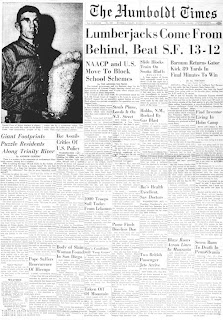
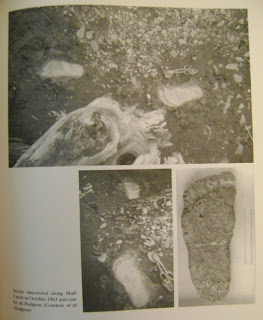
Images: A page from Jeff Meldrum's Sasquatch: Legend Meets Science, featuring Al's prints; below, Jerry Crew in the News--the original Humboldt Times 1958 article, front page, and another image of him with the track cast.

BIGFOOT BOOKS: Like church and family, business… three different shop locations!

AL HODGSON: Church and… business was a big thing. It took up a lot of my time.

BIGFOOT BOOKS: But you know, in the early days you knew Jerry Crew…

AL HODGSON: Oh yeah.

BIGFOOT BOOKS: He went to your church, as I recall?

AL HODGSON: Yeah, I knew Jerry. The thing is it got me…. And this is something I have to tell you. You know when Jerry made that film, OK?—I mean the casts, the casts—OK? They went up on Saturday, there were three of them up there, and they didn’t take any plaster of paris with them, and they said, what would make… plaster of paris, and they said OK…. So they came back to Willow Creek. And it was too late to go back again Saturday, so they went back up Sunday. But only two of them went back up Sunday. The third one was a pastor, and he had to preach the next day. [Laughs]

BIGFOOT BOOKS: And so he didn’t come up that second time.

AL HODGSON: No uh-uh. But that’s where that went. There are other things, too, that go into this. I don’t think I’ve ever told anybody about this… but there was a fourth guy, really, that had been, in fact he was a partner of Jerry’s. And I knew him, but I didn’t realize he had anything to do with that, until I found out his wife, his widow afterwards, was really upset about it, because Jerry hogged up all this and he was left out of it. Anyway, he and Jerry worked, I think they had a Cat together [e.g., owned a Caterpillar tractor] or something, I’m not sure what it was. But anyway, I knew him before I left Arcata even, I was still working in Arcata. I got to know him, I knew his name, ah, and now I can’t remember.

But anyways, I knew him. I worked for Humboldt Machine Works, and we sold him oxy-acetylene, and quite often he came in and got oxy-acetylene, and I knew him that way. But I didn’t realize he had anything to do with it, until I ran into his widow one night, or one day, in the mall in Eureka. And she told me, she was, well, I can’t remember what exactly she did tell me, but she was upset because Jerry hogged all the, uh, In fact, he was there, but, and Jerry went up on a weekend and made the film, the casts, and they left him clear out of it. And she was upset, and I haven’t… She’s since passed away. She has a daughter, and a son that lives in Redding. And I’ve talked to him once… I didn’t… oh, I know what it was, he stopped by the Museum one day, at the Bigfoot Museum. And I talked to him about it. And that’s the first I knew about it. He didn’t say much about it, he just said, well, maybe I oughtn’t to get into this. And then later I talked to his mother, his sister, and then I found out that they were upset. Because Jerry left them out of it. But I don’t know why, I don’t know anything else.

BIGFOOT BOOKS: No one was really getting anything out of it, were they?

AL HODGSON: No. It’s too bad, too bad it happened that way, anyway. It’s too bad. I’m gonna have to see if I can’t find out his name. I thought about it this morning, now I can’t even think of it. But the son, I think works in Redding, so if I can I will contact him. Nice guy. Nice guy, and I liked his dad, too. I got to know him fairly well, but I had no idea there was any connection there between, on Bigfoot at all. But it turned out to be, Jerry was well known…. Another one that was Jess, oh, Jess Beamis is the one I was thinking of, and can’t think of what the name of his son was. Jess was the father and then the name of his son was Beamis, but I can’t remember what it was. But the other guy I was thinking of was Jess Pascal. He was the one that was with Jerry when he made the casts. And he had a cast, but he never, he kind of stayed out of it.
BIGFOOT BOOKS: Now, these guys weren’t trying to get rich and famous or anything?

AL HODGSON: No, no. Well, Jerry wasn’t, really…

BIGFOOT BOOKS: And he was a humble man, honest, straight-forward kind of guy, didn’t go out of his way to seek attention. Right? That’s the impression I get…

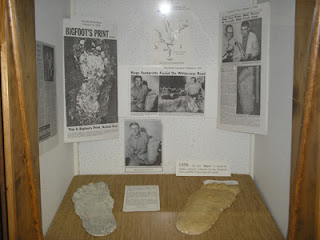
Image: The Willow Creek-China Flat Museum's Jerry Crew display.

AL HODGSON: Yeah, yeah. He was, Jerry was a nice guy. And he was a… have you ever heard of Child Evangelism? Anyway, he was, he used to have a bus, and go and pick the kids up, and he would pick ‘em up and…

BIGFOOT BOOKS: Like church camp?

AL HODGSON: Down here for ah [unintelligible], and he’d take ‘em home, and so, he was a nice kind of guy. And his wife, Ruth, she could whistle, and she could whistle a tune. Beautiful. It was a treat to hear her whistle.
BIGFOOT BOOKS: Did you whistle for Sasquatches?

AL HODGSON: [Laughs] Ah, I don’t know about that, but could whistle, she’d just whistle tunes. But Jerry was a nice guy. I liked Jerry. And I liked Jess Beamis, too, by the way, and his partner Jess Pascal. But Jess and his brother, they were nice guys, but they were…. They worked for Charles Whitson, down here, where the Whitson’s are at, they worked for him.

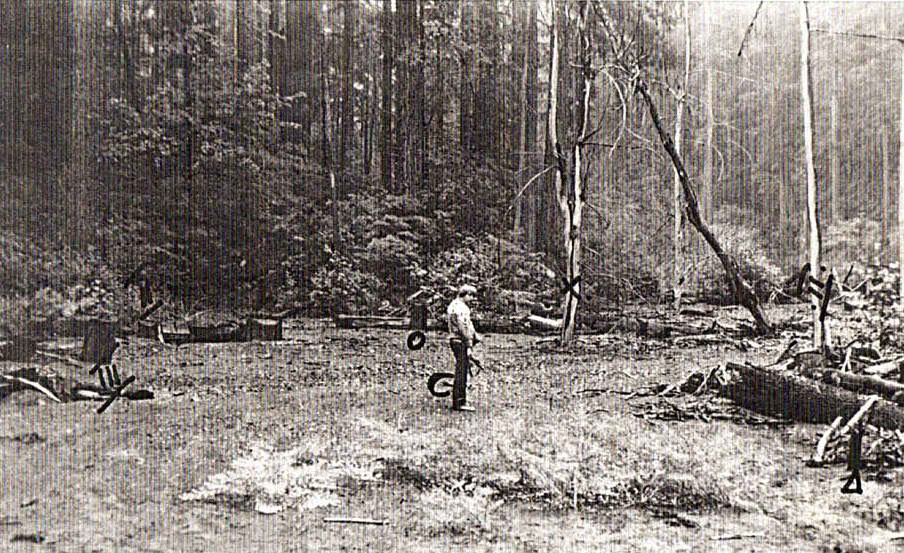
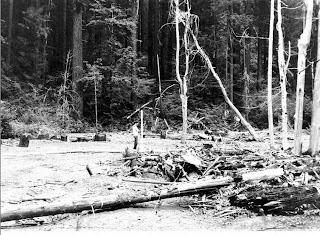
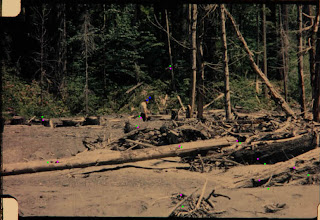
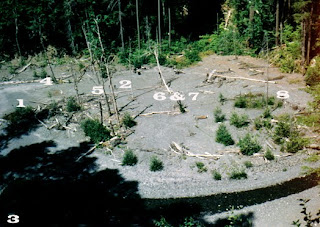
Image: Another image of the film site, taken from the dirt logging spur road above.

BIGFOOT BOOKS: Whitson the plumber?

AL HODGSON: Yeah, they were plumbers. And the backhoe, they, one or both of ‘em worked the backhoe, I can’t remember now. But anyway, you had to be careful or they’d be out on the job and they were able to convert you to Christianity before they got through! Ah, it was OK, but it was—and I believe in Christ by the way—but I do not, I’m not a [unintelligible] one, but by the third or fourth one, you know, I dunno, and that’s when I got into this book here…
(01:30:30 of 02:17:11, continuing)

[And here Al pats the other book on the table, BEFORE THE DELUGE, a book on Biblical history. And here we must come to the end of PART TWO.]

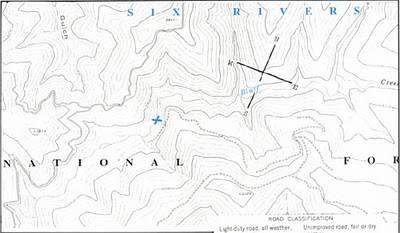
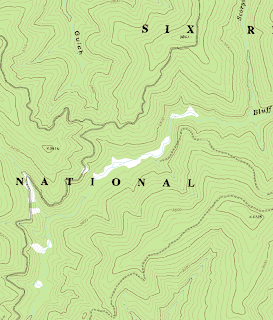
Image: Yet another Bluff Creek map, this one in wider scale, film site above the second "NA" in "National."
**********************************************************
COMING UP NEXT WEEK, same Squatch Time, same Squatch Channel, More Odd Questions for Al: How did they get Sasquatches onto Noah’s Ark? How did Noah find them in the first place? And much, much MORE!
PART THREE TO FOLLOW SOON, SO KEEP CHECKING BACK (or just subscribe)!
Transcribing this is an incredibly hard slog.
UPDATE!!! PART THREE of the INTERVIEW is now up! Available HERE.

**********************************************************
ANGRY BIGFOOT SPEAKS!
... is still hibernating this week.
And, man, is he pissed! You should see his dreams.
**********************************************************

Con-texts of this blog, save for archival or historical images ("fair use" for research), copyright 2010, Bigfoot Books Intergalactic and Steven Streufert.
Please feel free to quote with citation and link to this blog included.
**********************************************************