 THE HOOPA PROJECT: A Fact and Logic Check and Close Reading, Section One. (A Book Review.)
It was on April Fool's Day that Skamania County made its Bigfoot Ordinance, Mr. Paulides.
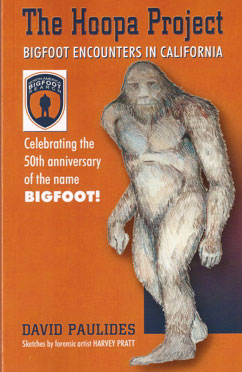
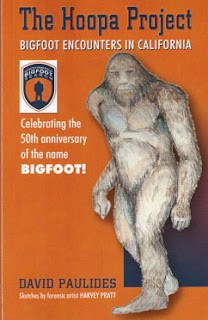
Paulides, David; Harvey Pratt, illustrations. THE HOOPA PROJECT: Bigfoot Encounters in California. Blaine, WA: Hancock House Publishers, 2008.
First, don't take this review the wrong way.
The Hoopa Project is, despite certain flaws, still a fascinating book. Say what you will about
David Paulides and Harvey Pratt, they have done some interesting work, some of it unique.
NABS decided to focus on one limited area of Bigfoot activity in this book, and also focussed on a particular cultural group, the Hupa Indians. This gives the book a certain strength and distinction. When we first read it upon its release we barrelled through it in just a few days, drawn on by intrigue to the end. However, as we went along there was a certain feeling of unease. We found ourselves repeatedly asking, Did he really say that? Isn't this or that point just plain wrong? That is not even begining to mention all of the typos and poor general editing. The redundancies in the book, with affidavits repeating the narrative for each sighting report, prove to be highly tedious, and hence the book could have been reduced to nearly half its size--but that is for another blog entry.
Here we cover just the first section, and think it will be clear if you read to the end of this part of our review, that the book sits on rather shaky foundations. In saying what we say below, please note, we are not trying to debunk Bigfoot, but rather to debunk the statements and methods found in this particular Bigfoot book. Hence, we do not necessarily question or doubt the Skookum cast or various hair and scat DNA finds, but Paulides' use of these in his narrative. It is our feeling that he and NABS are so eager to conquer the field and the issue at hand, so confident in their own investigative abilities, so concerned with outdoing all the other Bigfoot groups (especially the BFRO) and researchers, that they get going right from the start on the wrong foot, so to speak. If we are to prove Bigfoot to the world, or to make the field at all respectable to the general public or the scientific world, then we simply MUST have solid methodological foundations, and our analyses of evidence and reports should be sound, not fraught with gross errors of logic and procedure. If the story isn't straight to begin with, then everything that follows is corrupted in sequence, and the errors compound multiplicatively upon those that preceeded them.
After Paulides came out as being in support of the "Bluff Creek Massacre Theory" (blogged about earlier by us
HERE and
HERE, and the MK interview
HERE and
HERE) we really had to revisit those misgivings. We decided to go back and do a review. What follows is a close reading of the book's first 51 pages, with an eye bent to ascertaining fact, fiction, and error in the book. The sightings reports which constitute the majority of the book are best left for later. Despite minor errors and glitches of methodology and assumption in this later part of the book, the reports are still good, and need to be appreciated for what they are--personal stories, anecdotal evidence, and at least suggestive of certain traits of the Creature and of a particular Native American culture in Northwestern California. We particularly appreciate this part of the book, despite misgivings about the introductory part, as we, too, live in the same region, and we receive the same kinds of reports from locals constantly.
All of us make mistakes--that is for sure. Even Bigfoot's bLog does, we'll admit it humbly if and when it happens. We are here to learn, after all, not to dictate. However, we feel there is a real need to run through parts of this book in order to show how egregious the errors and illogical assumptions can be in a Bigfoot book. It would do us all well if we learned to fact-check, edit, and think correctly before we publish these things. If we bigfooters can't get the story straight, the media and public surely won't, either. Since the people outside of the world of Bigfooting cannot or will not look more deeply into the evidence, it is clear that they will evaluate the topic based upon what they can see: the behavior of the researchers, and the consistency of their productions.
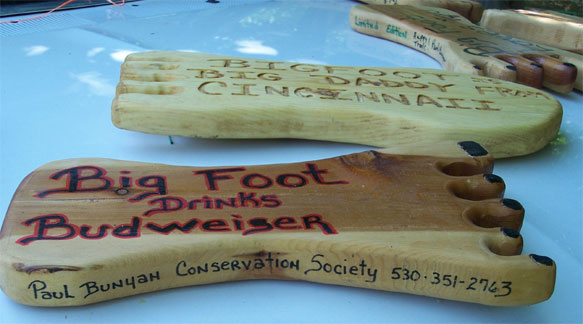
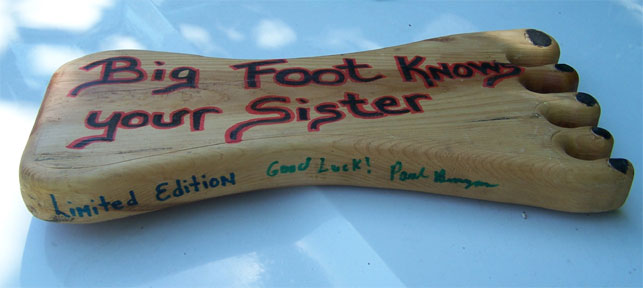
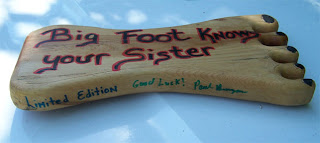
Image: "Paul Bunyan Conservation Society" footprint stompers, sold at Willow Creek Bigfoot Days festival, 2007. Photo by Steven Streufert. Rant Mullens and Ray Wallace would surely have envied these desigtns!
. On pp.
9-12 we find out how Paulides got his start hunting Bigfoot: in logical error and imaginative leaps. He tells of going out with his father into the mountains in Lassen County. They find a fire down in a creekbed, "made of fifteen to twenty small twigs broken into equal pieces approximately one foot long... placed on the sand in the shape of a teepee." Now, what this is doing in a Bigfoot book is a mystery, as there has never been a convincing report of these creatures utilizing fire. He notes that there were no footprints around the fire in the sand. If so, how could it have been a Bigfoot? Why assume it was made by a Bigfoot? He then acknowledges that this is odd, and admits that he doesn't really think it was a Bigfoot. OK, so will he say it? Maybe it was a pot grower? A hobo? No, he then proposes an even more extreme idea: maybe, he says, it was one of the "Little People" spoken of by Natives. But Dave, you then say they live in caves and underground, and that they only come out at night. And if there were no signs of footprints at all, what made the fire, a levitating elf? Occam's Razor would say that he should, logically, propose the simplest solution, not go from one presumptuous assumption to an even more wild presupposition. This may have intrigued Paulides about Bigfoot, or whatever; but as the first section of the book all it does is convince us that he is a guy who is prone to leaping to odd conclusions first, rather than the simplest and most rational ones. This, then, sets the logical tone of the book.
On
pp. 12-14 he speaks of the "Whistler incident," up in B.C., Canada, in 2002. What happened? Nothing. He went to Canada, hired a guide to take him fishing, and then the guide told him a story about a roadside sighting of Bigfoot, told to him after Paulides asked him a leading question about "strange, outdoor wildlife experiences." Dave says he was "mesmerized," as if he had never heard of Bigfoot before; but just a page earlier he is talking about hearing about it way back in his childhood. Why would anyone be so entranced by the most common kind of Bigfoot story: "it walked across the road"? We've all heard this a million times on TV and elsewhere. Also, later on in the book, he himself devalues such sightings as being not substantial enough.
On
page 14 he mentions that he then "read everything" he could about Bigfoot. If so, then why does he not give ANY credit to previous researchers on the pages that follow throughout his own book? If one is conducting professional research and scholarship and publishes a book or monograph one is ACCOUNTABLE to the field and other scholars that have gone before one, and one is
required to give citation of their works and conclusions. Rather, Paulides goes on to claim nearly all of the following pages' contents as solely his own, as if they arose only from his own original "experienced police" investigation; but he has already admitted that they did not. As we shall show, he takes credit for other's work as if these were new discoveries, effectively stealing their ideas. Plagiarism is not just the exact quoting of someone else's written words; rather, in a scholarly sense, it is the lifting and appropriation of ideas and theories, without due credit given, as well. To follow such shoddy scholarship with public arrogance and grandiose statements is even less palatable.
In
Chapter One Paulides covers what he calls "Government Acknowledgement" of Bigfoot. It is HARDLY that. No
official support of the Sasquatch's existence is ever released by The Government. That Skamania County, Washington (
pp. 19-22), issued a declaration about Bigfoot, in Ordinance No. 69-01, on APRIL FOOL'S DAY (of all days!), 1969, is obviously part good humor, and also partly related to the desire to prevent obsessed would-be Bigfoot hunters from shooting other hunters out in the woods. This was, notably, only a year and a half after the Patterson film was shot, and Bigfoot Hunting mania was at full steam. Yet Paulides takes it as a wholly literal statement of government belief in Bigfoot.
The ordinance specifically states,
"Whereas, publicity attendant upon such real or imagined sightings has resulted in an influx of scientific investigators as well as casual hunters, many armed with lethal weapons, and... Whereas, the absence of specific laws covering the taking of specimens encourages laxity in the use of firearms and other deadly devices and poses a clear and present threat to the safety and well-being of persons living and traveling within the boundaries of Skamania County as well as to the creatures themselves...".
An amendment to it from 1984 also states, "Should the Skamania County Coroner determine any victim/creatures to have been humanoid the Prosecuting Attorney shall pursue the case under the existing laws pertaining to homicide." Isn't it clear? This ordinance has been set down to hopefully prevent murder of humans, and is NOT a clear recognition of there actually being such a creature as Bigfoot out there. Rather, it only says that IF the creature exists, then the killing of one will not be considered to be murder, and will be subject to a fine. By "Victim" they obviously mean "human," so if someone is shot (i.e., Homo sapiens) during a Bigfoot hunt, then it will be considered to be murder. Clearly, the focus is on homicide, and discouraging it, not the acknowledgement of a Creature out there. All that the ordinance says is that it is "possible," that it is "possibly" out there in the hills--hardly a bold declaration of belief and support. We bigfooters believe, sure, but Skamania County is obviously hedging their bets and playing it safely.

Paulides claims that this declaration was found when he did "an internet search for Bigfoot/Sasquatch legislation," implying (given all of his claims of an extensive professional investigative background) that he was somehow searching "official" government information sites. Rather, obviously, he just up and
GOOGLED IT. One does not have to be an "Investigator" with "30 years experience" to do this. Furthermore, he must have already known about this ordinance, as it was WIDELY noted in the Bigfoot literature, in many books that he must have read if he read "everything" he could find on the subject; and it has been presented in a few television shows and Bigfoot documentaries, such as
Sasquatch Odyssey. Let's just pick a few books off of our own shelf and take a look. Oh, look! Here the Skamania ordinance is in John Green's book (1978), and here it is in Peter Byrne's book (1975), and here it is again extensively covered in Robert Michael Pyle's book (1995), and here is Murphy's book (2004) with photos of the official documents and everything! Surely the author has read at least one of these major tomes, since he read "everything on Bigfoot." This is NOT, then, original research.
The Hoopa Project author is not proving his big-time cop abilities, but rather just doing what any Bigfoot internet geek does. Why does he do this and not credit prior researchers? It is, it seems to us, to build up the narrative trope that he is some special kind of researcher, not just some guy reading books on Bigfoot and surfing the 'net. It is, it seems to us again, largely a fictional construction. Here comes Paulides, a guy in the field of Bigfooting only a couple of years, and already at the start he claims to be the only professional, full-time, serious Bigfoot researcher out there? Come on, and go figure.
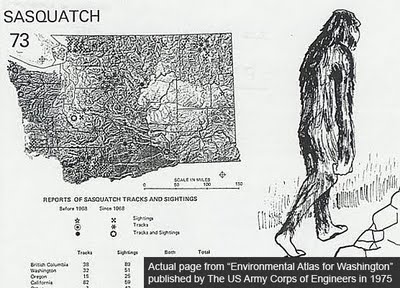
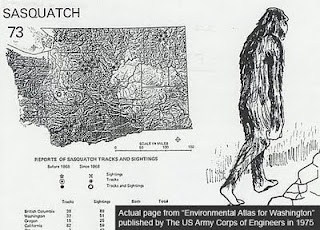
The book brings up the
Environmental Atlas for Washington, or “Provisional U.S. Army Corps of Engineers Environmental Reconnaissance Inventory of the State of Washington,” published by the Army Corps of Engineers in 1975. A lot is made of this publication, as if it proves official government recognition of the Sasquatch as a real animal. Rather, it can be taken as a slightly tongue-in-cheek presentation, but also seriously as a declaration that the creature has been
REPORTED to be in Washington. The Atlas does not present this topic mockingly, and does indeed take it as a possibility that there could be something to all of the reports. It is clear, however, that the “very existence of Sasquatch… is hotly disputed,” as the Atlas states. From this point it refers repeatedly only to
ALLEGED Bigfoot hair, “alleged sightings, tracks and other experiences.” It says these reports
CONJURE UP the image of Bigfoot, implying a phantasm. It does not come out and SAY that the creature is actually KNOWN to be 8-12 feet tall, and so on. It is a PROVISIONAL statement. Other qualifying words used throughout this report include, “reported,” “apparently,” “if” and “generally considered.” It is also clearly reporting on what is, to the author, generally considered to be folk mythology or cultural belief particular to the region, which MIGHT have some basis in fact—might, only, is what they are saying: “If Sasquatch is purely legendary, the legend is likely to be a long time dying…. Legendary or actual, Sasquatch excites a great popular interest in Washington.” See, this Atlas includes cultural dimensions, and not just environmental facts. Also, this Atlas is not an official production of the entire USA government, nor a statement of official governmental or institutional policy. It is a regional side-project, done by a certain and limited agency of the government only. It is no more official policy than a particular wildlife study or environmental impact report done by someone working for the government.
Paulides, though he at other points in his larger work is clearly suspicious of government cover-up (especially with his belief in the "Massacre" conspiracy theories, and his recent belief that an Oregon lake was closed by authorities because of Bigfoot activity), here places great credibility in government: “If you believe in your government and you believe they have the best evidence, laboratories, and tools available, then I believe the government is taking a bold step forward in the authentication of Bigfoot/Sasquatch as a creature.” (p. 19) However, there is no real original study being done in this Atlas, and its imprimatur is limited. It is a short summary of previously known aspects of the issue only. There was no new testing done officially in this project, though there is a mention of some hair having been analyzed at some point by the FBI with inconclusive results: “no known animal” does not necessarily prove Bigfoot. If one actually reads this brief bit from the Atlas one can clearly see that it is nothing official, scientific, nor comprehensive. On page 17 Paulides goes to great length to say how “extremely competent, intelligent, and technical” the US Army Corps of Engineers is, how “cautious” they are. But does he not recall how the Corps was largely blamed for the poor design and management of the levees that broke and inundated New Orleans during the Hurricane Katrina debacle? If we know one thing for certain about the government, it is that it is a vast, compartmentalized bureaucracy, one often at odds with itself, and in a great many instances incompetent and self-contradictory. Again, Paulides claims he found this Atlas in his “personal search of the United States government records,” but it was well known for years, seen or spoken of in many Bigfoot books and websites. We are sure he just read about it somewhere, and then wrote to the Corps to get a copy—no P.I. work necessary there; and no credit is given for previous work on the Atlas Bigfoot article. Oh well.
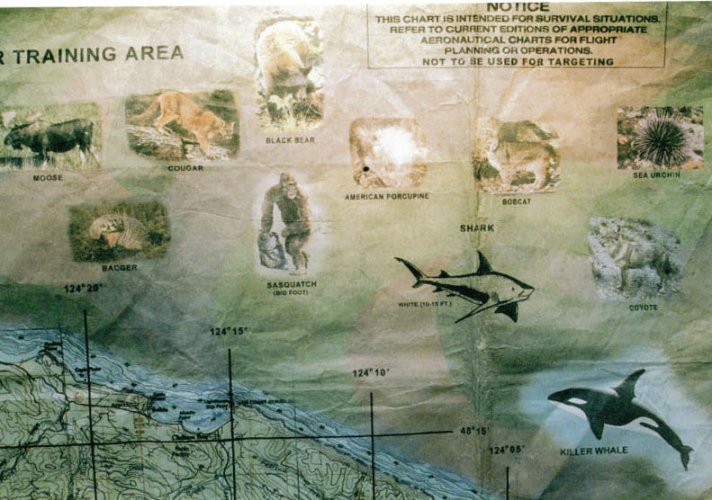
Images: From the Corps of Engineers Atlas of WA, showing Sasquatch in both. Click to Enlarge.
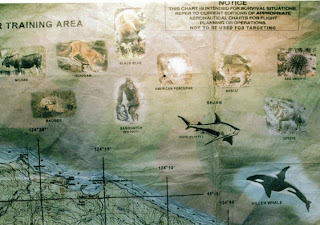
What does the Corps really say? The
BFRO asked and here is what they say: “But whenever they are questioned by reporters who seek clarification on the issue of whether the Corps or the state of Washington officially acknowledges the existence of bigfoots, they steadfastly claim that the listing in the Atlas was an ‘error’ or a ‘joke’ that was not corrected prior to the printing of the atlas.” And this appears on the
BFRO Blue Forum: "A biologist/writer was assigned to put together the WA state atlas. The criteria was defined broadly as environmental elements of interest to public (because the atlas was made for the public). The writer spent some time determining what things were of great interest to the public, that [are] broadly environmental in nature. The sasquatch was one of the items that came up consistently." So, this project was for popular consumption, not official, and was mainly (apparently) written by one biologist, not the entire Corps or US Government! Personally, we think it is cool that Sasquatch made it into the Atlas, and we think personally that the Creature does exist; but this Atlas IS NOT proof that the government agrees with us bigfooters. Why is Bigfoot in the Atlas, then, you ask? Because BIGFOOT IS COOL.
Anyway, let's ramble onward....
The next section, starting on
page 28, deals with how NABS (Dave, that is) "started the search," and found the location where they (he) would search for Bigfoot. Obviously, this is mostly a foregone conclusion--just look at the maps in John Green's old books and you'll have every clue you need. He proceeds to try to make his choice seem quasi-scientific, but again just runs through all of the basics already covered by Green and others decades earlier; and he glaringly does not give one bit of credit to Green or anyone else. He says he spent "weeks of working the Internet and deciphering graphs and charts," but then jumps immediately into talking about the area around Hoopa, CA. He does not really explain at this point why he chose this area save that basically he kind of liked the look of it. It had the
Patterson-Gimlin film site nearby, and lots of Native Americans. What more could one hope for? It is only later in the text, presumably narratively after he had decided on Hoopa already, that he begins to try to build a data structure to explain his choice. Almost all of this basic data was contained in John Green's books and
SASQUATCH DATABASE, now available online (click the highlighted text).
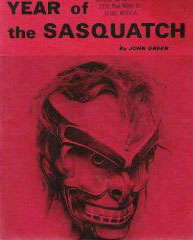
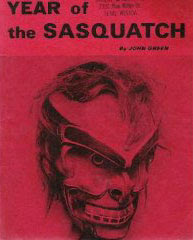 Image: One of John Green's early pamphlet books, predating and pre-configuring Paulides' research by over three decades.
Fact checks, pp. 28-34:
• He says that Hoopa Valley is one of only two valleys in this region. He is wrong. Basically every river has some kind of valley somewhere, Willow Creek has a valley. There is the Eel River valley, the Mattole valley, and on and on...
• He says the creature in the PGF is "running across Bluff Creek," but actually the creature WALKS away from the creek on a sandbar.
• He says that Louse Camp is on Bluff Creek, six miles south from the P-G film site, but it is NOT. It is 2.5 miles as the creek flows, west then southward, and even less by direct line.
• He says that there have been "few actual sightings in the new century" in this area, but we know and have heard of many, many of them, and know some who have seen Bigfoot right up from Louse Camp in recent years. Several BFRO researchers, as well as NABS-affiliated researcher Sean Fries of Weaverville, have reported constant wood knocks, vocalizations and other signs of Bigfoot activity in the area. Paulides is utterly WRONG when he says about Bluff Creek, "The weather can be treacherous, the trail is very tough and you won't see Bigfoot. You had a chance of seeing him in this region in the 1950s and maybe early 60s, but not now." Huh, what now Dave? This is just not true, based on no real research at all, and is a statement made simply off the top of his head. He uses it to make Hoopa seem like a more active zone. Also, there are roads in the area, not trails, and they are mostly fairly well graded and leveled. Bigfoot activity in the area is reported regularly, with new sightings and reports each year that goes by.
• He uses the name "Hoopa" to describe the people of that tribal group and reservation affiliation, though their official name is HUPA. Hoopa is the name of the city and reservation, not the people. This is a fundamental error that should never be made by someone who has supposedly spent two years living among these people.
• He states (
pg. 29) that the Hupa received their reservation in 1876, but in fact it was 1864 when the treaty was ratified and the reservation "comprising 90% of their original homelands" was established. (Source: Hutchinson Encyclopedia
article). He says that it was established under President Ulysses S. Grant, but Grant was only in office March 4, 1869 – March 4, 1877. This "official occupancy" recognized by the US government came only after the millennia-long homeland had been disrupted by the coming of European-Americans and the consequent decades of genocide, colonialism and "Indian Wars." It is a fact, though, that as remote and resilient as they are, these Natives never lost their traditions and connection to the land that they share with Oh-Mah.
• On the same page he says that Highway One is on the coast from Hoopa, but it is known as Highway 101. He speaks of the "Bald Mountains," but the name used for those is "Bald Hills," traversed by Bald Hills Road from Weitchpec to the coast near Orick, an area important to Bigfoot history.
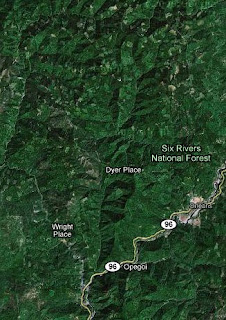
• On pg. 30 he speaks of the "Go Road," more properly called the G-O ROAD, or Gasquet-Orleans road. He mentions it as if it is the same road as the famed Bluff Creek Road. He conflates the G-O project with the Bigfoot track-find and equipment vandalism events of 1958, but the Bluff Creek one was a logging project road starting considerably south of Orleans. The G-O road was to end in Orleans, not down near the mouth of Bluff Creek, nearer to Weitchpec than Orleans, where the road Jerry Crew and Ray Wallace made famous starts. The Bluff Creek road runs past Louse Camp up into the dead-end of the creek's headwaters area for logging access. As evidenced by the Notice Creek bridge, which bears the marking "1958," built by Jerry's crew, this is the road project that the Bigfoot events happened on, not any of the G-O Road projects.
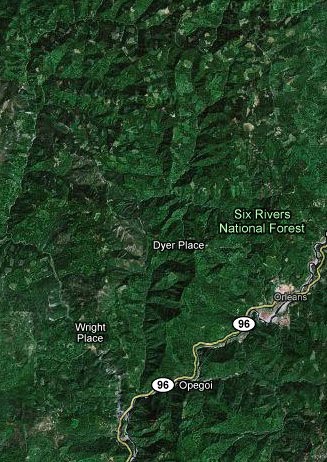
Image: Bluff Creek Basin on Google Earth. The Bluff Creek Road starts way at BOTTOM, Orleans and the G-O Road turnoff are at right. They are NOT the same road. Way up to north and west is the PGF site, where the creek bends eastward into the basin's headwaters.
• He claims on the same page that it was the "Hoopa" and Yurok Tribes that fought the battle in court to end the G-O Road construction before it entered Native sacred mountain peaks in the Siskiyou wilderness area. In fact, it was the Sierra Club and the passage of NEPA that got that ball rolling, and then a remarkable alliance of Native and environmental concerns later combined to assure the protection under the Indian Religious Freedom Act and eventual declaration of an official Siskyou Wilderness Area and also the Smith River Wild and Scenic National Recreation Area. Combining these two areas, plus the cost of fighting legal battles, eventually closed the road project only seven miles short of completion at its middle. One source says "The GO Road battle was won on environmental grounds, not on grounds of religious freedoms. As one Yurok stated, to establish the area as wilderness is to completely miss the point." (See article
HERE.)
• He says that Patterson and Gimlin came to Bluff Creek to film a Bigfoot, but their stated intention was to film tracks of the creature found recently. He says, wrongly, that they “left the area of the Go Road and started to slowly make their way by horseback down into the Bluff Creek region. Just as they were about to reach Bluff Creek they each saw movement in the creek…,” etc. ACTUALLY, no. They DROVE up Bluff Creek Road from down near the mouth at the Klamath, up from the Bluff Creek Company on the road to Louse Camp, where they camped just upstream from the campsite and Notice Creek. They were in the area for DAYS or WEEKS before eventually spotting the creature, and were riding up and down the creek a lot. Where Paulides gets his version of the story is surely a source in thin air, not actual research of documented sources.
• Furthermore, speaking of the filming (
pg. 31), Paulides says they were using a 35mm camera, but it was a 16mm camera.
• Speaking of the Creature he says experts have determined that she was 7-foot, 3-inches and over 700 pounds, but ACTUALLY, no one has really been able to finally agree on or conclusively prove these measurements, and there are many theories out there that differ pretty widely. There are whole books written about this subject, but which Paulides has simply not bothered to read and absorb.
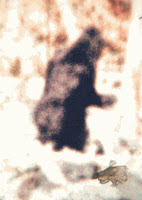
• Speaking of the film he says that the Creature was carrying "something" (a stick), as if this is an established fact. Actually, it is pretty much only M.K. Davis who sees that stick. We can't! This is verifiable proof that Paulides was under the sway of Davis’ odd and conspiratorial thinking even at this early, pre-Bluff Creek Massacre Theory stage of things.
• He speaks of muscles moving in the right thigh and right shoulder of the Creature. In fact, muscles can be seen moving ALL OVER the Bigfoot in the film, especially in the back and buttocks. This is why it looks real upon close inspection. Why does he select only two limited spots? Odd.
• He speaks of the creature "on tape," but actually, it was on FILM, from a real movie camera, not a video tape machine (which did not exist in the consumer market at the time). He also states that the film has been declared by "professors" and "experts" to be impossible to fake; but the sad fact is that way more such figures think that it IS a hoax. The film has never been finally or credibly debunked, but Paulides should say that there is still much disagreement on that topic.
• He speaks of Willow Creek’s Bigfoot Days as being “a huge event that draws university professors, professional Bigfoot hunters and a variety of amateur explorers.” Has he ever BEEN to this event? It is not some kind of academic conference. In fact, it is a small community parade with a festival of vendors and a car show down in the park. It has very little serious Bigfoot content, mostly consisting of gorilla suits, or knick-knack sellers hawking novelty goods.
• He says Willow Creek area itself has “relatively few” sightings “compared with other regions in Northern California,” but in fact, as evidenced by reports in the Bigfoot Books store and around town there are MANY sightings right around this area, every bit as much as on the Hoopa Reservation. This stuff is in the historical records and books, and even gets reported in Paulides' sequel,
Tribal Bigfoot. Living here in Willow Creek, we ourselves pass by a large number of Bigfoot sighting areas every single day, and new ones continue to be told to us.
• He says (
pg. 32) there are no public campgrounds anywhere in the Hoopa region, but in fact Tish Tang Creek, which he mentions, DOES have a public camping site. In fact, he
MENTIONS “Tish Tang Campgrounds” on the very same page, in his sightings chart.
• Astonishingly (
pg. 33), he says that “the Hoopa Valley has been an area with significant human habitation for over 250 years.” In another place he says "almost 200 years." IN FACT, the Hupa people claim residence in the area for over
4,000 years! And this is just what they remember. Archaeology probably proves or will prove an even more ancient occupancy--we need to look into this further. (See the Wikipedia
HUPA article.)
• He speaks of a finding of an animal bed, and then another instance where some scientists found some bedding material. Apparently they found it slightly odd, and found some deer bones near by it. Paulides leaps to the conclusion that it simply must have been Bigfoot, as what other animal would make a bed and leave bones around? This is NOT proof of Bigfoot, but just proof that some bones and a bed were found. A-hem! As Ray Crowe used to say, "Keep your Skepticals on."
Getting the picture yet??? Well, that was JUST A FEW PAGES of the book! Read on for more.
The next section, "By The Numbers" (
pg. 34-45) is a somewhat lengthy attempt at statistical accumulation and analysis. It is interesting, but it almost exactly replicates (WITHOUT credit given) the same work that John Green has done over the decades. Green was the first Bigfoot researcher we know of to attempt serious data accumulation and systemization, and to put it into a properly constructed computer database. This was back when computers still had the green, text-only screens, folks. Anyway, the conclusions Paulides comes up with completely mirror Green's in terms of the conclusion that Sasquatch/Bigfoot creatures generally tend to live in moist, rain-prone, forested and mountainous regions. Nothing new there!
He'd already decided to study the west coast, so he immediately excludes sightings hotspots such as Ohio, Florida, Texas, Pennsylvania, and northern Michigan and Wisconsin. This is unfortunate, but understandable--after all, he wanted to do his research in Northern California, fairly close to his home, right? So, his sightings research is initially biased in that he only searched for sightings in the far western, coastal states.

Also, one notes that his list of research sites is rather limited. He said he had read "everything" on Bigfoot earlier, but here there is only one book (
Bigfoot Casebook) and the
Track Record newsletter (known to be up, down, and all over the place). The rest of the list consists of eight web sites. The first two sites on his list are in fact NABS web sites! Did he REALLY think he could sneak this by us as ostensible research?
Nabigfootsearch.com and
CaliforniaBigfootsearch.com... that's odd. How could he create and gather his statistics for this analysis from his own web sites if he had just gotten started in accumulating data? That would be, um, impossible. You can't build a database without... building it! Anyway....


You've got to be kidding. That site on our checking today had only TWO sightings for all of Bigfoot-infested Humboldt County!
OregonBigfoot.com has a nice database, and a site which we highly recommend--another good choice. However,
Bigfootinfo.org had only 17 sightings for all of California. Next comes "
Home.clara.net," which is not even a Bigfoot site, but rather an internet service provider's home page! Ugh. The last,
BigfootEncounters.com is a great general site, but their sightings reports are not in any proper database format. The California list has no source citation. They are basically just long lists organized by location, of often non-attributed or unverified, and quite often very brief sightings.
These latter type of sources do NOT live up to the criteria Paulides lays out on
pg. 35, where he says that he eliminated all reports that did not have enough information: "In order to be considered significant, a sighting had to include information other than just 'Bigfoot sighted, Highway 37, 9 a.m., 1966.' I looked for dates and times, a narrative describing the circumstances, a description of the creature, and possibly the chance that the sighting was investigated to some degree." Fine, Dave, but really, nearly all Bigfoot sightings are like this stuff you want to rule out. The really good ones are all the more rare than the already rare fleeting ones. Now, when trying to accumulate raw data about a creature's distribution, it is NOT an effective method to just willy-nilly exclude sightings that do not live up to an arbitrary standard. For raw data you want... DATA! That means any credible sighting should be counted. If, however, you are seeking later to define what the best source sightings for a description of the creature are, then fine, use the best; but do not exclude data at the start--that is called BIAS.
So, whatever the results of his ten pages of analysis, we can say that at the start the data was corrupted by his bias for Northern California and Hoopa in particular. Also, some of his sources are good, but the others are simply bad or non-existent. Basically, he must have data-mined the BFRO database at that time, with a sprinkling of Bigfoot Encounters backgrounding. This would explain Matt Moneymaker's displeasure at Bigfoot Books' stocking of the NABS Bigfoot Sightings Map in our shop. A quick check encouraged by Matt revealed a huge data piracy from the BFRO site, though at least the map gives credit to the BFRO.
Paulides has gone to great lengths in this selection to at least read all of the sightings he could find in his limited selection of sources, and then to assemble it into graphs. This is a good idea, but as it is deeply flawed initially and in methodology in its selection bias, we're not sure what in it can be counted on to be reliable. Though it demonstrates clearly what was already widely known about Bigfoot and Sasquatch habitat in sightings, it fails to establish firm grounds outside of bias. He admits that there are problems, as Bigfoot is seen all over the country, and is reported to survive in some quite unlikely places which don't fit his assumptions, such as Arizona. Rather than trying to reconcile this, he just rules out the entire USA that does not fit into his presumptions. He then arbitrarily rules out any sightings or reports from before 1940. Then he declares that he only wants first-hand reports, even though a huge number of Bigfoot reports in the books and records are second and third- hand. He shows no stable criteria for his selection or de-selection of sightings, as if it is just up to how he feels about a report. This is not scientific. Then he goes even further, this time entering full illogic: "A Bigfoot incident in this book (for affidavit reasons) constitutes an occurrence that can be directly related to accepted and known Bigfoot behavior." So, we take it from this, only those reports that correspond with David Paulides' ASSUMPTIONS about what Bigfoot is like or how it acts will fit in to his modeling. In this regard, if one thinks Bigfoot is "human," then one will SEE Bigfoot as such, and it will turn up in one's reportage and forensic illustrations. This does not make sense. Bigfoot is NOT an established creature yet, though many have seen it or seen signs that may have been made by it. Bigfoot is a cryptid thus far because we DO NOT yet know all of the facts about it. Sure, patterns of behavior and size and shape arise, but they have not been absolutely verified. Therefore, it stands to reason that we should remain open-minded about what a Bigfoot is and what it can do. We assume that they are bipedal; so should we rule out ALL quadrupedal reports? They are supposed to be brown in color; so should we rule out any that are grey or silvery in color?
Already Paulides has ruled out sightings that don't include more than a date, place, time, any that are just fleeting road crossings, any that don't fit into his standard model (another bias), any that occur outside of his selected study area, etc., etc. So WHAT IS LEFT? It seems to us that the vast majority of Bigfoot sightings occur outside of the parameters Paulides has selected. Most are brief, many are vague, there is great uncertainty in some where the witness might be unsure of what they saw, and there are many that are told to only a few people often years after they happened, with details perhaps vaguely documented. Also, we cannot forget that perception is relative, so that how one person sees a Bigfoot will differ from how another sees one. Some of the sightings are surely misperceptions. Some of them are tall tales. How does statistician Dave decide which are which? As he does not make this very clear, all of his data, though interesting, is basically useless as statistic or science. It is ten pages of confirmation bias glaringly delineated.
In the end he selects Humboldt County, CA, which should have been obvious to begin with; but then he chooses Hoopa for nearly completely arbitrary reasons. "Hoopa seemed to be a natural location to set up my office and hang a shingle as it was set in a valley with all the amenities of home." So, after all of this work trying to find where Bigfoot lives, he opts for comfort. Then he repeats his false presumption that Hupa heritage goes back "almost two hundred years," when in fact it goes back thousands. He mentions the climate of Hoopa, but just about anywhere in Humboldt has that climate, with rain, a body of water, mountains, wilderness and parks. He even mentions that the "Bigfoot capital of the world," Willow Creek, is right nearby, as is Bluff Creek, where the PGF was shot. So, why not set up shop in Willow Creek, or Orleans? It is clear from what he says here: The area (Hoopa) also comes with an interesting history, a reservation, and a region that is almost completely surrounded by wilderness areas. So we see, rather clearly, that the selection that was the basis and foundation of this whole research and book project was based upon personal interest in this particular Native American reservation, and also upon the convenience of the researcher. This is bias, pure and simple, and hardly follows logically or necessarily from the preceding statistical analysis. Hence, we can call the whole process a distortion or a sham. His “Decision” was in fact no more scientific or credible than if we were to just up and say, hey, let’s go camp at Mount Shasta and look for UFOs and Lemurians!
Paulides goes on to talk briefly about the local Natives' "Sacred High Country." He puts it "by coincidence... directly in the middle of the Bluff Creek region, but in fact it is to the north and west of Bluff Creek. He speaks of "tribal elders" making the trek into this high, mountain peak area, but in fact it is mainly reserved only for the tribal groups' medicine men or shamans to make this pilgrimage. He rather superficially describes this quest, in what we feel are fairly ethnocentric terms, saying they go there to "pray to their gods." This is the general dismissal that old anthropologists always made to describe the "strange beliefs" that people they did not understand practiced and followed. In fact, this point demonstrates what is perhaps the greatest deficiency in The Hoopa Project--that of true ethnographic exploration. There is almost no real description of this cultural background so vital to understanding these people, and nearly all of the conversations are with younger tribal members, non-elders, dealing with events of the day, not the deep and rich reality that would give substance to any book about these issues. Despite all of his time spent in the Hoopa Valley, among the Hupa, here (
pg 49) Paulides goes to "court documents" go get to the idea that this area was the "center of the Indians' universe." OK, but what does it MEAN? We get no real insight into this realm from this book, sadly.
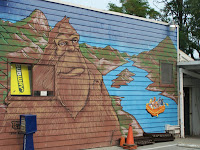
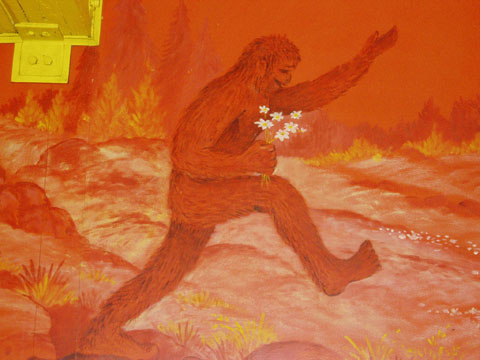
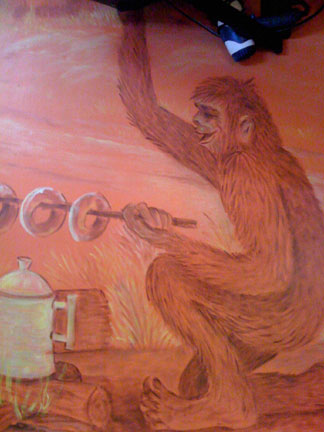
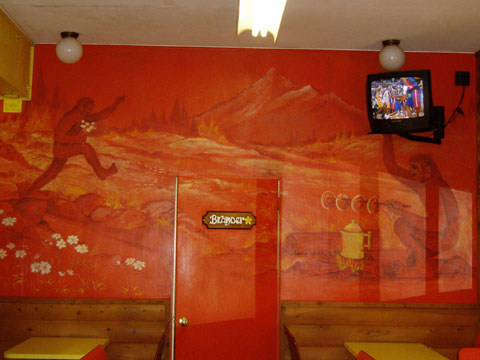
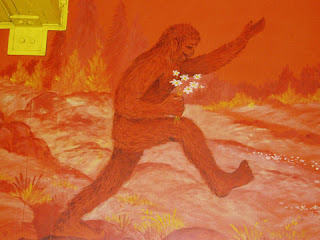
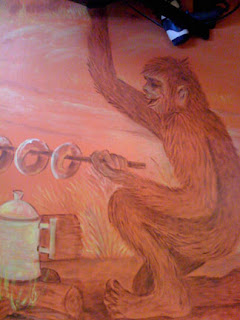
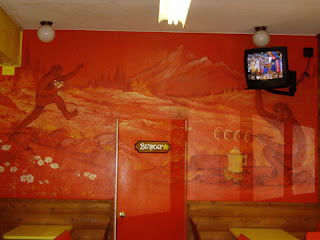
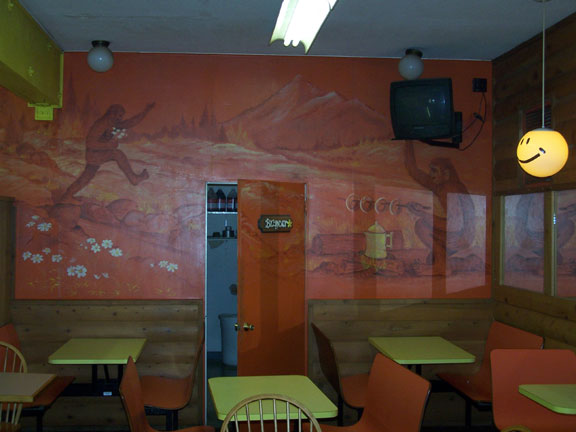
Images: Above and below, the Bigfoot Mural at the Early Bird "Bigfoot Burger" restaurant. Photos by Steven Streufert.
He then concludes the section we are analyzing with "Best Bigfoot Evidence, Past and Present." He speaks of the camcorder as revolutionizing the documentation of sightings, but in fact there are very few videos of Bigfoot, as opposed to the Patterson-Gimlin Film, that have any real quality or credibility. Well, maybe the Freeman video.... He talks about newspaper reports, but didn't he already rule these out earlier as unreliable and not first-hand enough for him? He speaks of DNA from hair and scat being "classified" as Bigfoot, as it often comes back as "not on file" and close to primate. However, the fact is that though these results are intriguing, they are often inconclusive, and often are not on file because the supposed DNA has been corrupted or degraded. DNA of a Bigfoot has never been verified AS from a Bigfoot because there as yet is not a standard set example of what a sample of Bigfoot DNA really is. This is a topic that constitutes interesting possibility, but has yet to prove much. He glances over a few historical bits at this point, with great superficiality and preconceptions.
Odd parasites have been claimed to have been found in some crap that was supposedly from a Bigfoot, but no one knows if Bigfoot made that pile of scat, and no one has to our knowledge actually seen Bigfoot take a dump. Despite this, Dave seems to know that Bigfoot scat looks like "a giant human scat, very large." He speaks of the more recent analyses of footprints done by Jeff Meldrum and Jimmy Chilcutt, but he fails to credit them in particular, and rather just proceeds to use general terms that exaggerate the number of academics and scientists who have looked into the issue and found the evidence to be convincing. In actuality, very few scientists find the evidence credible. This is what makes Meldrum special, and he should really be named and cited here, not just vaguely alluded to. He speaks of the Skookum cast, which may very well be an imprint of a Bigfoot butt, but he totally disregards the fact that there is still hot dispute over this artifact, with many claiming that it is clearly an impression made by an elk. Despite this inconclusive status, Paulides is ready to make the leap into self-validation: "This cast has validated much of the information about the physical aspects (size, weight, body structure, etc.) of Bigfoot." In fact, it really does not do this, but it is still a very interesting piece of possible evidence.
The last paragraph in this section reveals even more. "I am purposely avoiding an extensive description of the Bigfoot evidence because that is not what this book is about. There are many outstanding books in print that offer exhaustive insights into evidence that will satisfy anyone's craving in that area." Well, if this book isn't about evidence, then what IS it about? We'd really like to know. Sightings are evidence, and throughout the book he makes claims to various remains as evidence for the creature. We'd argue that without the analysis of any evidence we are left only with anecdotes. They are stories. Surely an ex-detective police investigator would know this. The stories are great, that is for sure. Some of them are very credible. But don't we want something that could "hold up in court" or convince others that this stuff is real? We need a convincing set of evidence to do this, complete with a logical and coherent system of investigation and methodology. Also, if Paulides is not going to quote or cite any of the researchers or authors of these "outstanding books" on Bigfoot, could he not at least have a Bibliography or Works Cited section? For all of its intriguing and very interesting accounts, The Hoopa Project simply comes up lacking in the end, and leaves any intelligent reader scratching his or her head in skeptical confusion on nearly every page we've reviewed here.
In Bigfooting we need to establish historical consistency, along with logic in methodology, or else we are a rudderless ship that will look like its foudering (or floundering) to the masses at large. Bigfooting needs to become more professional and serious if it is ever to gain the respect it deserves. We need PEER REVIEW, people. It cannot survive solely upon egotism and wild theoretical speculation. Sadly, with so many who just jump into it, without earning their bones and polishing their chops, it often looks like a circus. And human, all too human....
We will continue with this project on The Hoopa Project sometime in the future. Up to this point we have covered the major section of the book preceding the sightings reports. These reports are good, but soon our critical axe will fall in their direction, too. Look for our Part Two
coming soon!
BIGFOOT'S BLOG interviewed David Paulides of NABS in 2009, when they released Ray Crowe's newsletter
THE TRACK RECORD on CD.
Read that here:
DAVID PAULIDES, of NORTH AMERICA BIGFOOT SEARCH, Interview and Discussion with Bigfoot Books
************************************************************
ANGRY BIGFOOT SPEAKS!
Me so mad, me speech-less! Me fume. Me fester. Me boil over and make stink from here to Weitchpec! Me go roll more rock down in road now. Keep Bluff Creek closed all summer long!
***********************************************************
This weblog, website, soapbox, or whatever you call it is copyright 2010, Steven Streufert, Bigfoot Books Intergalactic. Sharing and borrowing is allowed (and often practiced by us, too) if you give full credit and a fair and nice link back to our page. Thanks!
 This week you'll find a Bigfoot odds-and-ends with a decidedly Willow Creek focus. This is how we intended our blog to operate at its conception; however, larger global issues of Sasquatchery often have overwhelmed our intention to stay local. Planning a trip to Willow Creek and Bigfoot Country this summer or in the future? Check out the listing below of all of the Bigfoot hotspots. No, we don't mean actual sightings, but rather those encounters of a more cultural and infrastructural variety.
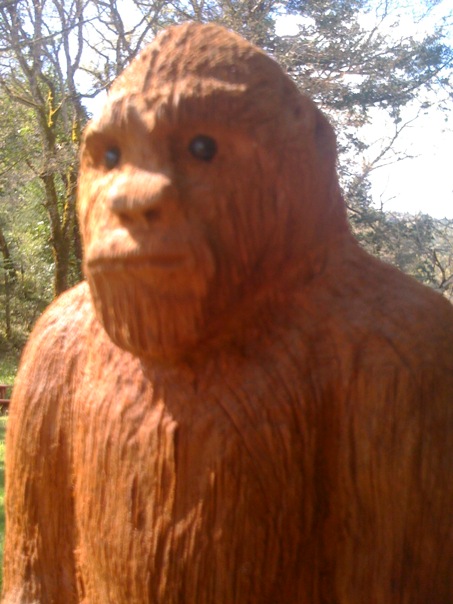
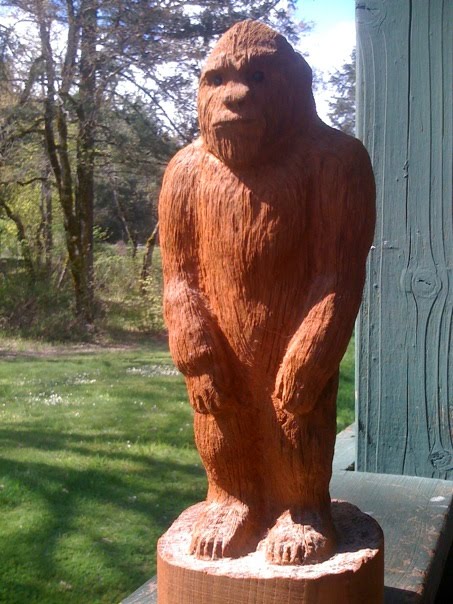
 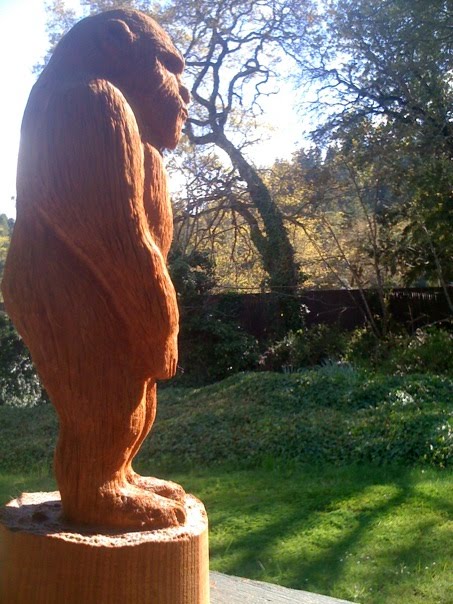 This week AL HODGSON, famous Willow Creek Bigfoot Elder (see our three-part interview with him by clicking his name, above), came in to the BIGFOOT BOOKS shop for a visit. He's always in a bit of a hurry to get back and care for his wife, but he managed to spread more Bigfoot good will. He left us with an absolutely fabulous redwood BIGFOOT SCULPTURE. This was made back in the day by someone in Crescent City, but Al could not recall the guy's name. Apparently they were meant to be put out onto the market, but never made it. Now prominently on display at the shop, our BF stands about 20 inches tall, and is damned proud of it.
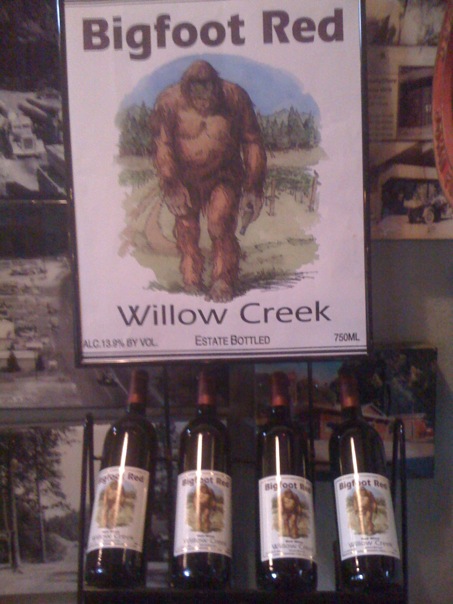 We found out that Cinnabar Sam's Restaurant in Willow Creek is no longer the exclusive distributor of this higher quality general table wine. Selling for $20.00 at Sam's can make it a bit steep for everyday, non-dining usage; but they assured us the wine can now be found more cheaply in the $14.00 and under range at the regional grocers, Ray's (with an affiliate in the former Bob's Market location in Willow Creek, and in Hoopa) and Murphy's. Also, you might want to drop in and visit the winery in our fine town for a visit and tasting. It is located up past the US Post Office, over the hill on Country Club Road, past Kimtu Park turnoff, and then to the left on Patterson Road after the bridge over the Trinity River.
 "Sentinel Winery was founded in spring of 2006 by Bruce and Janet Nelson. The 2-acre Covey Lane Vineyards and the winery are both located on the Nelson’s estate one-half mile from the Trinity River near the Trinity Alps Mountains in Willow Creek. All grapes used in making the wines are grown in the Willow Creek Viticulture Area and all wines are estate bottled. Bruce and Janet Neslon invite you to call for an appointment for a private barrel tasting and a visit with them on their wonderful front porch."
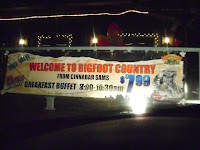 Speaking of CINNABAR SAM'S (read another set of reviews HERE), famous for its historical-themed interior and hearty pre- or post-Bigfoot field research meals: the business is up for sale. However, it remains open for hearty, mountain-style family dining. If you know of anyone interested in purchasing the building and taking over the business pass on the word. The owner, Steve Paine, is a font of knowledge of local history, and has shown a few Bigfoot-themed aspects in his business decor over the years.
 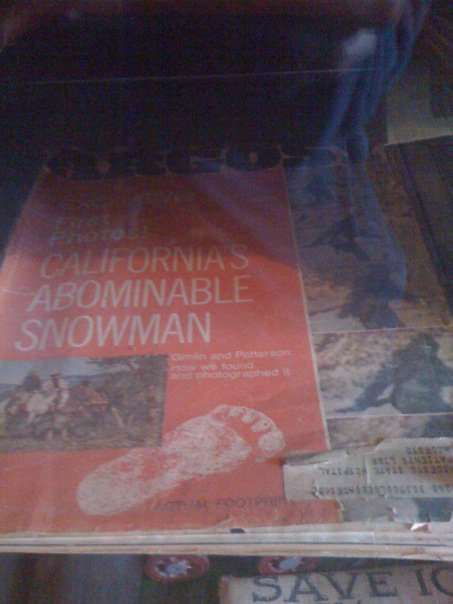 Images: The Bigfoot Country banner once displayed on the front rail of Cinnabar Sam's. Also, the elusive ARGOSY on display. Photos by Steven Streufert.
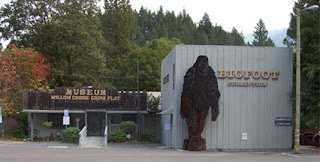 The prime Bigfoot destination in the town of Willow Creek is, of course, the WILLOW CREEK-CHINA FLAT MUSEUM, with its BIGFOOT COLLECTION add-on building. Al Hodgson was intstrumental in the founding and maintenance of this fine little museum, and along with John Green helped set up a wing to house one of the finest collections of Bigfoot footprint casts in the world, inherited from early researcher, Bob Titmus. There are wonderful historical displays on Bigfoot History in the general Klamath-Trinity area, including the PGF and the Jerry Crew footprint finds of 1958.
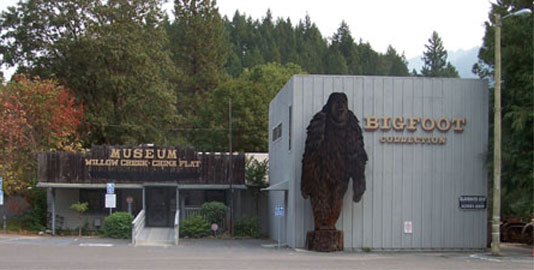 The prime Bigfoot destination in the town of Willow Creek is, of course, the WILLOW CREEK-CHINA FLAT MUSEUM, with its BIGFOOT COLLECTION add-on building. Al Hodgson was intstrumental in the founding and maintenance of this fine little museum, and along with John Green helped set up a wing to house one of the finest collections of Bigfoot footprint casts in the world, inherited from early researcher, Bob Titmus. There are wonderful historical displays on Bigfoot History in the general Klamath-Trinity area, including the PGF and the Jerry Crew footprint finds of 1958.
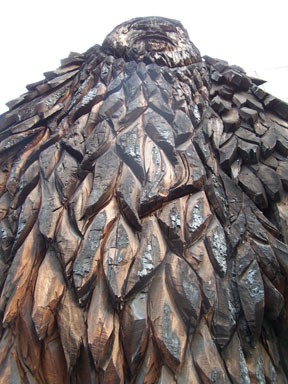 Closed duing much of the off-season, the Museum is open most days during the summer. It covers local history, culture and wildlife in one wing, and Bigfoot in another. They have a good selection of Bigfoot knick-knacks to purchase in the gift shop area. Also of interest is the LOG BOOK at the entranceway, which is chock full of visitors' Bigfoot sightings and encounters. Check it out.
 Willow Creek-China Flat Museum
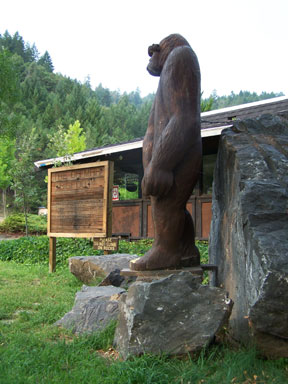
 This statue traditionally guards the entrance to Bigfoot Country at the junction of Highway 299 and the BIGFOOT SCENIC BYWAY, Highway 96, which leads up through Hoopa into the Bluff Creek area (see MAP below). Drive the highway north until you get to Happy Camp, CA, and you'll have traversed the richest zone of Bigfoot history in the world, in our own humble opinion. Stop in Orleans to get into the PGF zone (go up Eyesee Road about 16 miles then turn left on 12N13), or stop at the mouth of Bluff Creek, at the bridge where it flows into the Klamath River for a dip in the water and some great views.
 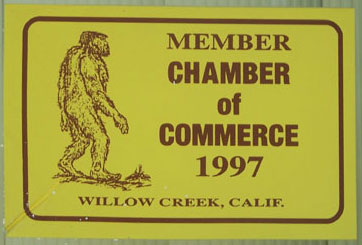 The statue sits just outside of the Willow Creek CHAMBER OF COMMERCE's Visitor Information Center. There are brochures here, some maps, and during open hours a helpful local elder who can tell you more than you know how to ask about the area around here.
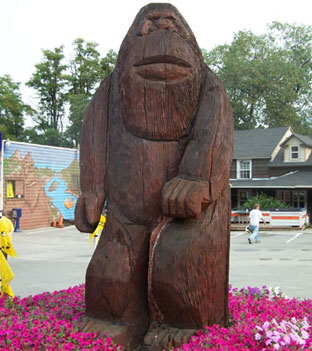 Images: Save for Byway logo, by Steven Streufert. CLICK TO ENLARGE to view.
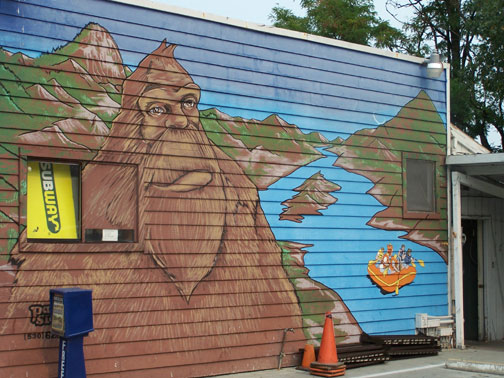 They used to sell Bigfoot novelties here, but have since moved on to more profitable beer, liquor, tobacco, snacks and lottery tickets, not to mention hookahs and CIA ball caps. It's still a great place to get your picture taken with Bigfoot.
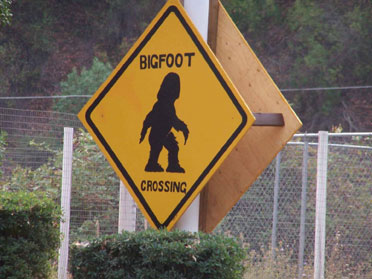 Images: Above and below, save for the map, photographed by Steven Streufert, 2005-2010.
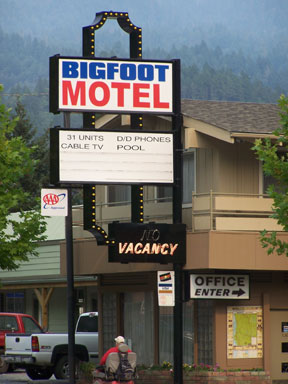 Bigfoot Motel
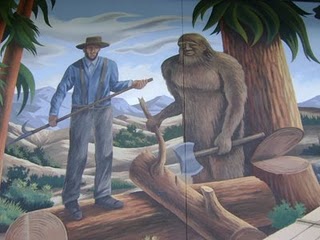 Just across the street from Cinnabar's you'll see a large full-wall BIGFOOT MURAL on the ACE HARDWARE building. It is huge. See the long, narrow image in the upper banner of this blog--just click it to see our photo montage of artist DUANE FLATMO's creation.
 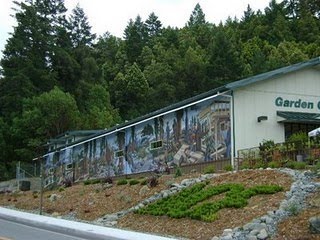 The theme is "Bigfoot in the Community," with the creature helping out with local trades and industries in five different locations along the wall. This is one you can't miss, and you might just learn something about the REAL history of the little hamlet of Willow Creek.
 (530) 629-2425
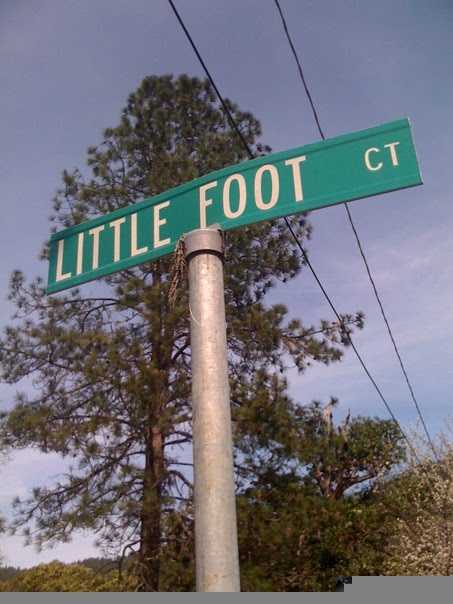
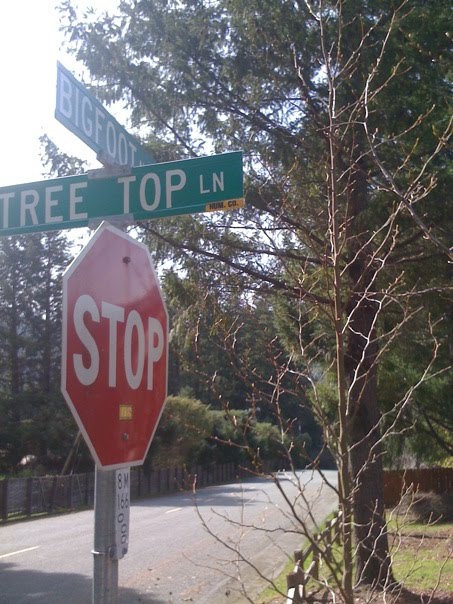 There you will See BIGFOOT AVENUE and its companion, LITTLE FOOT COURT. The WILLOW CREEK GOLF AND COUNTRY CLUB there used to be named after Bigfoot, but they changed it for some unknown and un-Squatchly reason.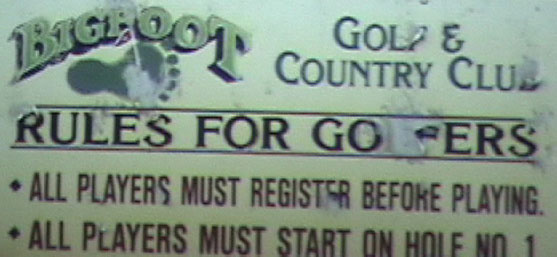

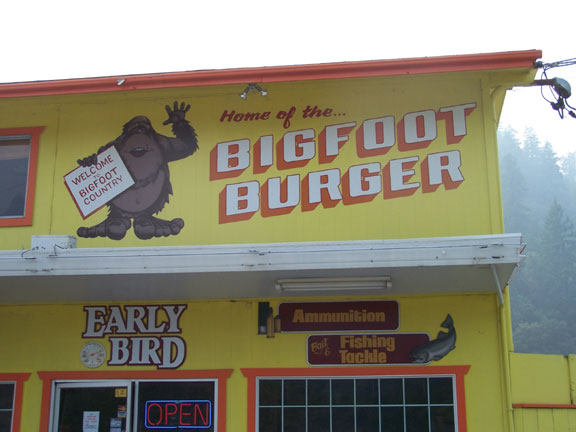
 Go farther down the 299 to the east and you'll come to BIGFOOT CONTRACTOR SUPPLY, another hardware store but with a builder's emphasis. They have a small shelf behind the counter of Bigfoot gift goodies, from shot glasses to t-shirts, most of them from the Bishop company line.
  Even PACIFIC GAS AND ELECTRIC (PGE) gets in on the fun. The sign near their electrical service center, just off Highway 96 outside of town, reads "BIGFOOT AREA"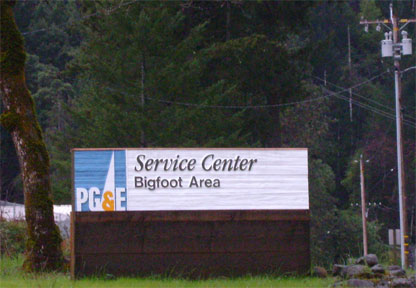
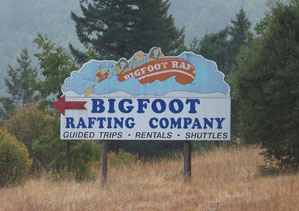 Bigfoot Rafting Company
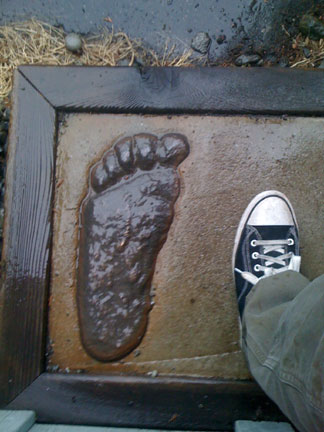 And, last but not least, if you head northward on Highway 96 you will supposedly find BIGFOOT PODIATRY. Now, we don't know if this is just a long-standing joke, or if there really is a foot doctor out there, but if your feet ache after a long bigfooting hike maybe give this number a try.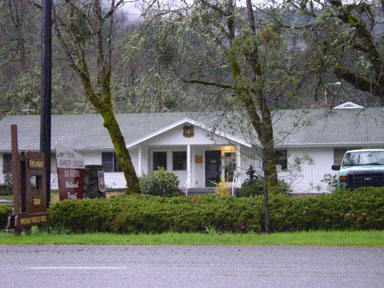
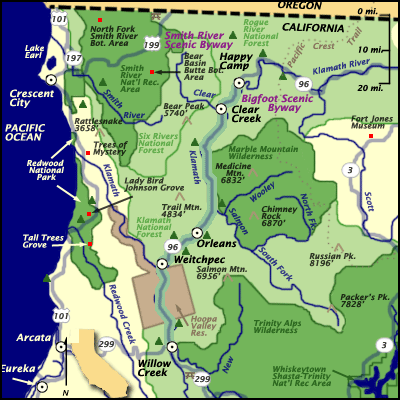 Click the link here for an interactive MAP OF WILLOW CREEK on Google Maps. The map at left shows the Bigfoot Scenic Byway.
 * Wenatchee National Forest -- Leiterman and Cutino
 ANGRY BIGFOOT SPEAKS!