Showing posts sorted by relevance for query gps. Sort by date Show all posts

Tuesday, May 17, 2011

Introduction to THE BLUFF CREEK FILM SITE PROJECT; Leiterman's Mission Statement; BIGFOOT BOOKS Now on YouTube

BIGFOOT'S BLOG, Late-October--Ooops!--Wait, NO! ...Mid-May 2011 Edition.

NOTE: THIS IS AN OLD BLOG POST WE NEVER GOT AROUND TO FINISHING. 
THE BLUFF CREEK FILM SITE PROJECT STUFF JUST OVERWHELMED IT SOMEHOW.  As the summer and the re-opening of the Bluff Creek roads are rapidly approaching, we're just going to give you this piece now as it is, unfinished. It covers the early stages of and introduction to the Project.
***
ANNOUNCEMENT:
The Bluff Creek Film Site Project's videos may be viewed on the NEW BIGFOOT BOOKS' YouTube Channel, or on the BFRO-Videos account.
Go to Bigfoot Books on YouTube!
Currently featuring the audio of our Al Hodgson Interview, in progress.
You'll also find some cool PGF clips and a
walking tour of Willow Creek BIGFOOT iconography and kitsch.
http://www.youtube.com/user/bigfootbooks
*******
THE FOLLOWING WAS WRITTEN BACK IN OCTOBER...

As you may have noticed by the two previous posts, we're finally getting all of these Bluff Creek ducks in a row. Yes, we admit it, too--we have betrayed you all (a little bit) by leaking information first and generally spending way more time than we'd have liked for a while on the BFF (Bigfoot Forums)... read our posts/threads there: EXPLORING BLUFF CREEK BIGFOOT HISTORY and WHERE IS THE PATTERSON-GIMLIN FILM SITE?  (We've posted a lot more extended information up there, so go look into it.) We also got drawn into one of Kitakaze's threads... apologies all around. The good news in all of this is that we have a tremendous amount of unpublished and quite fascinating material coming up for you, and soon, we hope. Bear with us--this post is just the first in a series on what we have investigated and discovered. See our two previous Preliminary Information posts for info. on the background to our Bluff Creek travels.
"There can only be one Film Site."
--Robert Leiterman
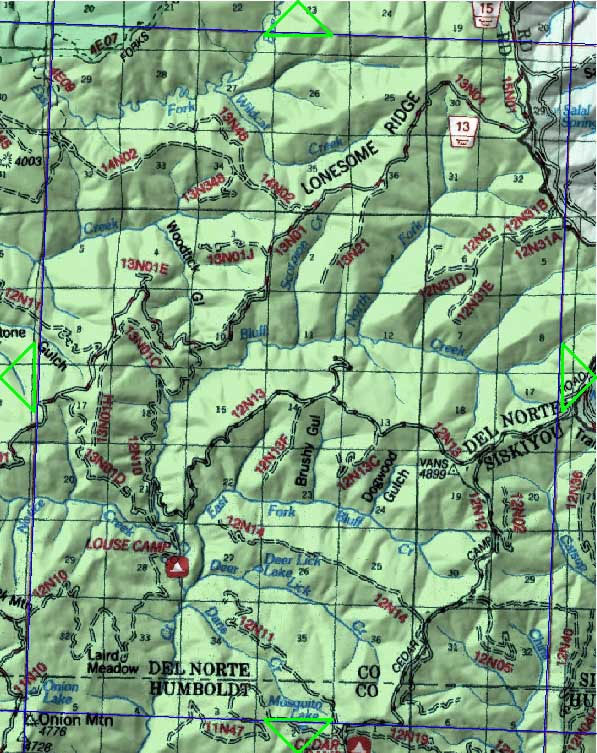
Lonesome Ridge, Bluff Creek, centered near the PGF site.
During the summer now passed we were up in the Bluff Creek basin many a time. In mid-September and early October we focussed upon locating the exact spot (to the best of our ability) of the Patterson-Gimlin film site. It may come as a surprise to some, but the site is not absolutely established any longer. The exact location and track-way WERE once known, and it was repeatedly documented by researchers such as Bob Titmus, Jim McClarin, John Green, Rene Dahinden and Peter Byrne, among others including many locals and those working up there on logging and road building crews. There is no doubt about that, as can be seen in the most notable film site photos from the early days. However, in the years since the site was studied most closely, it seems to have been lost to time, buried in dense overgrowth of alders and maples, and at least partially eroded away by landslides and creek flows. We were shocked at first to find out that there were several different locations being pointed to, by the old-time researchers and the internet Google-earthers. We found five different, but mostly very close, locations and a wide array of divergent GPS readings. Not all of them could be true and accurate. Read on, and you will see our process of "rediscovery." So as not to be redundant, we refer you to our many previous blog posts on Bluff Creek and the PGF site--just type those terms into the "Search This Blog" box to the upper left if you're interested. From here in this entry we will assume a certain basic familiarity with the site and the events that happened there. We do NOT question the validity of the PGF and its subject here; we are going on the presumption and evidence, as well as the gut feeling, that it IS REAL.

Photos by Steven Streufert, or video captures from Robert Leiterman's video (black borders or with text in image). All others are historical or maps for reference.
*******
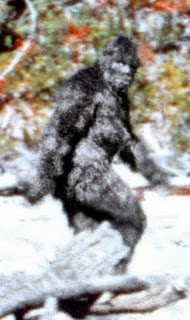
 Perhaps a little personal research history is in order here, briefly. Sometime around the year 2001 we first went camping up in the Bluff Creek basin. Being there at historic Louse Camp brought back the old childhood memories of reading the Bigfoot books at the public library, of having seen the P-G Film sometime around age 10 or 11, and being fascinated with the possibility of such a creature existing. At the time of that trip we had in our possession John Green's On the Track of Sasquatch, and we vaguely decided to try to find the site of the film. Well, it wasn't easy. After trying to hike up the creek we made it maybe a mile and a half, but found only one promising sandbar that didn't seem to come close enough to the mark on Green's map. It was all rather vague, as that mark was on a map without a scale close-up enough to see real detail. We prowled the old, now-closed forest roads along the west side of the creek. We tried hiking down to the creek, only to find ourselves stuck at huge log piles and near-vertical cliffs. We didn't make it up there after the 2003 Willow Creek International Bigfoot Symposium; but then we were a bit glad we didn't pay the $75.00 to go. The group had gotten there, with luminaries such as Green, Bob Gimlin, Al Hodgson, Daniel Perez, Christopher Murphy, Matt Moneymaker, Autumn Williams, Jim McClarin, and many more; and still they could not all agree on where the site of the exact track-way was. This problematic situation was documented in the Doug Hajicek TV show, Mysterious Encounters.The site had changed so much that those who had been there back in the day could hardly even recognize the general area, let alone the actual site of the sighting and film. We are told that even  Bob Gimlin, who was there that day of October 20th, 1967, could not recognize the place at first, and was taking cues from Perez as to its location.
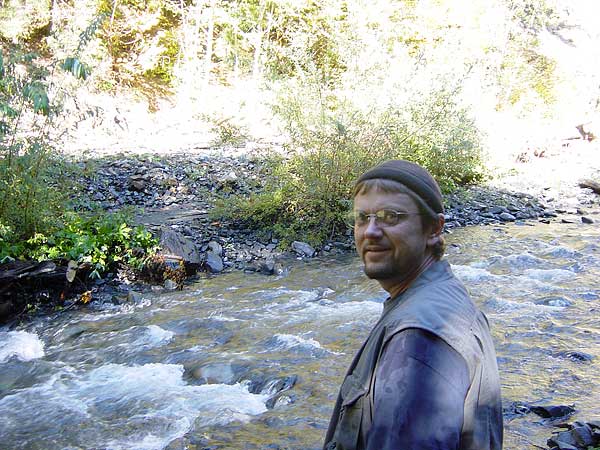
A file photo from 2007, Steve at Bluff Creek.
(Photo by Scott McClean)
 When at last we finally met up with the folks at the 40th Anniversary PGF Celebration, again in Willow Creek, we had been reading more avidly, and had better ideas of where the film site was. Based on advice from James "Bobo" Fay and Cliff Barackman, we headed on down to the site led by Tom Yamarone, with Scott McClean. So there we were, at the bottom of two miles of steep, nasty bushwhack driving, standing down at the creek-level landing, finally at the claimed area of the film site, and then it struck us, looking around at the unfamiliar territory--no one could take us right to the spot and prove it to be the spot. It turrned out that we did make it to the basic area most agree is the right one, but the sense of lingering doubt persisted as we gazed upon a vastly altered and unfamiliar landscape. Nothing looked the same, and no one could give exact directions. Some even think it is downstream, we were told by Yamarone. It became a bit of an obsession with us to discover the truth, especially as it is precisely uncertainties like this regarding the PGF that are exploited by the debunkers as supposed proof of a hoax.

The Crucial Transitional
Guidebook, by Daniel Perez
 In the three years following that conference, we've spent an inordinate amount of time trying to ascertain the history not only of Patterson and Gimlin's time spent in the area, but also the Bigfooting, logging and road-building history of the area. Much of this history seems to be lost to time. Other aspects of it seem vague or contradictory in the memories of many locals who worked up there and many Bigfooters who had been there over the time since the late 1950s when the area became famous for its hairy-hominoidal activities. Though stories were recalled, the exact locations of those events seemed either lost or poorly recalled. This a fact of human memory. So concerned were all involved with viewing the creature in the film, that many neglected to remember the site itself. It was once known well, and was visited and documented regularly by Rene Dahinden, the Swiss-Canadian who perhaps knew the film and its history best. But with the passing of Rene we were left with stories, old photos, an arrow on a topo map in Daniel Perez' Bigfoot at Bluff Creek, but apparently no one who could walk to the site and with absolute confidence put their foot down where Patty had walked. However, many claimed to know, without proof. We are lucky that Dahinden marked the map for Perez, and that Daniel was assiduous enough to preserve and publish it, or we might have lost the site forever.
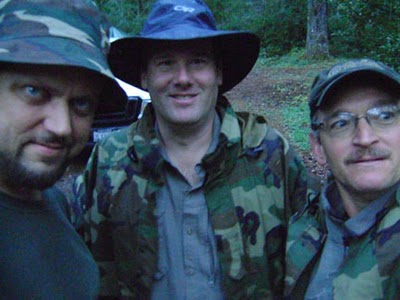
The Crew at Louse Camp. Yours Truly, "C.I." and Robert Leiterman,
ready to get rained upon.
It was frustrating, surely; but studying this history put us in touch with a good portion of the major Bigfoot researchers who were involved with the Bluff Creek site itself, including most of the aforementioned figures and some newer contacts such as Peter Byrne and Jim McClarin. Armed with their statements and advice, we felt prepared to try a series of expeditions to the mysterious creek basin to find out the truth. It was going to take a lot of Sherlocking, however, as we found with our research associate since 2009, "C.I." (name to be kept anonymous), when interviewing Mr. Hodgson and trying to dig the nuggets of certainty we'd need from the Bigfoot literature... it just wasn't there in a complete form. Maps, logging plans, contemporary roads, dates and other pertinent details were obfuscated by time. 
Various Site Locations, as per various researchers.
Sites identified by Steven Streufert via inquiries. Click to Enlarge!
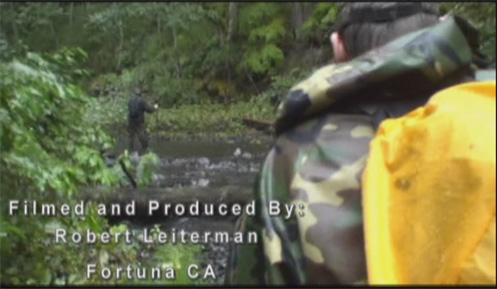
The history was fragmented, often conflicted, even sometimes intentionally hidden by certain researchers. Luckily, we got involved with CA State forest ranger Robert Leiterman (BFRO), of Fortuna, CA, who was making field videos for the BFRO YouTube site. A project was conceived between the three of us and, we feel, has nearly been completed. We are on the verge of proving tthings... but the full elaboration of that will have to wait for future installments and an early spring day when the site may be photographed without obscuring deciduous tree leaves. We've made what we think are major and fascinating discoveries and conclusions which we feel are pretty darn close to absolutely proving the true and exact location of the film site and track-way, otherwise cloaked in mystery and disagreement for these many years.
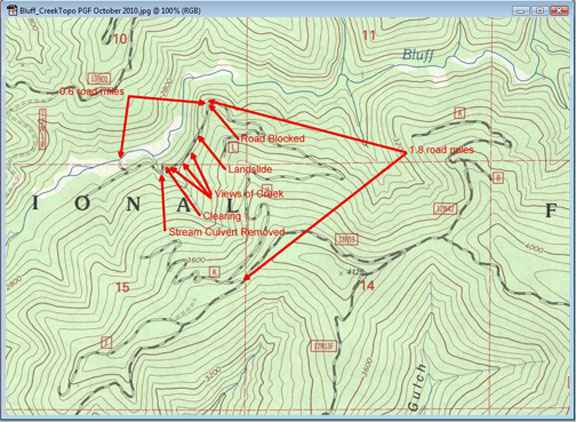
Topo map of route down to P-G Film site showing road closures and con-
struction spots. The spur down stems from FR 12N13. Click to Enlarge.
We decided something needed to be done. Before all of this was lost to time and fading memory, before all the old-timers were gone, we were determined to find the actual site and rule out the false ones, all while documenting it on video for presentation to the world of Bigfooting. For now, let us recount the first day and some preceding interviews. Part One of our first summer 2010 trip around the area has already been covered in travelogue form with maps and guides HERE, so check that out (there are plenty of links there covering our previous Bluff Creek trips). I'm going to skip part two of that for now in order to get started on this PGF site investigation series. 
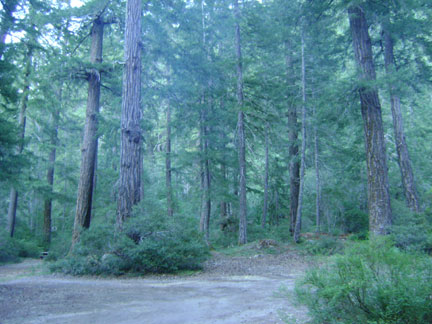
Louse Camp, on Bluff and Notice Creeks
This current entry will cover our second trip, which was partly rained out, but still succeeded in producing many hours of footage to be used in YouTube presentations via the BFRO-Videos page there. See BELOW, where we will present certain supplemental material as APPENDICES. These include conversations with John Green and Peter Byrne, and some of the stuff we posted on the BFF (HERE, if you want to view the whole "Where is the Patterson-Gimlin Film Site" thread). Armed with all the known film site photos, topo maps, and extensive notes and books, C.I and I met in Willow Creek and readied ourselves to set off for the famous Louse Camp to meet Robert Leiterman, who had been up there already for a couple of days preceding us. Of course, right as C.I. arrived in our humble Bigfoot Capital of the World, it stated to rain in a light deluge. 
Pacific Northwest Expedition, 1959. Tom
Slick, Rene Dahinden, Bob Titmus, etc.

PART ONE: LOUSE CAMP TO THE BLUFF CREEK BRIDGE

Undaunted, but skeptical of our prospects, we headed up to the hills above the Klamath River. Louse Camp is located right in the heart of the Bluff Creek basin, and is famous for being the location of a myriad of Bigfooting expeditions, including the famous Pacific Northwest Expedition (1959) that had Green, Byrne, Dahinden, Bob Titmus and Tom Slick, it's financial backer, among its members.
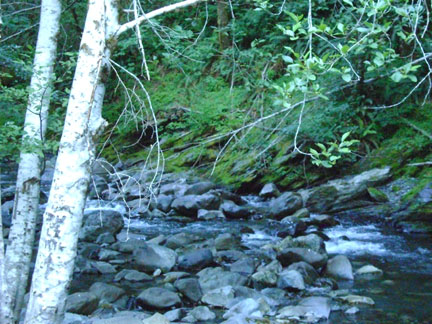
Bluff Creek flowing behind Louse Camp,
refreshed by the influx of Notice Creek just above.
We were lucky to get up there without being trapped by the kind of meteorological attack from the skies that nearly stranded Patterson and Gimlin back in 1967. The rain became light and sporadic throughout the night. The next day was another matter. Leiterman had just returned from a long, exploratory hike up the creek to the film site area and back. We heard his tales of adventure over a sputtering camp fire. He told of having found the M.K. Davis-identified "film site," downstream some 500 yards from the "bat boxes" landing where nearly all others agree is the real area of the site. He said he found the site implausible on a number of counts, based upon our previous discussions. This aspect will be discussed more thoroughly in State Two of this blog's presentation. Suffice it to say, the MK site is way too wide to fit what is known about the P-G site, and the trees were too far back to be acceptable as the ones in the film.

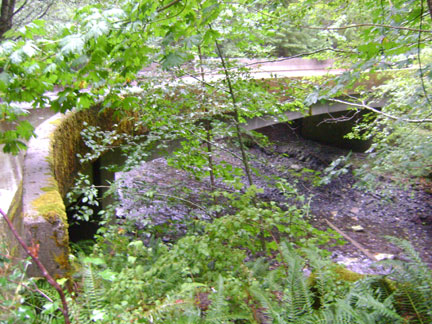
Bluff Creek Bridge, up 1 mile from Louse Camp
The next day, our first order of business was to try to figure out exactly where Patterson and Gimlin had set up their Bluff Creek base camp before capturing the creature on film. It has been said and rumored for years that they camped "somewhere" above Notice Creek, which flows just up from Louse Camp. Al Hodgson, when asked about this, told CI and I that it was true, and that there was a ford across Bluff Creek, where one could cross and then head up the creek. He also spoke of the bridge over the creek, up from Louse Camp about a mile, which had not been there in 1967. Heading up from Louse we observed that the road quickly ascended up above the creek along the hillside, with radical steep descents down to the creek below. Tracing this idea all the way to the bridge we found the truth: this bridge was the ONLY place after Notice Creek where one could possibly have forded the creek. So, Patterson and Gimlin must have forded here, to the east side of the creek, and then headed up the creek to find a suitable camping spot. Indeed, we found clear evidence of the old road cuts under the bridge, on either side of the creek.

Wasson's source:
Rene Dahinden!
We knew from Barbara Wasson's book, Sasquatch Apparitions (pg. 68), that the following was the case, in this slightly grammatically ambiguous sentence:

"Bob Gimlin awoke [on October 20th, the day of the filming] one sunny day in their camp some one half miles or so north of where the bridge ABOVE Notice Creek crosses Bluff Creek." 

Deciphering that sentence we knew it could not be referring to the Notice Creek Bridge, but rather this one. The bridge ON Notice Creek does not CROSS Bluff Creek, but rather Notice Creek. So, we took it that the bridge ABOVE Notice Creek HAD to be the one that is one mile north of Louse Camp. Confirming this, and comparing it with Robert Leiterman's GPS reading from the previous day we found that the half mile up Wasson mentions, combined with the 2.5 miles up from their camp to the film site generally mentioned by Bob Gimlin, made a perfect match with Robert's apprx. 3 mile result. Hence, they could not have camped at the Louse Camp area--that would have made it a nearly 4 mile ride.
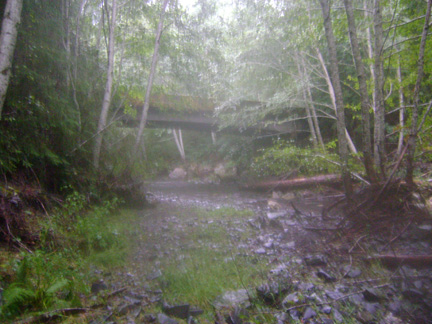
Under Bluff Creek Bridge, showing old road cut and ford to opposite side.
Down under the bridge we could clearly see the old ford's road cuts on either side of the creek, with an old roadbed heading up the east side of the creek, then fording across up a little bit to the west side. Already we knew that the road was just as we suspected: a winding logging access-4WD track that crossed the creek where needed, not the clean road cut up all the way on the east creek side as has been commonly assumed. The bed of the creek is just not wide enough to accommodate the latter, and it often cuts up against steep, hard rock faces. It is shallow enough most of the year, though, to allow for a multitude of needed fords. Again, as Al Hodgson had told us, the old dirt and gravel road had been washed out in the massive 1964 flood, and had then been re-plowed upstream to allow for salvage logging in 1965 and 1966. Despite all of these years gone by, we could still see remnant signs of this road cut, as well as many sawed off tree stumps and root-balls in the creek's course. Since 1964 there has not been a comparable flood to alter the major features cut out by the one in 1964, which also constructed the famous PGF sandbar upstream. We noted these results, and planned to investigate up the creek once we had returned from our drive up to the PGF site. Our plan to hike up there this day had been dampened by the rain, now again lightly drizzling down. It was clear to us, however, even at this early point, that we were on the right track to finding the Patterson-Gimlin 1967 base camp. In our Stage Two trip we discovered what is almost certainly the right site. More on that next time, though.
Lovely misty view down to Scorpion Creek,
from about 2/3 mile up from the site.
PART TWO: UP TO THE RIDGE, DOWN TO THE FILM SITE AREA
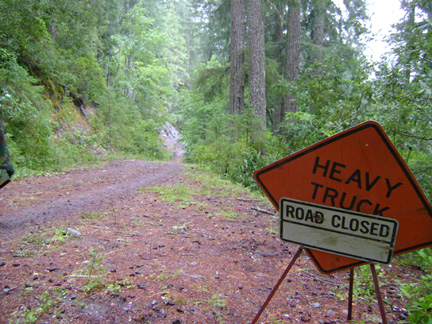
Warning sign of things to come on 12N13H.
Heading up Forest Road 12N13 from the bridge, up to the top of the ridge where it meets with the "H" spur road, we expected an easy ride down the recently cleared, trimmed and graded dirt road. However, the rain gave us concern... that dirt could easily turn to mud. Sure enough, it did. We found that the formerly nicely flat roadbed had been roughed up by tractor trails of some large, heavy equipment. Down the way just over a mile the road got worse and worse until it became a muddy slurry and mess in places. We had to stop, park the truck, and walk on down, a distance we knew would be about a mile through the muck, and a deadly slog back on up, too. Walking down the road, though, provided us with a slow-motion way to view down into the creek basin above the site and from the east heading down. This was, later, to give us the real, best clue we needed to locate the true site.
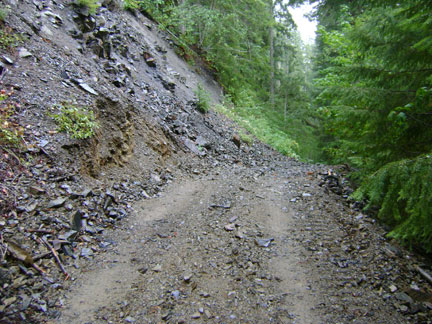
Once a rock slide, always a rock slide.
One bit of good news (temporary, see latest developments in State Two) was the plowing through done on the infamous rock slide. This slide has notoriously been the bane of PGF site visitors, especially those without high-clearance four-wheel drive vehicles. Last summer this was the spot of the near-death experience of Craig Woolheater and Sharon Lee (see our previous posts on the Believe-It Tour visit), as their rental van got stuck spinning its wheels after a photo-op and nearly slid off the side into the precipitous near-vertical drop down to the creek.
You Shall Not Pass. Robert at the
end of the PGF road's line.
Now, to die on the P-G film site may seem a glorious way to go, but we assure you no one feels that way as the wheels slip and slide on those jagged Bluff Creek rocks, and the world slips gut-wrenchingly sideways. Anyway, for this one moment, we thought the problem was solved; but as we found out later, the US Forest Service had a decidedly different idea.
Leiterman considers the impact of
man upon nature and geology.
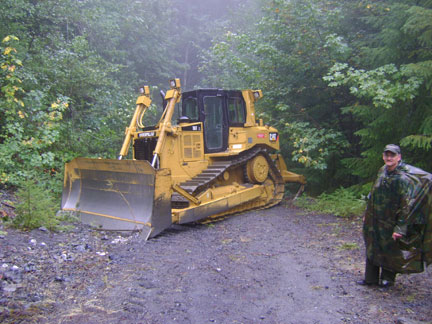
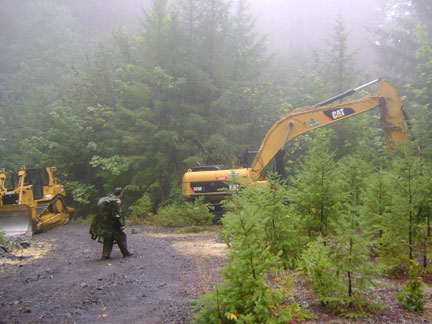
Down the road a bit we found the culprits of this mayhem--two tractors, a bulldozer and a huge Caterpillar. They dozer was actually parked IN the road, blocking it entirely for any prospective intrepid motorists. From here on down it would be on foot for everyone. Down farther, in the formerly marshy bog formed by a culvert-diverted creek that flows down into the film site area's gulch, we found they had torn out the culvert and torn the hell out of the spot.It was not clear to us what they were up to, but it appeared at this time that they were simply upgrading and replacing the culvert. Little did we know! But more on that later, too.
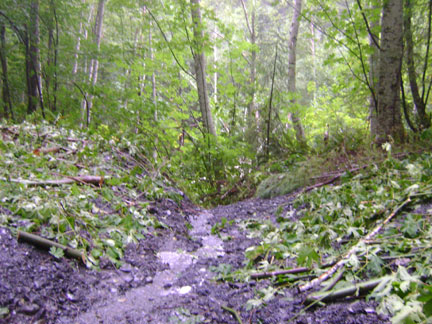
Once the road crossed here; now it
is returned to its natural state.
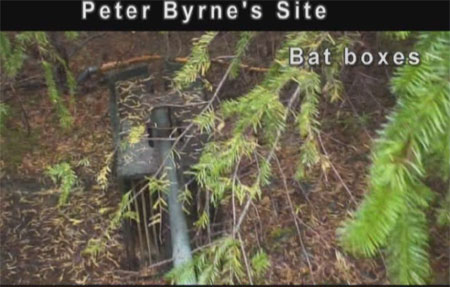
After the creek one descends down to the old landing where the "bat boxes" are. This used to be the easy park-and-camp option for PGF site pilgrims--no longer, unless you pack it in. This is where Peter Byrne said to look in my recent email correspondence with him (see Appendix B below for full discourse). The rain increased, saturating us and our gear. You'll note a fogginess enters the photographs here as my camera got wet. Darnit, so did my tobacco. Anyway, here at the bottom we were at our first on our list of prospective film site locations--and it really seemed almost too convenient, here where one could once just get out of the car and gaze at Bigfooting Mecca.
The toppled science experiment's bat
houses lay beneath these trees.
SITE ONE: THE PETER BYRNE SITE:
The Famous "Bat Boxes," across from the claimed
Peter Byrne film site.
In preparation for this expedition I had sent out email inquiries to many of the major first generation players in Bigfooting still living. We received a very cordial response from both John Green and Peter Byrne. John Green, who said he had only been to the site twice, in 1968 and in 2003, stated that when he was last there he could not even recognize the place, and could not spot the "Big Tree" seen so prominently in the film. So, despite the fact that the place was clearly well known and documented at the time, it was lost to at least one of its major researchers. Hence, we had high hopes in hearing what Mr. Byrne had to say. He'd been there many times, though not as many as the late Rene Dahinden.
Watch for the full series featuring our expedition on the
BFRO-Videos site on YouTube, or through BFRO.net.
Brief Summary:
Laser reading 97-98 yards across south to north, 100 yards in bat box camping area.
Trees that match Byrne's distance are way too high up the bank.
The creek is on the north side of the sandbar, not the south.
Though the area's dimensions match almost enough to the known film site (using a shoe horn to fit it, as C.I. likes to say), the creek and sand bar are in the wrong places, there is no "big bend," no "rootballs," and no level bank or sandbar at all where Byrne indicates.
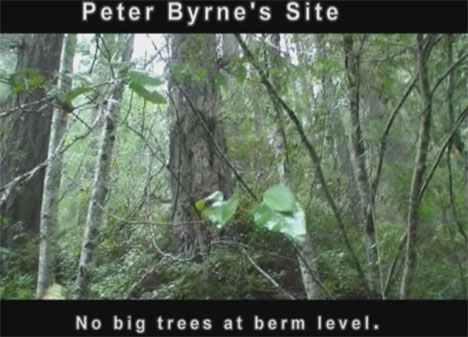
Photos with black borders or titles are screen captures
from Robert Leiterman's first edit video results.
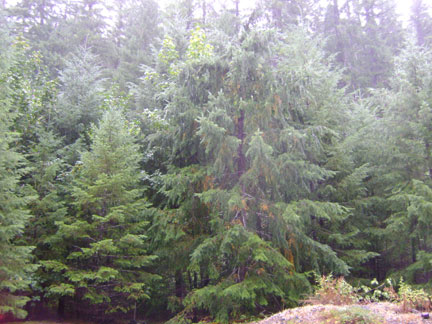
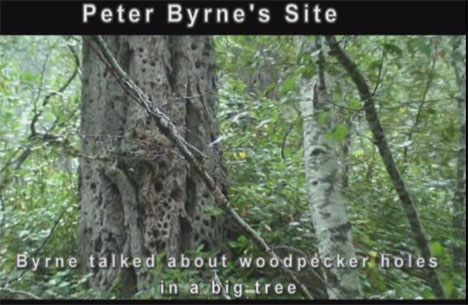
We found the tree described obviously by Byrne, pockmarked somewhat unusually with woodpecker holes, but it was at most 100 feet, not 100 yards across: too close; and the stumps he described are right next to it, not at the greater distance measured by Dahinden.  To reach up to the larger trees on the hill above the creek and sandbar would have had to have been some 30 or 40 feet higher--just not plausible, and exceeding the already high level of subsidence mentioned by Byrne in his email. The creek is in an old, established bed, at the lowest point of flow, and there is no indication of any major event that could have changed this geological fact.
The 300 feet or so needed to fit the film site in is here, but the creek would have had to have flowed way up against the south edge of the bat boxes landing, an area that is significantly raised up from where the creek is flowing.

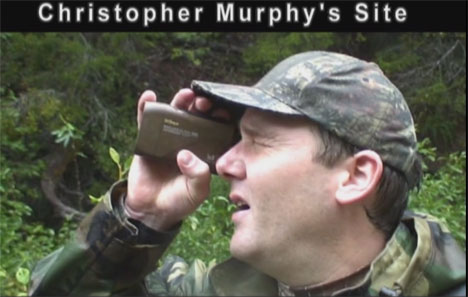
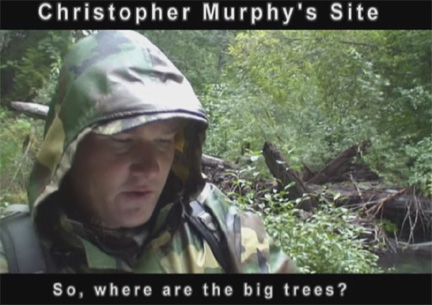
SITE TWO: THE CHRISTOPHER MURPHY SITE

The site is still too narrow, if we assume that the big tree here is one of the ones in the film. The creature would have had to start its walk down in the narrow gulch seen to the left. There is no "big bend" in the creek below that site either. In fact, the bend with rootballs is seen ABOVE the site located in Murphy's book, followed by a straight line in the creek headed west and downstream.
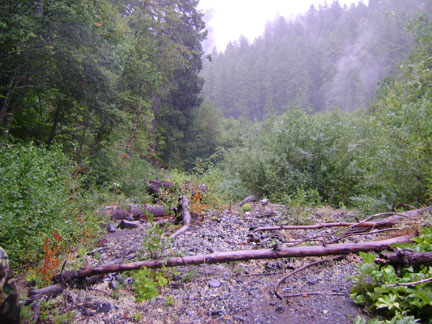
Lower Gulch below the Big Bend. For Murphy's site to
work the first sighting would have to have been in here.
In this narrow part of the creek there ARE a lot of big old firs that have fallen down across the creek due to erosion and rock slides on the north bank. However, if these were the trees in the film, as proposed by the Murphy site location, they are simply too close to the creek to allow for the big sand bar seen in the PGF. Also, there is no logical way the creek could have flowed some 200 feet or so to the south, as that direction features and upgrade and the start of some low hills. A creek cannot flow up on a higher course if there is an unobstructed lower course it can access.
C.I. using his trusty laser sight to measure the dimensions
of the proposed Christopher Murphy film site location.
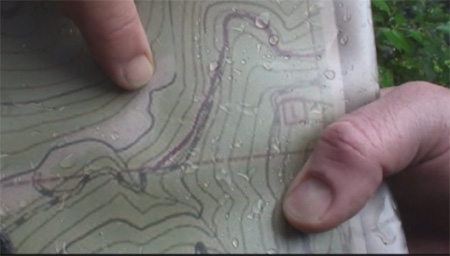
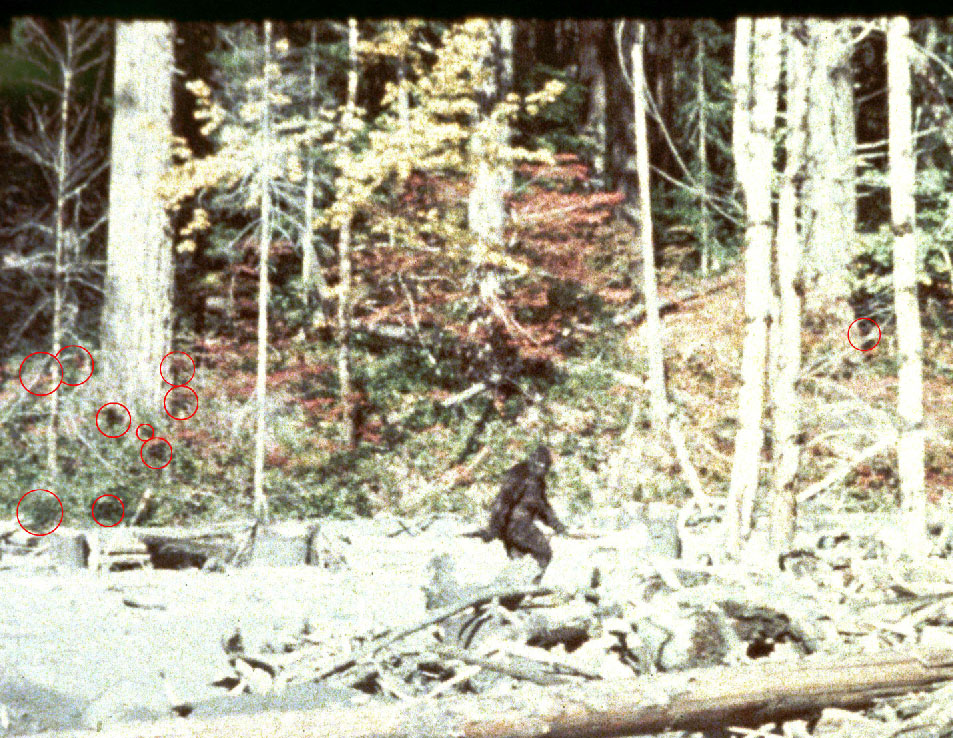
Laser readings 55 yards from creek to back trees, some 60 yards to the trees on the south bank. Again, this site fits "with a shoehorn," but the creek is way too far to the north, and there is no room at all for any of the known features of the old sandbar, the big bend or the root balls described by Gimlin. The big trees identified with this site are high up on the bank at least 20 feet up the hill--way too high, even allowing for sandbar subsidence. Most crucially, there is no hill going up high enough on the south bank, and yet close enough to the site, to allow for the angle of view seen in the 1971 Rene Dahinden photo which we used constantly for comparison on these trips.

Clip from Murphy's book, showing
where he thinks the site is supposedly located. In
actual fact, this is WAY off from Dahinden's mark.
There IS one big tree behind this spot, as can be seen on this blog (picture link HERE), but this tree is way too close to the fairly narrow sand bar at the bottom of the big bend that centers around a small feeder creek that flows down into Bluff at this point. It sits down on the sand bar near the current creek's bank, but there just isn't enough room to place this as the main "big tree" in the film. This spot, by the way, is where the National Geographic filming team landed their helicopter in 2009 to film and scan the site. Unfortunately, it doesn't appear to be the right location, and we tried to tell them that when we were down there then, to no avail. On this year's trip we even found their flagging tape wrapped around a rock, still there right in the creekbed, despite a whole winter's raised water.

Christopher Murphy's exploration of the film site he proposes, done in 2003, can be looked at here on Hancock House's site: FILM SITE ALBUMWe challenge you to compare his analysis, based on one visit, with the results we have come up with after some dozen visits.

See our videos on the BFROVideos site under "Uploads," as well as on THE BIGFOOT BOOKS YOUTUBE PAGE, under "Favorites." 
Watch for upcoming presentations to be done on this blog. "To Be Continued, Indeedy."
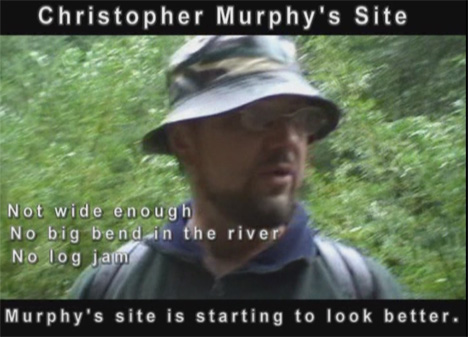
Steve, propounding again, upon the too-small dimensions
and missing features found on the Murphy site. Better than
Byrne's, but it lacks landmarks and proper orientation.
Above the Murphy site are found some big root balls, not
below the site, as Gimlin describes. No big trees in back either.
Pointing at Rene's Mark on the Map, upstream from the
Murphy site, for sure. Photo capture from Leiterman video.
*********************************
APPENDIX: STATEMENT OF ROBERT LEITERMAN ON THE BLUFF CREEK EXPEDITION MISSION
(As also sent to BIGFOOT TIMES' Daniel Perez, published in the October edition)
Leiterman, from his upcoming video release on our trip.
10-29-2010
Daniel,
Good talking with you on the phone yesterday. Thanks for getting back to me so soon. As you already know, I have been a subscriber to Bigfoot Times for several years now. My latest video project is on the Patterson/Gimlin Film Site entitled … Journey of Re-discovery- The Bluff Creek Film Site Project. I’ve been working mostly with Steven Streufert from Bigfoot Books (Willow Creek) and Ian from Northern CA over these last few months.  Our group’s motivations might be different but our goals are similar, relocating the film site 43 years later despite the environmental changes.

You have worked painstakingly hard over the last few years dealing with the film site subject matter. Your Bigfoot Times at Bluff Creek (1992) publication is excellent work, placing your self into a knowledgeable position on the subject. Despite your dedication and documentation there are a hand full of others, for whatever reasons, who still insist that the film site is either located above or below the area in which you have painstakingly established. I understand why you feel the way you do when you hear the echoes of doubt from a small minority vocalizing across the internet. I also realize that dumping even more documentation into their laps may not change their opinions either. With that said, the project I have taken on is a rediscover for my self, a journey for understanding. With the help of Steve and Ian, I’m video documenting the process. I feel the video footage will allow others with an interest in the subject, to join in with a discovery of their own.

As you know, there can only be one film site. While looking over the literature, interviewing those who were there, and examining what remains of the scene, we are looking forward to the outcome. The several days I have already spent with hunger and fatigue in the heat and rain: following what is left of the Bluff Creek Trail up the creek, pondering campsites, crisscrossing the alleged film site locations looking for the big trees, locations of old stumps, gravel bars (existing or not), deposits of alluvial sand, bends in the creek, woody debris, large root balls, and matching historic photos, has been an adventure in itself. And yes, I’m fully aware that 43 years have worked their magic. While I’m at it, I’m developing a better understanding of the historic event and the surrounding topography. I only wish I had started this journey years earlier.

 Despite all of my effort, some say I’m wasting my time, that the answers may never be found, erased forever by time, that there is nothing more to learn from rediscovering that moment. I disagree. Putting your self right there in the thick of it does something to you. To walk through the cool clear water, to hear the echoes in the creek canyon, to go back in time, to grab a hand full of alluvial sand and tell your partner … “Patty walked here!” To watch them grin ear to ear and nod their heads in agreement as they look curiously over their shoulders. And before you know it, you’ve taken one more step closer to imagining how Patterson and Gimlin must have felt that autumn day. For me, the bottom of the dark, forested canyon still has meaning. 

For those planning a journey of their own to the Bluff Creek Film Site be advised that the last mile or so of 12N13H has been permanently been put to bed. On the weekend of 09-18-2010 the road was freshly graded and the heavy equipment lay parked about. By the weekend of 10-09-2010, the heavy equipment was gone and the road had a new ending. With about a mile to the bottom, a enormous new earthen berm was there to greet us. The rest of what use to be the road had been out sloped, portions covered with trimmed vegetation to help protect the exposed soil from erosion, culverts were removed and the creeks reestablished back into their own channels. Give yourself more time for exploration. Avoid wet weather, the fresh graded soil turns quickly into mud. Be prepared to put in a little more effort to reach the film site. Think of it as a way of reconnecting.  Reaching the bottom will feel that much more rewarding … it’s the hike out that’s going to suck! ---Robert Leiterman

"Watch for Robert’s soon to be uploaded  Journey of Re-discovery- The Bluff Creek Film Site Project and his other video projects on the B.F.R.O.’s (Bigfoot Field Research Organization) video channel."
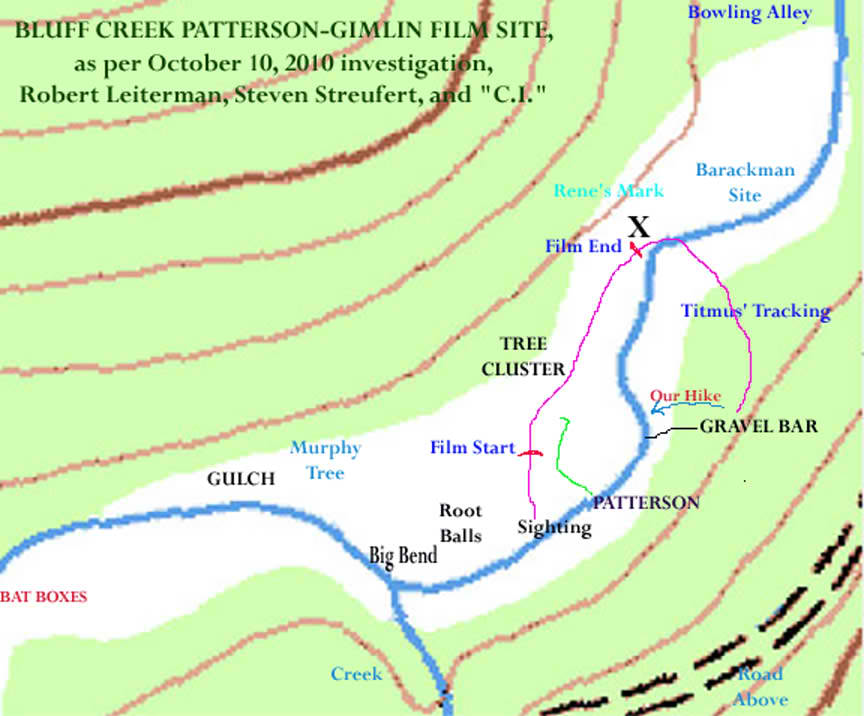
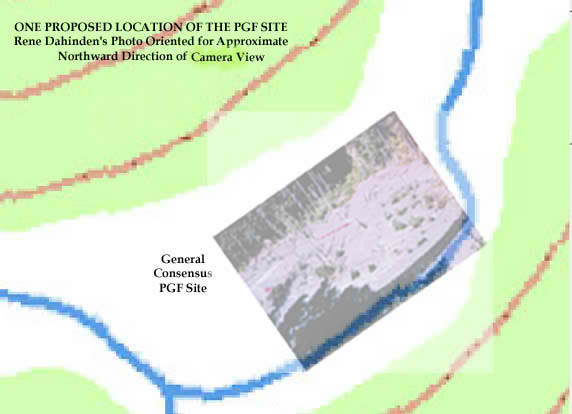
Some preliminary theories we've come up with, along with the
major proposed site locations and landmarks.
One Proposed Location. Photo aligned to creek, not quite to scale.
The cluster of trees in back, plus a downed tree on the sand bar, and
stumps in the right locations make this location promising. It looks
just about perfect as a match for the "aerial" Dahinden photo.
The first sighting would be just to left of the photo border.
****************************************************
ANGRY BIGFOOT SPEAKS!

Me so very happy you hu-man looking in wrong creek for me! Like NABS Dave say, you not find me there anytime more. You look in Hoopa, you find me. That right! Me hang at Golden Bear Casino ever night, and you not know! JHa Ha Ho Ho! They have good food all night, and not ever question how furry me are, not how stinky, so long as me have token for machine. See? Dave right after all!!!
****************************************************
This blog is copyright and all that jazz, save for occasional small elements borrowed for "research" and information or satirical purposes only, 2011, Bigfoot Books and Steven Streufert. Borrowings for non-commercial purposes will be tolerated without the revenge of Angry Bigfoot, if notification, credit, citation and a kindly web-link are given, preferably after contacting us and saying, Hello, like a normal person would before taking a cup of salt. No serious rip-offs of our material for vulgar commercial gain will be tolerated without major BF stomping action coming down on you, hu-man.

Friday, March 21, 2014

A Miscellany of Stuff I Posted on the BIGFOOT FORUMS re. the PGF Site

BigfootBookman

Member Since 29 Aug 2010
ONLINE Last Active Today, 02:55 PM
*****

#615774The Munns Report

 Posted by BigfootBookman on 01 August 2012 - 04:46 PM
The only filmed release of this expedition will be as part of the BLUFF CREEK FILM SITE PROJECT. Those should appear in late summer or early fall. Drop that title into YouTube if you haven't seen our videos. This was a fully independent, non-commercial and unbiased labor of love for all of us. Before there was "Finding Bigfoot" there were two guys named Cliff and Bobo, and they were friends of mine. They helped me by confirming things that they knew about the site, such as that Gimlin had tentatively identified the general location back in 2003. Daniel Perez, of course, has always been a great resource on history for me. We did the best we could with our experience and local expertise to find and document the site and validate or refute aspects of the claims about the history of Bigfoot in Bluff Creek. We wanted those who had helped us along the way to be there, and we also wanted those who could with their own expertise take it farther than we could to the next step. Having Bill Munns come up there with us occurred to us as a natural idea way back in 2009, and it was quite a glorious day when he finally made it there and got to see the Big Trees on the true film site. Now the data is in his hands, as well as a geologist who is doing independent surveying analysis on the site, and our own work is essentially done. I know already that Bill is the right guy for the job going forward, and from his work we should at last have reliable information about the action and subject seen in the Patterson-Gimlin Film.

This link will sort BLUFF CREEK FILM SITE PROJECT by most recent videos first, for those who are interested. Just scroll down past the Coast to Coast AM links to find them.
http://www.youtube.c...o_date_uploaded

More info covering the whole "re-discovery" process may be found on my blog, of course (bigfootbooksblog.blogspot.com)

Here is an image of Bill just after he first saw the Big Tree, and then started pointing out the others seen in the background of the PGF.
Munns at Big Tree.jpg
Click to Enlarge

Best,
Steve/BFBM
http://bigfootbooksblog.blogspot.com/
  • 1

#615047The Munns Report

 Posted by BigfootBookman on 30 July 2012 - 05:59 PM
Bill, it was truly a great thing to have you come to the film site. I hope that the data we all retrieved will advance your cause, and lead to real knowledge (at last) about the PGF and its subject as it moved through the site. Having you, Daniel Perez, and the others come up and join us in the BLUFF CREEK FILM SITE PROJECT was truly an honor. We very much look forward to your results.

I'll have more photos and information on my blog soon, but for now here is a group photo from down in Louse Camp.
Bluff Creek Trip GROUP SHOT.jpg
Back row: Todd Hale, Tom Yamarone, Steven Streufert, Ian C., Daniel Perez, Rowdy Kelley, Terry Smith, Scott McClean, Cliff Barackman
Front row: James Bobo Fay, Francis and Robert Leiterman, Bill Munns
Foreground: Monkey and Pre

Here is another, on the site right on the trackway, to include all members...
Group Shot at Site.jpg
Cliff Barackman, Ian C., Rowdy Kelley, Todd Hale, Jamie Snowhorse, Robert and Francis Leiterman, Bart Cutino, Terry Smith, James Bobo Fay, Bill Munns and myself.
(Missing Richard L., the retired USFS hydrologist who joined us the first day, and Scott and Tom who stayed in camp.)

Here are the original BLUFF CREEK FILM SITE PROJECT guys, reunited with Ian's return...
Bluff Creek Project GROUP 2012.jpg
Steve, Ian, Robert and Rowdy, in front of the Big Trees.

Images will enlarge if clicked.

Best regards,
BFBM
Steven Streufert
http://bigfootbooksblog.blogspot.com/
  • 1

#596543The Munns Report

 Posted by BigfootBookman on 03 June 2012 - 04:58 PM
Thank you, Bill.
I certainly do not wish to violate the rules of this Forum.

Here is an image that shows how we first started seeing with surety that we must have found the right spot, beyond just finding the "Big Trees" and some stumps.
Leiterman PGF Comparison with Aerial medium.jpg
Click to Enlarge. Red lettering and map drawn by Robert Leiterman.

The mathematical proof done by an independent geologist that the site we surveyed and the "aerial" photo by Dahinden taken in 1971 are the same spot is available in the link I posted right above. We no longer have any doubts, but we look forward to other views from people like Bill Munns this summer. To be clear, what we sought in the survey were OLD FEATURES that were not part of the new growth. Almost all new trees on the nearly fully still-extant sandbar are from after the 1964 flood, and so should not have been there in 1967. We noted all of these on the map, and eliminated the rest. We noted all old-growth trees that mattered as well, knowing they were older than 44 years. This would give us, we hoped, a view of the sandbar as it was when Roger Patterson put his viewfinder upon it. Conditions today vary mainly in new trees obstructing clear view of the site. The sandbar is nearly all there as it was, save for the front or southern side, which has received some erosion due to the creek course leveling down from the higher post-flood conditions. Bob Gimlin noted this when he was there. However, the track-way and camera positions are still there.

BFBM

'Bill', on 03 Jun 2012 - 5:14 PM, said:
Steve:
Mike G was referring to the "PattyBob" stuff, which has nothing to do with my report.
Site analysis, like your excellent work, is both relevent and welcomed.
Bill

  • 2

#596519The Munns Report

 Posted by BigfootBookman on 03 June 2012 - 02:53 PM
These discussions of the PGF site just above seem absolutely relevant to the work of Bill Munns, as it will help to determine many things about the film itself, its subject and trackway, and the camera lens size used to film it. Bill is going to be working on this issue this summer, so it is a vital part of the Work-in-Progress known as the Munns Report.

I'll just respond to the fellow who said above that "no one really knows where the site is" that, well, we DO know, with an incredibly high level of conviction and with evidence, where the site is. See our many YouTube videos to see how we tracked down the site, what issues and evidence and history we considered, and how we confirmed the site location in the end. See my blog in general,http://bigfootbooksblog.blogspot.com/, and perhaps this post in particular...
http://bigfootbooksb...ematically.html

Here is a search link for BLUFF CREEK FILM SITE PROJECT on YouTube, Season Two:
http://www.youtube.c...0.0.rcn36iqRe8s

Best,
BFBM
  • 4

#595674The Munns Report

 Posted by BigfootBookman on 31 May 2012 - 04:44 PM
From our survey map we got this, across the creek from the first sighting spot, roughly equivalent to where we think the first frames subject was walking...
PGF GPS Map.jpg

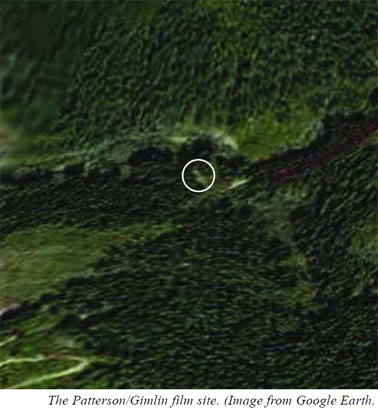
Here is the incorrect BFRO GoogleEarth location (blue pin) and ours (at first white letter)...
BFRO Film Site Location.jpg

The trackway would look *roughly* like this (Bill will be able to tell better on-site, and this is just a sketch)...
ESTIMATED TRACKWAY 2.jpg
Click images to enlarge.
GPS unit readings do tend to vary, so I am told, keep in mind.

Any professional survey advice before we get back up there would of course be appreciated.

BFBM

'xspider1', on 31 May 2012 - 2:25 PM, said:
According to this from Steve's blog:

http://bigfootbooksb...om/search?q=gps

the coordinates are about:
N 41° 26.399 W 123° 42.105
(unless that has been revised).

I looked on Google Earth and on Google maps but I didn't spot Patty yet : /
haha

  • 1

#594998The Munns Report

 Posted by BigfootBookman on 29 May 2012 - 06:14 PM
Gimlin first re-identified the first sighting spot in 2003, but was not too sure of it then. The creekbed has changed somewhat, and the sandbar is covered in new trees. It seems incredible, but no one could identify the actual spot where the film subject walked, the big trees and other features, until we came along and tried to prove the true film site. We had to rule out many areas, but Gimlin's memory turned out to be totally accurate. Based upon many other factors, we were able to rule out the other proposed locations, and chose to survey the extant sandbar up the bank from Gimlin's spot. The Finding Bigfoot show did not even attempt to film on the actual sandbar, and only showed Gimlin at the sighting spot on the opposite side of the creek. Bobo's re-enactment was filmed in the creekbed, not up on the higher sandbar above, due to the need for a clear area and proper lighting for filming.

See the survey map I posted a few posts up for the current state of things. Also, we have over sixty videos on YouTube showing the whole area. Watch the last 10 or so if you want to see the actual spot as it is today.

Links to all of this, the information and videos, may be found here: http://bigfootbooksblog.blogspot.com/
A lot of the information is in this one: http://bigfootbooksb...discovered.html

BFBM

'BFSleuth', on 29 May 2012 - 10:12 AM, said:
Drew, if you go to BFROVIDEOS channel on Youtube they have several videos at the site. These aren't shot with Bob Gimlin as they aren't shot with Finding Bigfoot and I believe the one time they tried the snow was too much. TV producers need to learn that little things like weather and snow conditions play a role in production schedules. Yes, the site has changed quite a bit since 1967. The floods from the winter of 66/67 created the wide open area we see in the PGF. The flood scoured out a wide channel and many trees were sucked into the waters, creating log jams here and there on the river. Since that time trees have grown up again and I'm sure there has been a more minor flood or two. The basics of the area look familiar in the BFRO videos for anyone that has studied the PGF. And the sand and soil is medium gray. No snow white sand anywhere to be found.

  • 1

#582731The Munns Report

 Posted by BigfootBookman on 20 April 2012 - 01:42 PM
Here is some info. on the Kodak cameras...
"Kodak 16mm: Kodak 100’ Models include the following cameras, divided by film requirements: Models: A, B, BB*, E and G, made from 1923 through about 1954 use 2R only. Few are still in serious use.
Models: Cine Kodak Special (1933-1948), Cine Kodak Special II (1948-1961), Cine Kodak K-100 and Reflex Special all use 1R"
http://motion.kodak....ion/caminfo.htm

and...
"The final 16mm spool loading Cine-Kodak the K100 arrived in 1956 with both turret and non-turret versions."
from http://en.wikipedia....wiki/Cine-Kodak

You can see me with my K-100 here...
http://bigfootbooksb...s-and-ends.html

Here's a couple of samples:
K-100.jpg
k100 and me.jpg

It has 25 and 50 mm lenses in the turret.

BFBM
  • 1

#138410The Munns Report

 Posted by BigfootBookman on 30 January 2012 - 05:07 PM
Our mathematical analysis comparing the site survey map to the 1971 aerial photograph by Dahinden not only proves the site location conclusively, but should also aid in locating the exact trackway and camera postition.
We will hopefully have a professional surveyor up there next summer to refine measurements, and it would of course be grand to have the famous Munns optical/film expertise on site.


Check out the latest analysis and information, and view our latest videos here:
http://bigfootbooksb...ematically.html

The analysis was done by a practicing geologist, using trigonometry and geometry that goes way over my English major head.
PGF PROOF 3.jpg 
(Click image to enlarge.)

Best,
BFBM

(Steve, Bigfoot Books, Willow Creek)
http://bigfootbooksblog.blogspot.com/

'Bill', on 30 Jan 2012 - 4:10 PM, said:
zigoapex:
In the matter of the distance "Patty" walked and calculating stride, I believe we are close to finally settling that once and for all. I do need a personal site visit to wrap that up, and the prospect of that happening this year is promising at present. Walk speed however is also dependent on the camera filming speed, and we haven't yet found a way to certify the film camera's speed. So there is that obstacle to overcome.
But one thing I have found is that sometimes a new piece of evidence will unlock a previously stalled line of investigation, and make something possible which was not possible before. So I'll have to wait and see how much new evidence is obtained from the site visit. The camera speed may yet be solved. I will keep an open mind to the problem and possible solutions.
Bill

  • 1

#124320The Munns Report

 Posted by BigfootBookman on 06 December 2011 - 08:08 PM
I already commented on the flora issue a while back.

With the current image on here I can see more detail. I agree it looks like holly, but it probably isn't. The red looks like a dead part of a leaf, not berries, under enlargement. The glossy leaves are interesting. There are live oaks growing sporadically up there. There are also azaleas and rhododendrons all over those hillsides. It also seems too early for holly berries in mid-late October. I have no recollection of seeing holly growing up there, over many years and wide travels up and down the creek.

The "rose" is not a rose; by any other name, it is a young madrone or a rhododendron, with dying leaves in spots. This is common for pre-winter times of the year, where these plants can lose "superfluous" leaves or branches, prioritizing for the ones that are most viable under low-moisture summer conditions. Wild roses around here are fairly rare, and are pinkish and whitish in color. I am no botanist, but have gotten pretty darn familiar with the flora around here and in Bluff. I don't recall holly up there. I am asking Robert Leiterman, a member of our Film Site Project who is a parks ranger, to comment. I have learned much of my Bluff Creek botany from him. It's part of his job.

The black lines on the tree are clearly the shadows of vine maples, which infest the area. It is my decided opinion that the photo was taken at Bluff Creek.

The "bucket," under this higher resolution, looks clearly like a wood chunk. Same with the other piece on the ground. And I'd say they look perfectly ordinary for the remains of a logging project. They cut out wedges when falling trees. There was salvage logging on the site in 1965-66, which included taking out some of the trees on the sandbar to clear it against potential future flooding and log jams. These stumps are still there on the site, as are old sawed off log pieces.

Louse Camp is right on Bluff Creek, but that is not Louse, as P and G were not seen there by the road construction crews based there for the building of the Blue Creek Mountain ridge road extension that summer and fall.

BFBM 

  • 1

#115035The Munns Report

 Posted by BigfootBookman on 31 October 2011 - 04:33 PM
We only suggested it as a possibility, Parnassus. I have not gone off the handle. Gimlin would not have been able to refer to a bridge that was not there the one time he was there before Wasson's book. However, she went up that very part of the creek with Rene, as that was the way in there in 1977. Our speculations on this matter remain reasonable. BUT yes, it is often very difficult to find solidly verifiable sources on these Bluff Creek matters. Sometimes one has to theorize. Nothing is wrong with that.

I would suggest to you, Parnassus, that you should take YOUR stuff to some other thread. Frankly, why not JREF?

"Personal stuff and ad homs"... I have no idea what you are even talking about.
In fact, I will not waste my "time and cred" even listening to you anymore.

BFBM
  • 9

#114764The Munns Report

 Posted by BigfootBookman on 30 October 2011 - 09:24 PM
Just back from Bluff Creek. We measured all the big main tree distances. We got more GPS readings. Leiterman is camped there on the sandbar as I speak. Hopefully he won't get eaten by a cougar.

Seeing those trees today has left me with no doubt in my mind. Still, we have to prove it; and Bill is the man to do it.

More tomorrow. I promise photos.

BFBM
  • 1

#114383The Munns Report

 Posted by BigfootBookman on 29 October 2011 - 06:37 PM
'Bill', on 29 Oct 2011 - 7:04 PM, said:
Steve:

I look forward to seeing it. Any sign of the cluster of 4-5 trees up the slope and between the Big tree and the Ladder tree? I figured that for one of the more reliable things still standing, as trees or as stumps.

If you can email me a high resolution map of your site documentation, I'd appreciate it. send to wmunns@gte.net

Photos would be wonderful too.

I'd like to compare it to my site model diagram.

Bill

Bill, the only logging done there was 1965 to 1966, salvage logging post-flood, pre-PGF. The old firs still stand, and there are indeed clusters of big firs behind there and along the subsequent background area. It is not easy to get a proper photograph due to new growth obscuring and also destroying the possibility of gaining perspective. I may be able to get up there tomorrow to check. It would be very helpful to have the images of the trees you've done showing them with clarity. I'd be happy to send all the data to you in a cooperative spirit. What would help us greatly is at least a clip section of your frame by frame scans of the film to sort out camera perspectives during the film as the view shifts among the old stumps and in relation to the big trees. In our grid I can see where I think cameraman and subject walked, but it is difficult to establish perspective orientation of our map to the actual film as seen mainly in Frame 352 and the documentation of it done by Dahinden, Green, and Byrne. Using the aerial photo requires a radical shifting of viewpoint. We hope your expertise will enable us to establish facts, distinguished from perceptual suppositions and perspective illusions. At this point we are finding the Murphy site model insufficient, and perhaps inaccurate.

Parnassus, you mean Louse CAMP, right? Well, the road there went right along the creek just up a bit on the hillside as it does today. Then it descended slightly to creek level where it headed left upstream or right up to the ridge. McClarin and Henry drove this route in 1967, as did many locals over the years. The old Bluff Creek Road heads up the creek from around Fish Lake to and past Louse Camp, all the way past the film site three miles past the bridge. What is your issue, aside from a large need for the thrill of schadenfreude?

BFBM
  • 2

#114368The Munns Report

 Posted by BigfootBookman on 29 October 2011 - 05:31 PM
'parnassus', on 29 Oct 2011 - 3:17 PM, said:
Stop trying to use Dahinden for this. Wasson doesn't say that her source is Dahinden, does she? In fact, it appears that her source for that section of the book is Gimlin. Wouldn't u agree? Its just another version of Gimlin's same story. So trying to drag Dahinden into this is not warranted; it's wishful thinking and it's deceptive. tsk tsk.

And that pretty well blows up your suggestion of Dahinden rebar marking the campsite. Not to mention the fact that nobody else seems to have been able to drive north along the creek bottom from the vicinity of Louse Creek.

When Gimlin was there there was in fact no bridge over Bluff Creek at that spot, so it could not have been he who told that to Wasson. However, she went to the site with Dahinden in 1977 while she was researching her book. It could only have been he, and in fact she is said to have been "involved" with Rene at the time. Another arrogant fail, Mr Parnassus.

Bill, we have almost certainly gained proof of the location of the true PGF site. We have found the big tree, with a maple beside it, a fir beside that, followed by a spiky younger fir snag, and a dead ringer for the ladder tree, with other firs following that match well. We have gridded out the entire sandbar, and have a map showing all major old stumps and wood debris piles. All seem to match very well. We'd like to have your professional opinion of the site map we have produced. I'll post a lower resolution version here soon. We have all measurement data for you, on a north to south axis from Gimlin's first sighting spot. The north line runs directly to the big trees spot. Features are plotted within ten yard squares on the grid. This should be enough to prove it out once camera perspective is established.

BFBM
  • 4

#111033The Munns Report

 Posted by BigfootBookman on 20 October 2011 - 04:30 PM
My post has a lot to do with this thread, namely identifying the spots depicted in Roll One of the Patterson footage, which Bill Munns has rediscovered and scanned and presented here.
There was doubt expressed as to whether the packhorse footage was shot in the Bluff Creek bottom. Well, I can with near 100% certainty say that it indeed is. If that isn't Bluff Creek to you, then I simply don't know what I can say. Much of it is extremely familiar to me, and also essentially identical to the scenery seen in the Bigfoot parts. Hence, Bill's work serves once again to confirm the veracity of much in the PGF accounts given by Patterson and Gimlin. 


If you want to police this thread, perhaps you should ask Mr. Munns first if it needs it, eh?
I am talking about film that Munns has been studying, so I really don't know how to make Parnassus happy. Perhaps nothing will, short of an ape suit.

BFBM

Here is Bluff Creek, from October 12th. This is the vine maple foliage still yellow, with nary a reddish tinge found on the PGF site.
Film Site October 12 Vine Maples.jpg 

Here are some old sawn stumps and rotting logs found on the upper sandbar, near the big trees, PGF site, Oct. 12th this year. We believe these are those seen in the film.
Stumps on Film Site October 12.jpg 

Here is one of the best prospects for the "Big Tree," found near those stumps.
Big Tree prospect Oct. 12.jpg