is finally coming out in full public view with the Bigfoot beliefs I always suspected he held, I got to thinking about a book I read over a decade ago, and a certain mysterious creature in it:
[NOTE: The 2009 Texas Bigfoot Conference will be held in Tyler, Texas, September 26, 2009, 8:30 A.M. to 6:30 P.M."]
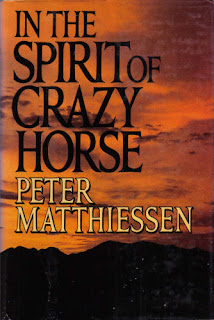
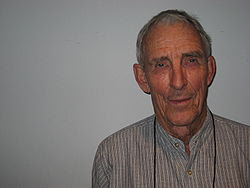
Back in the mid-to-late 90s I was on a jag of reading "bad history" (the horror, the horror!), absorbing all I could of the nightmare of humanity's past (trying to awaken). During this time I read Peter Matthiessen's
IN THE SPIRIT OF CRAZY HORSE, right after "Bury My Heart at Wounded Knee" and "American Holocaust." As I read along I began to sense something strange about this book. Mostly it is a legalistic recounting of the horrid injustices done to the Lakota, the American Indian Movement, and in particular, Leonard Peltier. But it is also an attempt to tell the history of the People through the aspects of the culture still living and viable in the modern world. A recurrent theme, popping up over and over again, to the point I had to stop, go to the index, and re-read the segments where RUGARU, or THE BIG HAIRY MAN, was discussed. What was Bigfoot-- as the author and his interviewees clearly meant to say this spirit/creature was--doing in this book? Rugaru, just as the Bigfoot we know more familiarly, creeps on the margins, or at the heart of things in this book, as a sub-text that emerges as the main message: Humanity is out of touch, out of balance, crimes against nature and people must be righted, and our ways of life changed to their proper states.
See, Bigfoot (or Sasquatch, or Rugaru, or...) isn't some phenomenon originating in 1950s or 1960s popular culture; it has been here for thousands of years, most likely brought over by (or preceding) the Native Americans as they crossed from Asia during the prior Ice Ages. Personally, I learned about Bigfoot in the usual way of my generation, through Leonard Nimoy on "In Search Of," and then through John Green's books in the paranormal section of the public library. I was obsessed, at around the age of nine or ten, with such things, be they ghosts, ESP, cryptid creatures or monsters, UFOs or demons--I was down with it. But in the years interceding my mental use of Bigfoot became increasingly of a humorous nature. It was just simply funny, seen on the cover of The Weekly World News. Bigfoot had the air of something rebellious in it, too: it lived outside of human parameters and society, stank to high heaven, and loved to mess with logging equipment. Bigfoot was the first Earth First-er! Sasquatch was a Rebel. Bigfoot began to appeal to my associates in the
ARMCHAIR ANARCHISTS 
SOCIETY, to the degree that we formed a splinter group,
THE CHURCH OF BIGFOOT SCIENTIST. Even as we laughed, joked and chanted "Rugaru, Rugaru!!!" around the campfires, something was slowly changing in me, I was beginning to suspect there WERE perhaps eyes looking back at me from the dark forests, wondering about our absurd behavior and myriad empty beer bottles. And then we encountered something brown and tall, moving through heavy forest brush several miles in to old logging company land way back in the hills above Blue Lake, CA. We only really saw it's head moving quickly through the branches, its body obscured. It could, perhaps, have been an elk; but I've never seen the dogs we had with us respond this way to anything, and they were used to bear, deer, cougars and foxes. They positively freaked out. The thing quickly disappeared down into the deep thickets, but we could hear its treads retreating. There was something strange about it, an unexplainable feeling in the experience.
I referred back to Matthiessen's book again, haunted by his evocation of the BIG MAN, the spirit of the woods, of earth's justice, of something beyond current culture and the hegemonic dominance of cheezoid and crass corporate consumerism. As I began reading the books about Sasquatch, eventually consuming about 50 of them, the myth and legend began to become a plausible reality. No, it wasn't just a joke: this thing has been leaving tracks, making appearances, and maybe abducting human females and children, for centuries. The reported characteristics are so consistent that eventually one has to take out Occam's Razor and admit it: the simplest explanation, simpler by far than "myth" and "hoaxing," is that THERE IS SUCH A CREATURE, and it is alive and well out there in the world beyond our imaginations as well as within them.
Here are quotes from the book, mysteriously hidden within the massive 686 page narrative of historical oppression and heroic survival:
"My travels with Indians began some years ago with the discovery that most traditional communities in North America know of a messenger who appears in evil times as a warning from the Creator that man's disrespect for His sacred instructions has upset the harmony and balance of existence; some say that the messenger comes in sign of a great destroying fire that will purify the world of the disruption and pollution of earth, air, water, and all living things. He has strong spirit powers and sometimes takes the form of a huge hairy man; in recent years this primordial being has appeared near Indian communities from the northern Plains states to far northern Alberta and throughout the Pacific Northwest." (pg. xxiii)
"Along the way I learned a little of the Indians' identity with land and life (very different from our 'environmental' understanding) and shared a little of their long sadness about the theft and ruin of ancestral lands--one reason, they felt, why That-One-You-Are-Speaking-About had reappeared." (pg. xxiii)
"'There's a lot going on up in that country now,' said Archie Fire, referring not only to the threat to the Great Plains from widespread mining but to recent appearances of the big hairy man at Little Eagle, on the Standing Rock Reservation, who came in sign, some people said, of those days at the world's end 'when the moon will turn red and the sun will turn blue' and the Lakota people will resume their place at the center of existence." (pg. xxvi)
"Turtle Mountain was among the many Indian communities that had been visited in recent years by the "rugaru," as the Ojibwa call the hairy man who appears in symptom of danger or psychic disruption in the community. Mary's son Richard talked a little about the appearance of these beings in recent years to Lakota people at Little Eagle, South Dakota. 'There were just too many sightings down there to ignore. I mean, a lot of people saw it. Around here, we didn't have very many reports; most of them were right here where we live now.' He waved his hand to indicate the woods outside, where I camped that night along the lake edge." (pg. xxvii)
"A few weeks before, the big, hairy man had appeared in Little Eagle for the third straight year, and more than forty people had seen him. 'I think that the Big Man is kind of the husband of Unk-ksa, the Earth, who is wise in the way of anything with its own natural wisdom. Sometimes we say that this One is kind of a big reptile from the ancient times, who can take a big, hairy form; I also think he can change into a coyote. He is very powerful. Some of the people who saw him did not respect what they were seeing, they did not honor him, and they are already gone." (xxix-xxx)
"Her family paid no attention. 'They're all Christians up there now,' Lame Deer had told me. And Joe Flying By, asked how the old people of Little Eagle accounted for the Big Man, had said shortly, 'There are no more old people.'" (pg. xxxi)
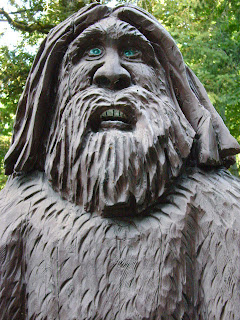
"Sidney Keith said that the Big Man seen at Little Eagle might be Unk-cegi, which means literally 'Earth Brown' or "Brown Shit'--the filth of Creation. Unk-cegi lived long, long ago, in the time of the great animals, but he had been covered up in the Great Flood, with all the other giants. 'He was down there too deep to be saved by Noah,' Sidney Keith observed dryly. But all the mining, all these underground explosions of the white man's bombs, had made fissures in the earth and released not Unk-cegi but his spirit. 'His bones are still down there. That's why Indians get so upset when burial grounds are disturbed, when the whole burying ceremony is interfered with; it isn't just a matter of disrespect. Disturbing the burial grounds the way the white man does releases those spirits. Unk-cegi was here when Indian man first came here. He seeks out Indian communities because he knew Indians in the Old Days, and he sought out Little Eagle because that is the worst place for drinking in Standing Rock, and maybe Cheyenne River, too. We drink too much in Eagle Butte, but not like that; even their old people are all drunk over there. Unk-cegi appeared to kids who smoke grass, and drunks and hotheads... nice people, some of 'em, but they do bad things. He won't appear to the good people; that's why Joe Flying By didn't see him. And he won't appear at the sun dance--that's a good circle.'" (pg. xxxiii)
"'Maybe it's a good thing that Nature would come along and change everything, clear all that away, and start again.' Of the Big Man, Joe Eagle Elk said, 'It seems maybe he has got a good heart. He has never hurt nobody. A lot of people over there at Little Eagle, they been shooting at him instead of trying to exchange words and ask why he is coming around. Maybe he is trying to tell us what he wants and where he comes from; maybe he is bringing news for us, a warning.'"
"'This nation--I can't say my nation, because they stole it away from me. ...They cheated and lied, and broke every treaty, even the sacred treaty that protected the Black Hills.' The medicine man subsided suddenly and became silent, composing himself. 'We've come to an age when we should know better than we are doing,' Pete Catches resumed softly, in a silence that followed some meditations on the Big Man, who was trying to save mankind, he said, from the great cataclysm the Indian people knew was coming. 'We must now try to understand what is wrong with us, why we have to tamper with and change the forests and the land. We have done this too long--not us, but the white man. Let's not walk on the moon, then fail to understand what this Creation is all about. This is life, this is beautiful, everything is the way it should be. (pg. xxxviii)
"'Maybe around three or four o'clock, ...not long before the sun, we heard something very big walking in the creek. It wasn't any animal, either, and it wasn't somebody tossing in big rocks; it was
plunk-plunk-plunk, like that, big steady steps. Zimmerman was so scared he just ran off, he wanted to wake up Joe, because him and Joe was living in one tent. Norman Brown said it was
the Big Man, and that his people over in Arizona knew all about it, but we were all too scared to go down there and look.' In the evening of that day, huge dark thunderheads gathered over the Black Hills, followed by wild angry winds and lashing rain that caused property damage all over the western part of South Dakota." (pg. 149)
"I told Sam about the footsteps in the creek heard on the night before the shoot-out by Jean Bordeaux and Jimmy Zimmerman and Norman Brown, and he nodded, saying, 'That was a sign, a warning.' 'There is your Big Man standing there, ever waiting, ever present, like the coming of a new day,' Pete Catches had told me two years earlier, here on Pine Ridge. "He is both spirit AND real being'--he had slapped the iron of his cot for emphasis--'but he can also glide through the forest, like a moose with big antlers, as if the trees weren't there. At Little Eagle, all those people came, and they went out with rifles and long scopes, and they couldn't see him, but all those other people at the bonfire, he came up close to them, they smelled him, heard him breathing; and when they tried to get too close, he went away. He didn't harm no one; I know him as my brother. I wanted to live over there at Little Eagle, go out by myself where he was last seen, and come in contact with him. I want him to touch me, just a touch, a blessing, something I could bring home to my sons and grandchildren, that I was there, that I approached him, and he touched me. It doesn't matter what you call him; he has many names. I call him Brother, Ci-e, and that's what the Old People would call him, too. We know that he was here with us for a long time; and we are fortunate to see him in our generation. We may not see him again for many, many generations. But he will come back, just when the next Ice Age comes into being.'" (pg. 559)
So, we should all consider our humanity, humaneness, and the value to be found in the life that surrounds us. That life IS us. Rugaru seems to be here, if not perhaps to warn us in our stupidity, then at least to remind us in our ignorance of the real, wild and largely unknown world that we are a part of, despite many centuries of deluded actions and insane culture.
If you want to study this subject further, here is a great article we found in researching this blog entry: "
Attitudes Toward Bigfoot in Many Native American Cultures," by Gayle Highpine.
"Our people don't call themselves Sioux or Dakota. That's white man talk. We call ourselves Ikce Wicasa--THE NATURAL HUMANS, THE FREE, THE WILD, COMMON PEOPLE. I am pleased to be called that." --John Fire Lame Deer

"Rugaru," as a neologism or pidgin term is certainly derived from Native interactions with French frontiersmen and traders. The root terms would be "loup" and "garou," meaning basically "wolf-man," "werewolf," or a lycanthropic shapeshifter. It would seem that this was the French folks' interpretation of the Native's "big hairy man."

Recently a comic book/graphic novel was produced by
Zenoscope Entertainment, called (of all things)
WILLOW CREEK, and set here in our area. It involves Bigfoot and a werewolf beast being mixed up between Native and modern culture. A whole group of Bigfoot hunters is slaughtered. The blood and gore flies. Mysteries are revealed. Sadly, production on this cool horror project was suspended indefinitely when the artist contracted spinal cancer. Let's hope he recovers and the series continues. The two back issues are still available at Bigfoot Books, however, while supplies last.
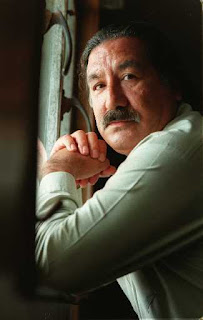
Leonard Peltier was recently denied parole, AGAIN. It would seem he is the scapegoat the FBI and government require. Matthiessen's book proves pretty damn conclusively that he is NOT guilty of shooting those federal agents. To take action start with the
Leonard Peltier Defense Committee.
Coming soon to this blog:
"SEVEN-YEAR-OLD GOES SQUATCHING"!
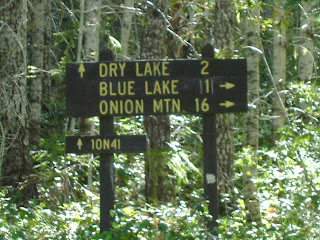
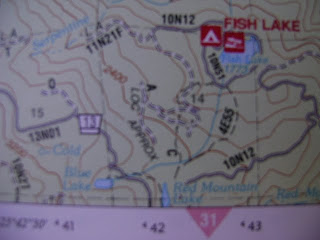
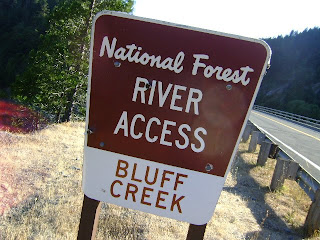
Dad and daughter will be going up to Bluff Creek, Fish Lake, Onion Lake and Onion Mountain Road this weekend. Bigfoot will be found!!!
PS--the more I work and live out here the more I hear, from locals and people from the various Native American tribes, about Bigfoot as a shape-shifter, a spiritual, interdimensional being. Before, I'd thought this stuff was kind of nutso. But now I am starting to wonder.... Watch the right side of the blog for a new POLL TOPIC on this matter.
 [Parental Advisory: this blog entry contains murder, gross bigfoot nudity, and terribly bad beer! Parents are advised not to view it.]
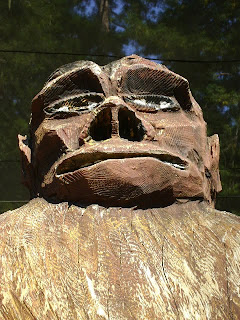
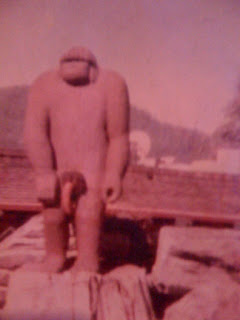 This image, found in SIMON LEGREE'S Roadhouse, in Hawkin's Bar (about ten miles east of Willow Creek on Hwy. 299), depicts a jokingly vandalized JIM MCCLARIN BIGFOOT STATUE in Willow Creek. This act of local hooliganism really happened, sometime back in the 1980s. It is not a Photoshop job.
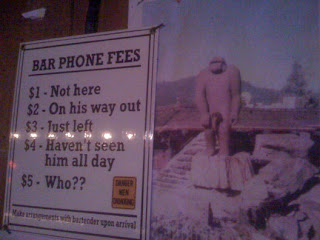 Simon's bar also has a relic of the days around 2005-06 when a quite tall man calling himself "Paul Bunyan," from somewhere around Redding or Anderson, had planned to lead a Bigfoot Outdoor Camp and expedition training in our area. He came here, carved a lot of wooden footprint stompers, chopped some trees, and then disappeared.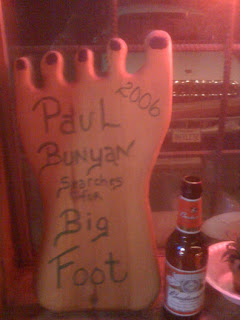
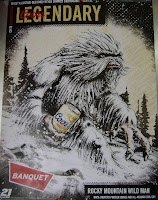 One may also find the Coors Beer Wildman raging from banners and posters in many a bar or liquor store.
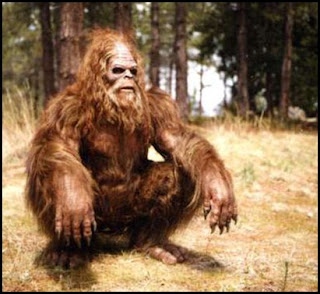 I won't even begin to talk about the Jack Links Jerkey ads. Someday Sasquatch is gonna soundly kick their asses!